COVID To Not Impact Fiscal Deficit Target, Expect Recovery From July: KV Subramanian
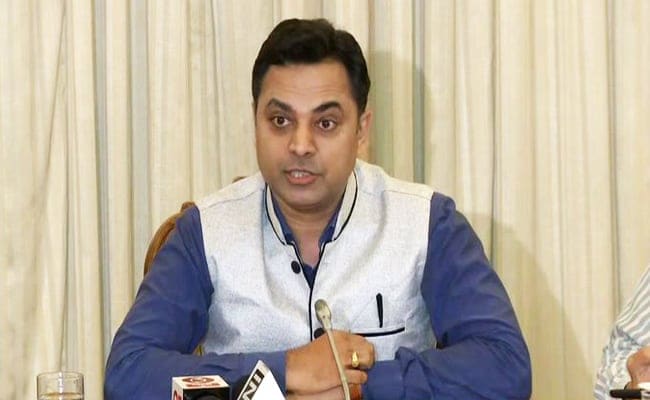
The second wave of the COVID-19 pandemic has affected the momentum of the economy, however, economic recovery is expected from July 2021, Krishnamurthy Venkata (KV) Subramanian told news agency ANI today. ''We expect a recovery in the economy from July. Now, states have started removing restrictions and if we speed up vaccination, our economy will start recovering,'' said KV Subramanian, Chief Economic Advisor (CEA) to the central government. (Also Read: Pandemic Has Affected Employment In India: Chief Economic Adviser To NDTV )
The comment from the top economist come at a time when the country is battling against the severity of the second wave of the pandemic with thousands of job losses registered across sectors. ''India will be able to achieve vaccination for all by December. If we vaccinate people in three shifts each day, then, we can vaccinate one crore people in a day. This is definitely ambitious, but not impossible,'' said Mr Subramanian.
The second wave of COVID19 has affected the momentum of economic recovery. We expect a recovery in the economy from July. Now, States have started removing restrictions and if we speedup vaccination our economy will start recovering: Chief Economic Advisor KV Subramanian to ANI pic.twitter.com/YmKkN0EMsI
June 3, 2021Impact On Fiscal Deficit Target
The Chief Economic Advisor added that the impact of the COVID-19 pandemic will affect the fiscal deficit and disinvestment targets. According to government data, the fiscal deficit for the financial year 2020-21 stood at 9.3 per cent of the gross domestic product (GDP), lower than 9.5 per cent-mark estimated by the Ministry of Finance in the revised budget estimates.
The fiscal deficit arises when the expenditure of a government exceeds the revenue generated by the government in a given financial year. It is the difference between the total revenue and total expenditure of the government in a particular fiscal.
Registering its worst-ever performance in over four decades, the economy clocked a de-growth of 7.3 per cent for the financial year 2020-21 while the fourth quarter of the fiscal recorded a growth of 1.6 per cent. (Also Read: Economy Contracts By Record 7.3% In 2020-21 )
Impact On Stock Markets
The Chief Economic Advisor stated that the stock market is at a record high as investors believe that the economy will do well. ''The prediction of good economic growth and investment by developed nations in the Indian stock market has led the stock market to a record high,'' added Mr Subramanian.
Meanwhile, on Thursday, June 3, the Indian equity benchmarks closed at record highs after showing dull trend in the previous two sessions. The benchmarks staged a gap up opening, where the Sensex climbed as much as 424 points and the Nifty 50 index inched a record high of 15,705.10.
Today, the Sensex gained 383 points to close at an all-time high of 52,232, while Nifty 50 index advanced 114 points to close at record high of 15,690.
According to analysts, markets are witnessing gains on hopes of a faster economic recovery amid the declining trend of new coronavirus infections in the country. Investors also await the announcements of the Reserve Bank of India's Monetary Policy Committee (MPC) on Friday, where economists expect the central bank to retain the key lending rates at a record low, to maintain its accommodative stance amid the pandemic.

-
Where You Live Shapes How You Get To Work | The Reason Why

Two-wheelers are the most popular way to get to work in India, accounting for nearly 43% of workplace commutes.
-
High US Salaries, No Green Card Certainty: The Financial Calculation Facing Indian H-1B Families
The suspension of PERM processing at eight technology employers does not cancel existing H-1B visas. What it does is force a question many Indian families have been avoiding: is the US salary worth tying your career and family plans to one employer?
-
Unhedged Position: Can India See An Indonesia-Style Time Correction?
The Nifty is trading below levels it first clocked in 2024. Is there, then, as I have suggested in the headline, potential that the current time correction drags on painfully for the next three-five, even ten years?
-
Navigating Friction And Energy Realities: An Analysis Of Marco Rubio's October Visit To India
Occurring at a critical juncture marked by stalled trade negotiations and escalating geopolitical pressures over global energy supplies, the visit offers a profound window into modern US-India relations.
-
India Exports Capital. Why Not Export Trusteeship?
The big question, then, is whether India can build an institution that global borrowers, investors, banks, and lawyers can trust, even without an Indian connection.
-
France's Economy & Politics Are In Crisis | The Reason Why
Let's look at how the French economy and politics evolved under Nicolas Sarkozy, Franois Hollande and Emmanuel Macron.
-
You May Inherit The Business. You Must Earn Its Credibility.
Succession tests the founder's ability to share authority as much as it tests the next generation's readiness to assume it.
-
Signing Deals Is One Thing; Making Them Work Is Another | The Week In Whys
Sometimes, things don't turn out as planned. Indian companies have lost some bids to rivals, some projects won't produce until 2030.
-
FOMC Wall, PERM Suspension, Hospital Stocks | Talking Points This Week
A PERM suspension would directly affect green-card sponsorship rather than H-1B visas, so the near-term earnings impact could remain relatively limited. The key question is whether this marks a new phase in US scrutiny of Indian IT.
-
Everything, Everywhere, All At Once: Dalal Street's Week To Forget | Joining The Dots
Visa curbs, a Starlink spat and cancer drug caps: what connects this week's shocks for Indian markets









