Exit Poll Euphoria: Why Investors Should Be Cautious
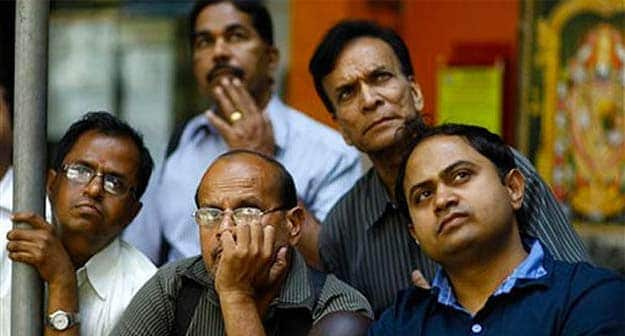
Indian stock markets are on a roll sensing a win for the Narendra Modi-led National Democratic Alliance in elections concluded on Monday. The Sensex gained 1,200 points in just two sessions since Friday and today it has hit a third successive record high after exit polls projected a win for Mr Modi.
The bullish mood on Dalal Street has been built on the BJP being seen by markets as more investor- and business-friendly and there are hopes that a change in government will lead to faster reforms and robust economic growth.
However, history suggests that predicating optimism of a favourable electoral outcome on exit polls alone, is tricky business.
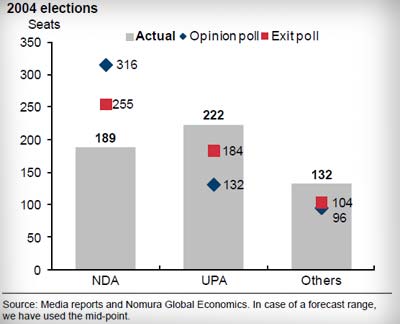
In 2004, both opinion and exit polls predicate an NDA win, but results announced on May 17 threw up a convincing win for Congress-led UPA. On that day, the BSE Sensex crashed 842 points and trading was halted twice. At close, the Sensex dropped by 565 points to end at 4,505.
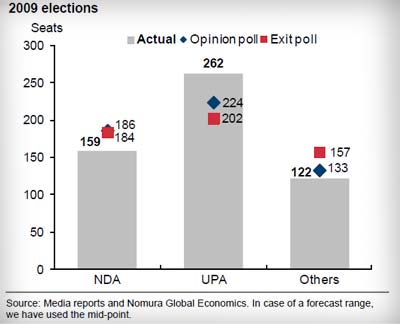
In 2009, most opinion and exit polls predicted a hung parliament, but the Congress emerged as the biggest party with over 200 seats and formed a stable government on its own.
After the exit polls yesterday, market expert TS Harihar tweeted, "Mistaking an #exitpoll for actual verdict is like mistaking an analyst recommendation for stock returns."
This time, the BJP-led NDA is projected to win between 249 and 340 seats, according to six exit polls. The wide variation in numbers suggests that exit polls could go wrong this time as well, analysts say.
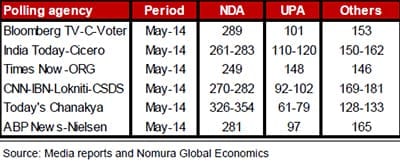
"The wide range between the lowest and highest forecasts (approximately 90 seats) confirms, in our view, as proved to be the case in 2004 and 2009, that the exit polls should be treated with some caution," Nomura said.
According to Credit Suisse, Monday's exit polls reveal a "range of high uncertainty." The investment bank points out that while national totals are within a relatively narrow range, the state numbers that add up to those totals vary "widely."
"This suggests high measurement error margins," Credit Suisse says.
However, there are other analysts who are confident that this time around things will be different. Rahul Arora, chief executive officer of Nirmal Bang Securities interprets the national voter turnout at 66.38 per cent, the highest ever for India, as logically implying an anti-incumbency vote which will assist the NDA in its overall tally.
Other analysts point to the large difference in vote share that exit polls have indicated between the NDA and UPA to buttress the point that the BJP is home and dry.
In any case, retail investors should be prepared for the worst. That's because any results that show BJP falling short of a majority could cause shares to plunge 8 to 10 per cent in one day, and up to 20 per cent in the aftermath, analysts say.

-
High US Salaries, No Green Card Certainty: The Financial Calculation Facing Indian H-1B Families

The suspension of PERM processing at eight technology employers does not cancel existing H-1B visas. What it does is force a question many Indian families have been avoiding: is the US salary worth tying your career and family plans to one employer?
-
Swiggy vs Eternal: Food Delivery's Two Rivals Are No Longer In The Same Race
Eternal is building a private AI assistant, dark.ai. Swiggy is still working out how to make Instamart pay, with an operating loss of Rs 895 crore in the July-September quarter while Blinkit stayed profitable.
-
Where You Live Shapes How You Get To Work | The Reason Why
Two-wheelers are the most popular way to get to work in India, accounting for nearly 43% of workplace commutes.
-
Unhedged Position: Can India See An Indonesia-Style Time Correction?
The Nifty is trading below levels it first clocked in 2024. Is there, then, as I have suggested in the headline, potential that the current time correction drags on painfully for the next three-five, even ten years?
-
Navigating Friction And Energy Realities: An Analysis Of Marco Rubio's October Visit To India
Occurring at a critical juncture marked by stalled trade negotiations and escalating geopolitical pressures over global energy supplies, the visit offers a profound window into modern US-India relations.
-
India Exports Capital. Why Not Export Trusteeship?
The big question, then, is whether India can build an institution that global borrowers, investors, banks, and lawyers can trust, even without an Indian connection.
-
France's Economy & Politics Are In Crisis | The Reason Why
Let's look at how the French economy and politics evolved under Nicolas Sarkozy, Franois Hollande and Emmanuel Macron.
-
You May Inherit The Business. You Must Earn Its Credibility.
Succession tests the founder's ability to share authority as much as it tests the next generation's readiness to assume it.
-
Signing Deals Is One Thing; Making Them Work Is Another | The Week In Whys
Sometimes, things don't turn out as planned. Indian companies have lost some bids to rivals, some projects won't produce until 2030.
-
FOMC Wall, PERM Suspension, Hospital Stocks | Talking Points This Week
A PERM suspension would directly affect green-card sponsorship rather than H-1B visas, so the near-term earnings impact could remain relatively limited. The key question is whether this marks a new phase in US scrutiny of Indian IT.









