Europe's Eyes On Angela Merkel To Rebuild EU After Brexit Vote
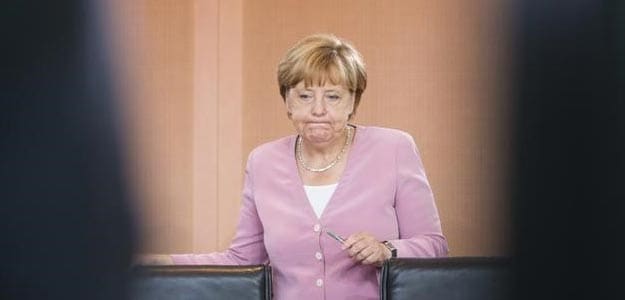
Brussels: When the chips are down in Europe, everyone turns to Angela Merkel for a solution. But the German chancellor often sits on her hands until the last minute, then does the minimum necessary to keep the show on the road.
Since last month's shock British referendum vote to leave the European Union, all eyes have been on Berlin to indicate a way out of danger for the 27 members who will remain.
As usual, Ms Merkel, the continent's most powerful and experienced leader, is biding her time and letting underlings air their differences without tipping her hand before she departs for her three-week summer break this week.
Votes had barely been tallied in Britain when her vice-chancellor, Sigmar Gabriel, leader of the Social Democrats party, and European Parliament President Martin Schulz rushed out a 10-point plan for a "refoundation" of Europe.
Lamenting that ever more citizens doubted Europe's ability to deliver a better future, they called for a more federal Europe with the European Commission as its government, and a more flexible, growth-friendly economic policy turning away from austerity to investment in an "industrial renaissance".
Finance Minister Wolfgang Schaeuble rapidly shot down those ideas, rejecting any need for economic stimulus spending and reaffirming his balanced budget target up to 2020 at a time when many in Europe are pleading with Berlin to borrow money free of interest and invest massively in infrastructure.
He refuses to accept that surplus countries like Germany, which has a giant current account surplus of eight percentage points of GDP, should help poorer deficit countries adjust by spending more on public investment and boosting consumption.
Furthermore, Mr Schaeuble said those calling for a bold federal leap forward in integration had failed to understand the public disenchantment with the EU that fuelled the British vote and is driving nationalistic euro-scepticism elsewhere in Europe.
Rather than give more power to Brussels, the veteran conservative, who once advocated a federal "core Europe", said it was time for national governments to take matters more into their own hands if the Commission was unable to do the job.
Mr Schaeuble is blocking the next steps forward in Eurozone risk-sharing - the creation of a European bank deposit insurance system and of a fiscal backstop for the currency area's single resolution fund to help wind down failed banks.
The 71-year-old finance minister has also managed to delay any debt relief for Greece until after next year's German election in September and manoeuvered to delay public support for Italy's ailing banks, saying there was no acute crisis.
Less vulnerable
Even the German head of the Eurozone's rescue fund, Klaus Regling, argued last week that Berlin and its partners needed to go further to make the currency area less vulnerable to shocks.
Restructuring Italian banks' bad loans and forcing investors including retail savers to take losses before any public money can be injected under the EU's new bank recovery and resolution rules could trigger precisely that kind of post-Brexit shock.
Mr Regling called for completing European banking union by phasing in a deposit insurance scheme after a transition period. He also advocated a limited budgetary capacity for the euro area to cushion economic shocks hitting only some countries.
Both proposals have so far been anathema to Mr Schaeuble, who speaks for a school of German fiscal hawks in warning that such steps would lead to unacceptable permanent north-south transfers inside the monetary union.
At least there is debate in Germany about what the EU should do to regain momentum and overcome the trauma of losing Britain, its second largest economy, even if much of it resembles shadow boxing before next year's German elections.
In many EU countries, politicians have simply fallen back on blaming Brussels, with some demanding the scalp of European Commission President Jean-Claude Juncker as a scapegoat.
To be sure, Mr Juncker has contributed to the sense of disarray by first trying to rush an EU trade deal with Canada through the European Parliament without letting national lawmakers have a say, then reversing himself under pressure from governments.
The result is that the Canada deal could be bogged down for many months, perhaps indefinitely, and the chances of getting a bigger and more sensitive trade and investment partnership with the United States wrapped up and ratified seem even more remote.
No progress on monetary or banking union, deadlock on trade - that doesn't leave much scope for restoring public and financial market confidence in Europe.
The German and French foreign ministers, both social democrats, have issued more modest joint proposals for the EU to focus on internal and external security, managing migration and refugee flows, and boosting the economy and job creation.
Their nine-page paper, which would not require changing the EU's founding treaty with the risk of more referendum defeats, called for a European Security Compact with a more integrated foreign and security policy and a permanent civil-military chain of command for crisis management operations.
But when it came to the euro - the economic heart of the European project - their suggestions of investment-boosting measures by surplus countries and a common fiscal capacity(budget) for the Eurozone, ran into the same stonewall in the German Finance Ministry.
Ms Merkel has broadly welcomed the Franco-German paper and broadly adopted its focus on three main themes - migration, security and growth/jobs. Whether she is willing to overrule Mr Schaeuble and take political risks before next year's federal elections is highly doubtful.
(This story has not been edited by NDTV staff and is auto-generated from a syndicated feed.)

-
High US Salaries, No Green Card Certainty: The Financial Calculation Facing Indian H-1B Families

The suspension of PERM processing at eight technology employers does not cancel existing H-1B visas. What it does is force a question many Indian families have been avoiding: is the US salary worth tying your career and family plans to one employer?
-
Swiggy vs Eternal: Food Delivery's Two Rivals Are No Longer In The Same Race
Eternal is building a private AI assistant, dark.ai. Swiggy is still working out how to make Instamart pay, with an operating loss of Rs 895 crore in the July-September quarter while Blinkit stayed profitable.
-
Where You Live Shapes How You Get To Work | The Reason Why
Two-wheelers are the most popular way to get to work in India, accounting for nearly 43% of workplace commutes.
-
Unhedged Position: Can India See An Indonesia-Style Time Correction?
The Nifty is trading below levels it first clocked in 2024. Is there, then, as I have suggested in the headline, potential that the current time correction drags on painfully for the next three-five, even ten years?
-
Navigating Friction And Energy Realities: An Analysis Of Marco Rubio's October Visit To India
Occurring at a critical juncture marked by stalled trade negotiations and escalating geopolitical pressures over global energy supplies, the visit offers a profound window into modern US-India relations.
-
India Exports Capital. Why Not Export Trusteeship?
The big question, then, is whether India can build an institution that global borrowers, investors, banks, and lawyers can trust, even without an Indian connection.
-
France's Economy & Politics Are In Crisis | The Reason Why
Let's look at how the French economy and politics evolved under Nicolas Sarkozy, Franois Hollande and Emmanuel Macron.
-
You May Inherit The Business. You Must Earn Its Credibility.
Succession tests the founder's ability to share authority as much as it tests the next generation's readiness to assume it.
-
Signing Deals Is One Thing; Making Them Work Is Another | The Week In Whys
Sometimes, things don't turn out as planned. Indian companies have lost some bids to rivals, some projects won't produce until 2030.
-
FOMC Wall, PERM Suspension, Hospital Stocks | Talking Points This Week
A PERM suspension would directly affect green-card sponsorship rather than H-1B visas, so the near-term earnings impact could remain relatively limited. The key question is whether this marks a new phase in US scrutiny of Indian IT.









