Empty Shelves And Rising Prices Test Tunisians' Patience
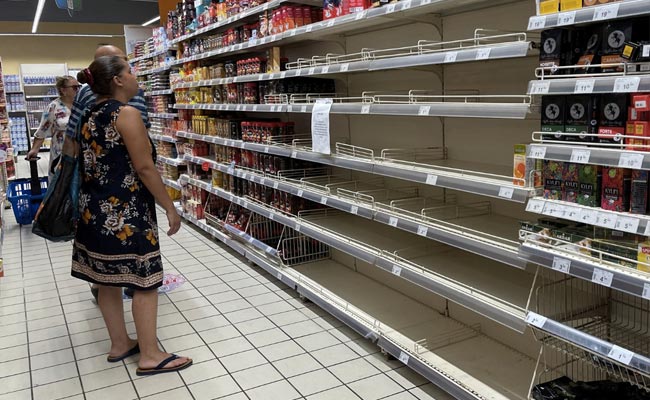
Food shortages are worsening in Tunisia with empty shelves in supermarkets and bakeries, adding to popular discontent at high prices and risking unrest as the government tries to stave off a crisis in public finances.
There are widespread shortages of sugar, cooking oil, milk and butter, coffee, tobacco and bottled water, with the situation seeming worse in poorer regions far from the capital.
Street tea vendor Mustafa Dahech, 82, said he relied on sugar to make the sweet drink he sells in paper cups from a metal teapot as he wanders through the narrow alleys of a poor Tunis district.
"There is no sugar. I swear to you there is none," he said, making it harder for him to raise his income beyond his state pension of $55 a month.
Small protests have already taken place and the head of the powerful main labour union, the UGTT, has warned repeatedly in recent months of a "revolution of the hungry".
The shortages are partly due to a global commodities squeeze and price rise because of disruption linked to the COVID pandemic and to the war in Ukraine.
PRECARIOUS FINANCES
However, Tunisia may face increased disruption because its weak fiscal position makes it harder to buy staples at elevated international rates and sell them internally at the same subsidised rate it was already using.
The government is seeking an International Monetary Fund (IMF) bailout to help it fund its budget and debt repayments, but support will likely hinge on subsidy and public sector wage bill cuts, and restructuring of state-owned companies.
Talks between the government and UGTT to agree on those reforms - a likely condition of IMF support - are still stuck.
Without an IMF bailout, Tunisia would likely have to borrow internally, restricting credit to local businesses in ways diplomats say could further harm the economy, or use its foreign currency reserves, harming the dinar and raising inflation.
The government has blamed the shortages on the global commodities squeeze and on domestic hoarders and speculators and denied it faces problems paying for imports.
The UGTT said earlier this year that the government was struggling to pay for wheat imports. The World Bank, European Union, Japan and European Bank for Reconstruction and Development have all given Tunisia food aid loans this year.
Dairy producers have demanded state assistance with inflation on animal feed and other running costs which they have blamed for shortages of milk and butter.
A UGTT official has said the sugar shortage has caused outages at several food factories. Workers at a soda drink factory last week protested over the threat to their jobs.
Shortages of coffee, which is being rationed to a single pack per customer in some shops, have also led to some temporary cafe closures.
"We're a cafe. We have nothing but coffee to offer our customers," said Noureddine Ben Hsan, owner of the Independence cafe in Tunis, adding that the coffee, milk and sugar shortages had forced him to close.
(This story has not been edited by NDTV staff and is auto-generated from a syndicated feed.)

-
Navigating Friction And Energy Realities: An Analysis Of Marco Rubio's October Visit To India

Occurring at a critical juncture marked by stalled trade negotiations and escalating geopolitical pressures over global energy supplies, the visit offers a profound window into modern US-India relations.
-
India Exports Capital. Why Not Export Trusteeship?
The big question, then, is whether India can build an institution that global borrowers, investors, banks, and lawyers can trust, even without an Indian connection.
-
France's Economy & Politics Are In Crisis | The Reason Why
Let's look at how the French economy and politics evolved under Nicolas Sarkozy, Franois Hollande and Emmanuel Macron.
-
You May Inherit The Business. You Must Earn Its Credibility.
Succession tests the founder's ability to share authority as much as it tests the next generation's readiness to assume it.
-
Signing Deals Is One Thing; Making Them Work Is Another | The Week In Whys
Sometimes, things don't turn out as planned. Indian companies have lost some bids to rivals, some projects won't produce until 2030.
-
FOMC Wall, PERM Suspension, Hospital Stocks | Talking Points This Week
A PERM suspension would directly affect green-card sponsorship rather than H-1B visas, so the near-term earnings impact could remain relatively limited. The key question is whether this marks a new phase in US scrutiny of Indian IT.
-
Everything, Everywhere, All At Once: Dalal Street's Week To Forget | Joining The Dots
Visa curbs, a Starlink spat and cancer drug caps: what connects this week's shocks for Indian markets
-
India Is Going Abroad For Critical Minerals. But It May Take Years To Pay Off | The Reason Why
Although India's steps are in the right direction, they remain modest compared with India's growing dependence.
-
When Everyone Has AI, What Gives You An Edge?
India's young workforce is entering an uncertain world of work where powerful AI tools are becoming widely accessible. The advantage will belong to those who combine deep expertise with digital fluency, and the distinctly human capabilities that technology cannot manufacture.
-
Wrong Labels, High Pesticide Residues Holding Back Agri Exports | The Reason Why
India needs stronger domestic food-safety and labelling standards, with best practices becoming part of everyday business for farmers, traders and food companies.










