EM Stocks Set For Worst Week Since August Amid Mideast Conflict

(Bloomberg) -- Emerging-market stocks are set to post the biggest weekly losses since mid-August as the escalating conflict in the Middle East diminishes chances of a year-end rally.
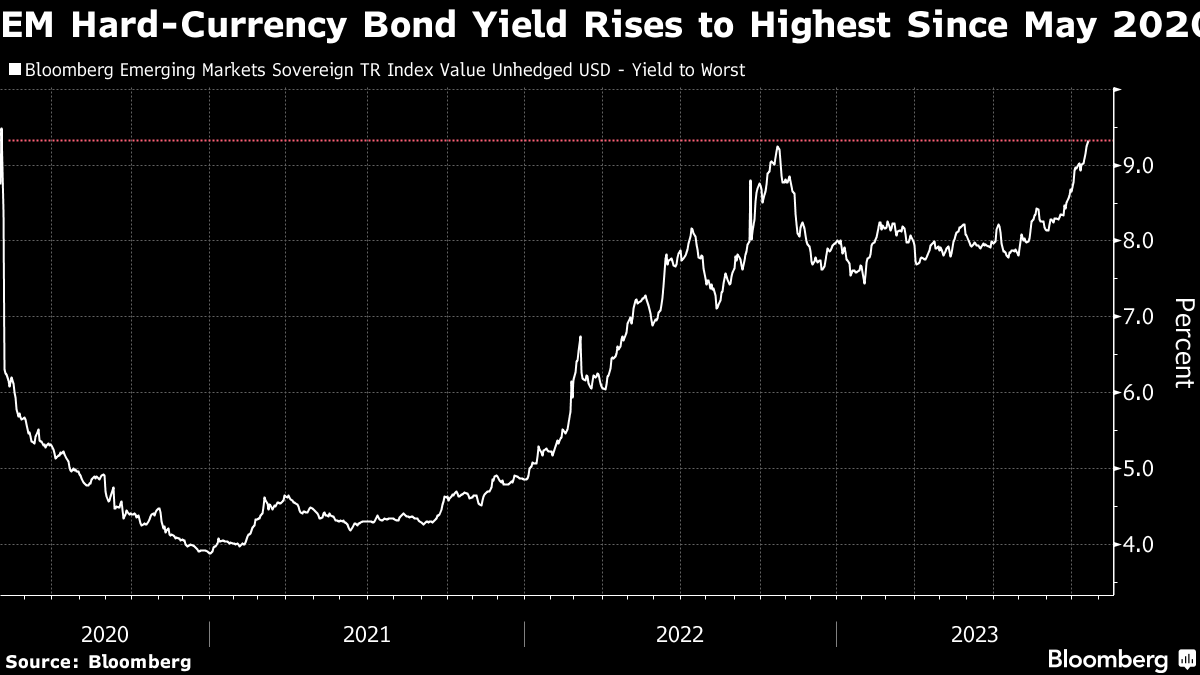
The benchmark MSCI equity index for developing countries fell for the third day to its lowest since last November, while the average yield on EM hard-currency bonds advanced to the highest since 2020. The Polish currency and bonds bucked the trend, rallying this week as the pro-European Union opposition was set to form the next government, paving the way for unblocking EU funds.
Markets are under pressure as oil is trading above $90 a barrel and gold approached $2,000 an ounce amid attacks on US bases in Iraq and Syria, with Israel's shekel depreciating for the 10th day in a row. Foreign investor outflows from China continued due to concerns about the property sector and the economy's recovery. All in all, EM equity losses for 2023 have exceeded 3%, on track for their third year of declines.
“The risks of an escalation of the Israel-Hamas conflict will likely dampen the conditions for what we expect to be a year-end rally, in our opinion,' said Citigroup Inc. strategists including Eric Ollom in a note to clients. “The risk-off headwinds from the Israel-Hamas conflict, combined with lingering uncertainty over the pace and direction of Fed policy, have so far delayed this lift-off.”
Chinese stocks have slid 16% from a Jan. 30 peak amid relentless selling by global funds, many of whom cite China's ongoing housing crisis and tensions with the West as the biggest worries. A US exchange-traded fund that buys stocks in emerging markets other than China received its single-biggest daily inflows on record. Investors poured $350 million into BlackRock Inc.'s iShares MSCI EM Ex-China ETF on Thursday.
“EM could be hurt if this adds to the already negative growth outlook on China. Weaker Chinese demand is bad for global growth and therefore bad news for cyclical economies, like most EM,” said Henrik Gullberg, a macro strategist at Coex Partners Ltd. “On the other hand, it might result in further measures to stimulate growth in China and then it would eventually be growth/risk supportive.”
The average emerging market sovereign dollar-bond yield has risen 67 basis points in October amid a global selloff sparked by rising US Treasuries. The average yield has risen every day save for two in October to trade at 9.32%, the highest since May 2020.
More stories like this are available on bloomberg.com
©2023 Bloomberg L.P.

-
Ten Things I Learnt This Samvat

Patience can be a trap. Cheap stocks can stay cheap. Leverage can wipe you out. What did Samvat 2082 teach us? Niraj Shah writes on 10 lessons from the year gone by.
-
Talking Points This Week: Tech Nerves, FII Buying, And A Faraway Banking Shock
The global markets are not shining this Diwali. The exception in the large markets is, India.
-
Midterm Rally Lasted A Day. The Hard Reality Of A Divided US May Last Two Years | Opinion
Between a contested AI boom, a debt ceiling that arrives in 2027 and a president with every incentive to act alone, the next two years may prove more volatile than the first day's rally suggests.
-
Blue Wave Will Derail the AI Trade but Won't Dismantle the AI Era | Unhedged Position
The Democrats' sweep of the US Congress will see politics collide with economic forces both over the long and short term.
-
It's Time To Take The GST Council's Bet On Trust Global
Payment records can prove India's services exports, and clear, proportionate rules can bring foreign digital sellers into the tax net.
-
Opinion | India at 38: From Innovation Overperformer to Innovation Powerhouse
India now has 453 VC-backed deep science startups, 18 of them late-stage, after 117 percent growth since 2020. Laurus Labs, at USD 9.3 billion, is the most valuable deep science company in any middle-income economy outside China.
-
Navigating Energy Crossroads: S Jaishankar's Call For Diversified Supply Chains At G20 Ministerial Meeting
As geopolitical fault lines continue to test maritime trade routes and commodity flows, Jaishankar's message remains pertinent: true economic resilience requires open markets, protected transit lines, and a genuine commitment to multilateral cooperation rather than coercion.
-
Indians Are Travelling, But Not Every Journey Is A Holiday | The Week In Whys
Pilgrims, patients and working women are the real travellers, and the system hasn't quite caught up with them.
-
Getting To Work Costs Women More | The Reason Why
It is not just about women paying more than men. It is about women paying much more in cities than in villages.









