Elon Musk's Pay Trial To Decide If Tesla's Growth Justifies $56 Billion Salary
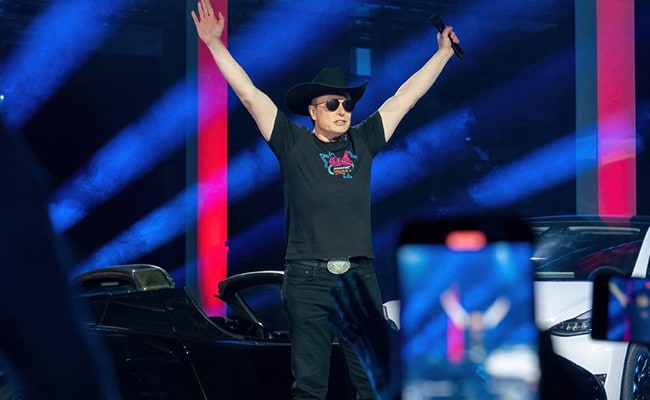
After five days of testimony, including three hours from Elon Musk, a Delaware judge will now decide whether Musk's $56 billion pay package from Tesla Inc was justified by the company's explosive growth or undermined by a flawed process.
Musk and the Tesla directors named as defendants repeatedly testified that the package achieved what it set out to do -- deliver 10-fold growth in the company's stock price, enriching investors and Musk.
"We thought if we could pull this off, if this plan was executed, Tesla would be one of the most valuable technology companies," Antonio Gracias, a Tesla board member from 2007 to 2021, told the Delaware Court of Chancery on Wednesday. "It was a great deal for the shareholders."
The trial seeks to resolve claims by shareholder Richard Tornetta that the 2018 pay package was dictated by Musk, the world's richest person, to subservient directors and approved by a vote of shareholders who were misled by Tesla.
The trial wrapped up on Friday, as Musk struggles to oversee a chaotic overhaul of Twitter Inc, which he was forced to buy for $44 billion in a separate legal battle before the same judge, Chancellor Kathaleen McCormick.
"My sense is that even though it went all the way to trial, a ruling is going to favor Mr. Musk," said Eric Talley, a professor at Columbia Law School who has followed the case.
It will be months before McCormick rules and her decision can be appealed to the Delaware Supreme Court.
During the week-long trial, directors said the pay package was meant to ensure Musk guided the electric vehicle maker through a critical phase when he could have focused on his rocket company SpaceX or tunneling venture The Boring Co.
Musk told the board he wanted a huge package to finance his dream of travel to Mars, or as he testified, to make "life multi-planetary in order to ensure the long-term survival of consciousness."
Musk described his efforts to push the company from the brink of failure in 2017 to exponential growth. "The amount of pain, no words can express," Musk testified on Wednesday.
Gracias recalled that Musk celebrated his birthday in a factory conference room with a grocery store cake. "This was all hands on deck, 24/7, brutal," he told the court.
The package allows Musk to buy 1% of Tesla's stock at a deep discount each time escalating performance and financial targets are met. Otherwise, Musk gets nothing.
Tesla has hit 11 of the 12 targets as its value ballooned briefly to more than $1 trillion from $50 billion.
Tornetta wants the plan rescinded and the stock granted under the plan returned to Tesla.
Much of the trial focused on the information provided to shareholders before they approved the plan. Tornetta's lawyers tried to show Tesla concealed that three targets of the package were likely to be quickly met.
The plaintiff portrayed the directors as personal friends or business partners of Musk, who was the link to their wealth.
The directors tried to show they could hold the line against Musk's demands. But evidence of extracting concessions was limited to the best method for accounting for the stock grants and a requirement that Musk had to hold his stock for five years.
"It wasn't a knock-down, drag-out affair," Todd Maron testified about the pay talks in 2017 when he was general counsel.
Talley said Musk is a unique CEO and his pay reflects that.
"He's like a Labrador retriever. He sees a ball and he runs after it. You could almost make an argument they didn't pay him enough because he ran off after Twitter."
(Except for the headline, this story has not been edited by NDTV staff and is published from a syndicated feed.)

-
Why Amazon And Flipkart Are Struggling To Beat Meesho In India's Smaller Cities

With 274 million users and lowest-cost logistics, Meesho is defending its value commerce crown against giants like Amazon and Flipkart.
-
High US Salaries, No Green Card Certainty: The Financial Calculation Facing Indian H-1B Families
The suspension of PERM processing at eight technology employers does not cancel existing H-1B visas. What it does is force a question many Indian families have been avoiding: is the US salary worth tying your career and family plans to one employer?
-
Swiggy vs Eternal: Food Delivery's Two Rivals Are No Longer In The Same Race
Eternal is building a private AI assistant, dark.ai. Swiggy is still working out how to make Instamart pay, with an operating loss of Rs 895 crore in the July-September quarter while Blinkit stayed profitable.
-
Where You Live Shapes How You Get To Work | The Reason Why
Two-wheelers are the most popular way to get to work in India, accounting for nearly 43% of workplace commutes.
-
Unhedged Position: Can India See An Indonesia-Style Time Correction?
The Nifty is trading below levels it first clocked in 2024. Is there, then, as I have suggested in the headline, potential that the current time correction drags on painfully for the next three-five, even ten years?
-
Navigating Friction And Energy Realities: An Analysis Of Marco Rubio's October Visit To India
Occurring at a critical juncture marked by stalled trade negotiations and escalating geopolitical pressures over global energy supplies, the visit offers a profound window into modern US-India relations.
-
India Exports Capital. Why Not Export Trusteeship?
The big question, then, is whether India can build an institution that global borrowers, investors, banks, and lawyers can trust, even without an Indian connection.
-
France's Economy & Politics Are In Crisis | The Reason Why
Let's look at how the French economy and politics evolved under Nicolas Sarkozy, Franois Hollande and Emmanuel Macron.
-
You May Inherit The Business. You Must Earn Its Credibility.
Succession tests the founder's ability to share authority as much as it tests the next generation's readiness to assume it.
-
Signing Deals Is One Thing; Making Them Work Is Another | The Week In Whys
Sometimes, things don't turn out as planned. Indian companies have lost some bids to rivals, some projects won't produce until 2030.










