Easier To Do Business In India, But Country Still Among Worst Performers
India improved its ease of doing business ranking last year–moving up from 131 to 130 in a list of 190 countries–by reducing the average time taken to start an enterprise and secure a permanent electricity connection, according to 2016 World Bank data. However, an IndiaSpend analysis of these data shows that India still ranks among the worst performers on other key parameters.
Using five parameters, IndiaSpend picked 10 nations across seven regions to compare India's ease of doing business–south and east Asia (including China), developed countries, sub-Saharan Africa, lower middle income countries such as India (with per capita incomes between $1,026 and $4,035) and the European Union. In most indicators, India ranked low, coming closest to sub-Saharan African countries.
The five indicators are all related to the time taken to get key tasks completed. Those include: (1) starting a business, (2) building a warehouse and equip the industrial premises with water and sewerage connection, telephone line and safety measures, (3) getting permanent provision of electricity, (4) completing legal procedures and (5) resolving insolvency if a business fails.
Start Time Improves And Electricity Comes Faster, But Far From Ideal
When compared to the most advanced western economies and Japan, Indian businesses take twice the time (26 days) that the slowest of the four most advanced countries take: U.S. (6), U.K. (5), Germany (11) and Japan (11). However, it is an improvement over the 34 days it took in 2014 to get a new project going.
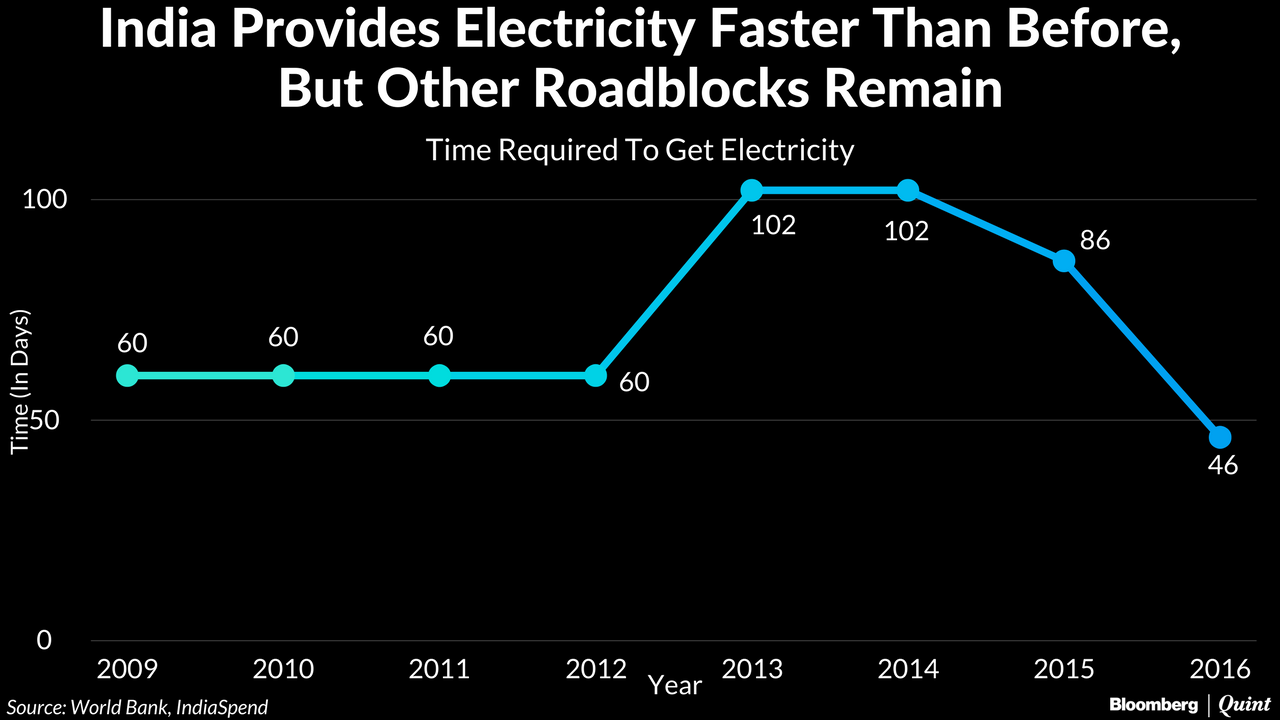
The one area where India has made considerable improvement is provision of electricity to new businesses. It has overtaken three major economies and lags only behind Germany in this aspect. From 60 days in 2009-12, the time taken to provide electricity to a new enterprise rose to 100 days in 2013-14, and then gradually fell to 46 days in 2016. South Korea leads with the least time, 18 days.
Warehousing, Dispute Resolution And Dealing With Insolvency: India Still Way Behind
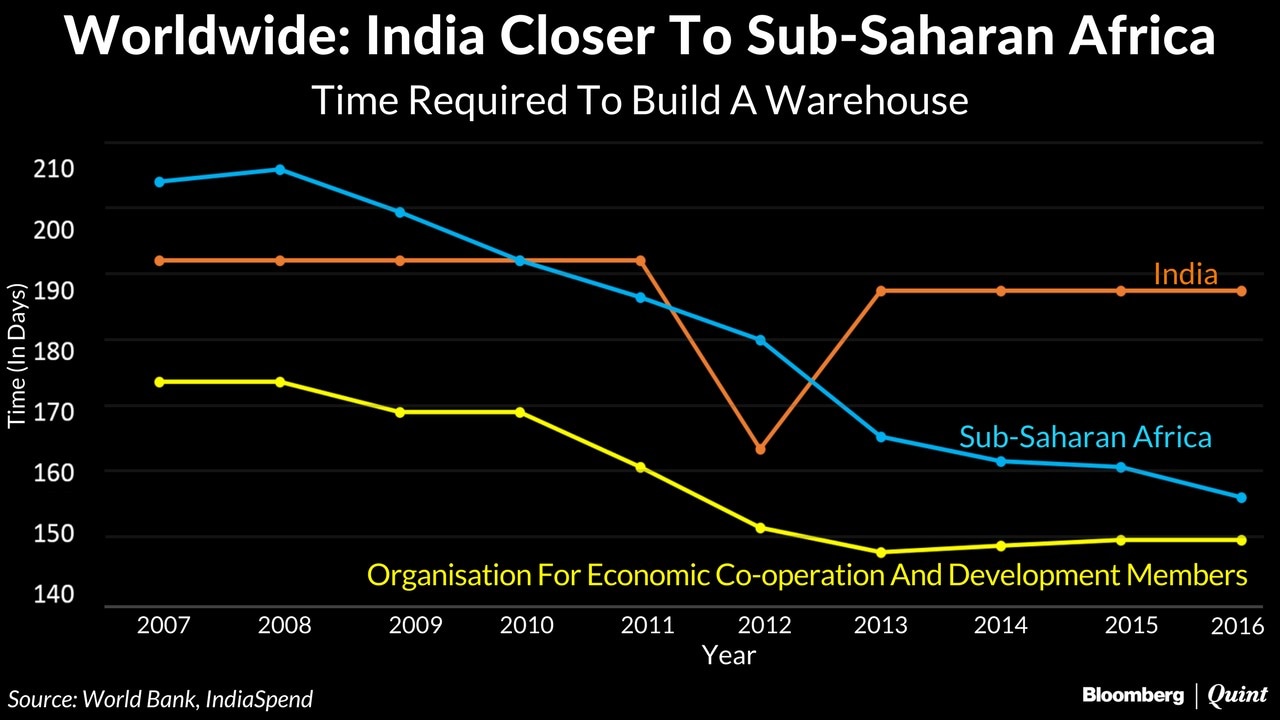
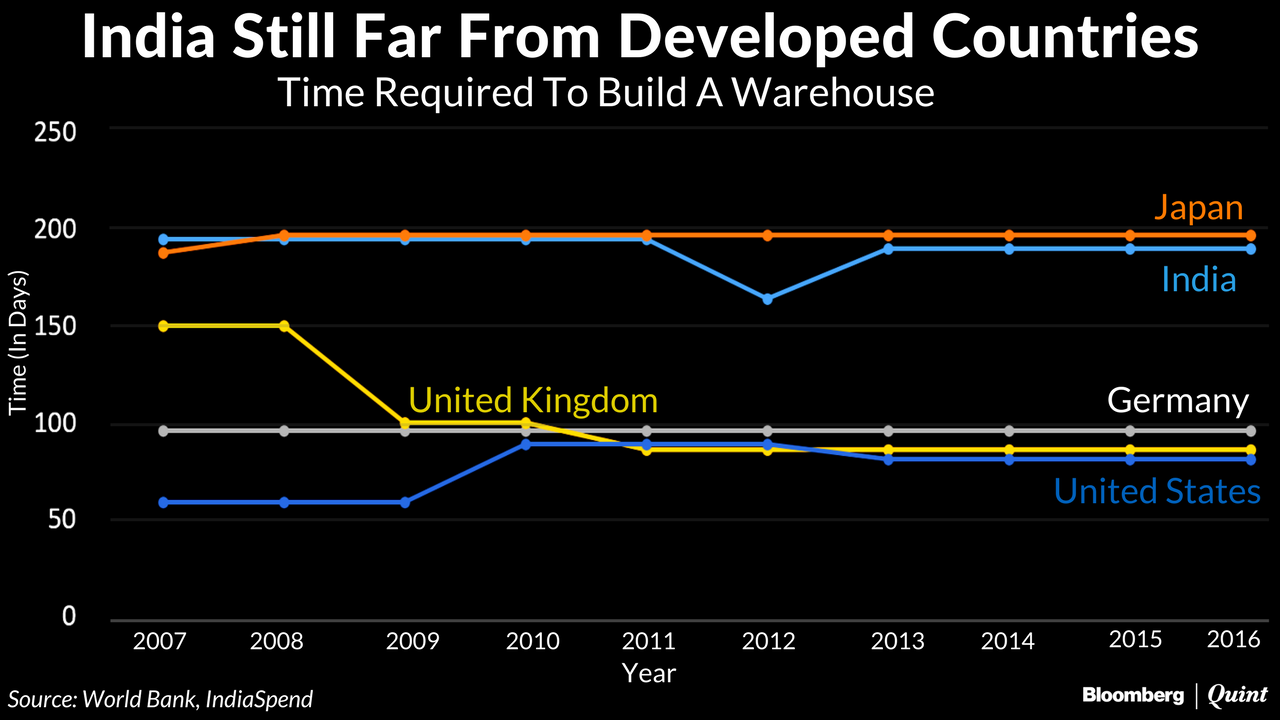
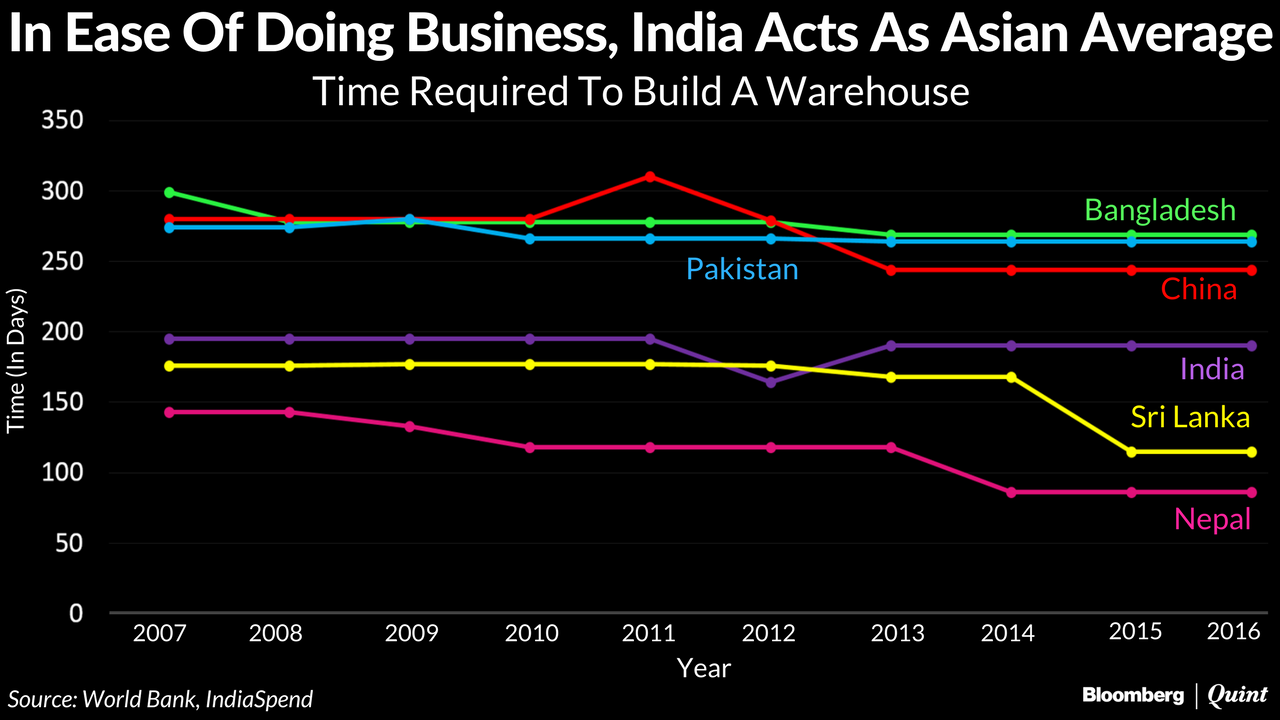
Companies in India take about half a year to build a warehouse, costing about Rs 50 lakh ($75,000) in Mumbai, with provisions for water, telephone and safety. This is about the same time that Japan takes and twice the time taken by developed western nations such as U.S., U.K. and Germany. South Asia is the slowest region in this respect, slower than even African countries.
In every country, industrial and commercial disputes arise when there is a conflict of interest between companies or between companies and the government. Resolving these conflicts in the least possible time is a sign of a healthy and growing economy.
India, on an average, takes thrice the time to resolve disputes than developed countries. India's judicial system is fraught with delays and there is a shortage of lower as well as higher court judges, as IndiaSpend reported in May 2015 and December 2015.
India is slower than even its poorer Asian neighbours at resolving insolvencies that are common in market economies. When businesses collapse, it is important to resolve and recover accumulated loans and debts so that entrepreneurs and banks do not suffer.
This “twin balance sheet problem”–soaring company debts coupled with unrecovered bank loans–was stressed in the Economic Survey 2015-16, after non-performing assets (NPA) of public sector banks piled up to 9 percent of the total loans disbursed by them. Today, their NPAs have crossed 12 percent of the total advances.
It takes, on average, four years and four months to resolve insolvency in India, compared to four years in Bangladesh, two years and seven months in Pakistan, and one year and eight months in China and Sri Lanka.
Japan resolves insolvency issues in seven months, the least time taken among the ten countries and regional averages analysed.
This article has been published in arrangement with IndiaSpend.

-
Navigating Energy Crossroads: S Jaishankar's Call For Diversified Supply Chains At G20 Ministerial Meeting

As geopolitical fault lines continue to test maritime trade routes and commodity flows, Jaishankar's message remains pertinent: true economic resilience requires open markets, protected transit lines, and a genuine commitment to multilateral cooperation rather than coercion.
-
Indians Are Travelling, But Not Every Journey Is A Holiday | The Week In Whys
Pilgrims, patients and working women are the real travellers, and the system hasn't quite caught up with them.
-
Getting To Work Costs Women More | The Reason Why
It is not just about women paying more than men. It is about women paying much more in cities than in villages.
-
AI Bias In Investing Cannot Be Eliminated, But It Can Be Governed
Framing is a particularly important example as identical financial information presented in terms of gains rather than losses can lead an LLM to reach a different assessment.
-
Joining The Dots | Dark Skies, Steady Diya: Why Hope Holds This Diwali
With war, a weak rupee and foreign outflows weighing on sentiment, policymakers at the NDTV World Summit and market veterans at NDTV Profit Ignite: Diwali Edition offered the same advice: stay invested and filter out the noise.
-
The Curious Case of Equitas Small Finance Bank And A CEO Who Quit For Stock
PN Vasudevan believes persistent investor concerns over a perceived conflict of interest had become a governance overhang on Equitas Small Finance Bank's stock, even as the lender improved profitability and asset quality.
-
Talking Points This Week: AI Cash Burn, A Tiger Comeback And An India That Still Finds Its Own Path
India is not immune to higher oil or tighter global liquidity, yet its earnings base is broader, its domestic policy levers are still available.
-
Foreign Investors Own Half Of HDFC Bank and ICICI Bank. An LTCG Cut Could Matter Most Here
Foreign portfolio investors have US$115 billion parked in HDFC Bank, ICICI Bank. If the government cuts long-term capital gains tax, Jefferies says returning foreign money could land here first.
-
'Never Seen This Level Of Negativity': Sandeep Tandon Says The Next Rally May Be Closer Than You Think
Veteran investor Sandeep Tandon says foreign selling is easing, large-caps are due a comeback and mid-caps are crowded, while he turns positive on gold, power and pharma this Diwali.










