Easier Access To Cash Won’t Solve White-Label ATM Operators’ Biggest Problem
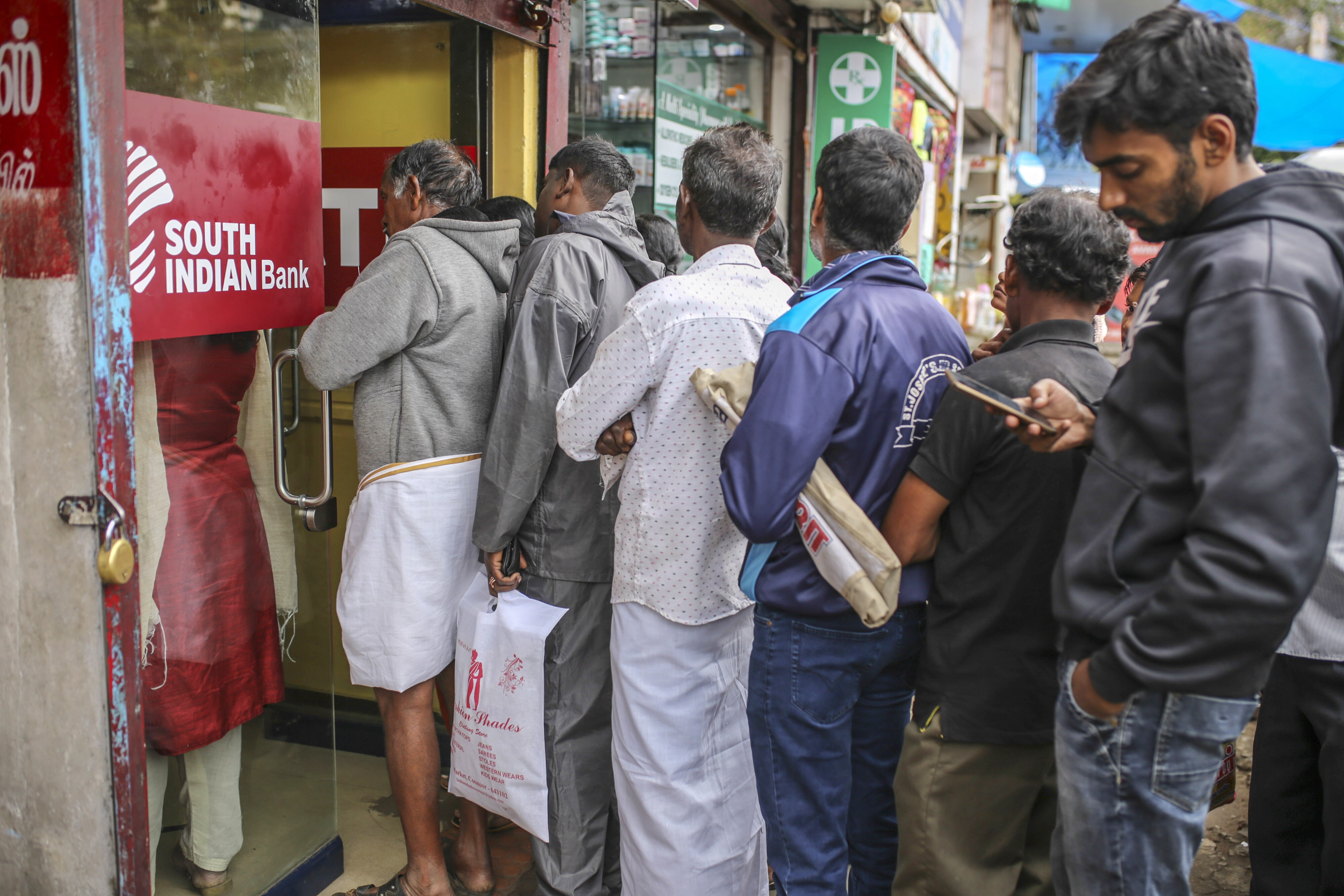
Operators of white-label ATMs expect new rules allowing them to source cash from the Reserve Bank of India and banks other than their partners to aid expansion of network. But their biggest concern remains unresolved.
“These [new norms] are peripheral changes and we may get some additional revenues,” KR Bijimon, chief general manager at Muthoot Finance Ltd., said. “But we were all expecting an increase in the interchange rate so that white-label operations can become more viable.”
White-label ATMs are set up by third parties and are not sponsored by a bank. The operators rely on the fee charged from banks for every transaction for their earnings. But high transaction and operational costs hurt their revenue. The operators have been seeking an increase in the fee for some time and the new rules don't address that issue.
Bijimon said some individual ATMs the company operated were financially viable either because of the location, the number of customers or through bank relations for cheaper funding. “But when the scale of operations is very high, for us or any other operator, the costs are very large and the entire model is unviable.”
At present, the interchange fee—that ATM operators charge banks—stands at Rs 15 per transaction, reduced from an earlier rate of Rs 18, according to heads of two white-label ATM operators BTI Payments Pvt. Ltd. and CMS Info Systems Pvt Ltd. The cost of running the ATM network is closer to Rs 20 per transaction, they said.
This makes the operating model unviable, said K Srinivas, chief executive officer and managing director at BTI Payments. Unless the interchange rates are raised, it will be uneconomical to roll out more ATMs, he said.
Anush Raghavan, vice president, CMS Info Systems, said there is headroom for the fee to go up without necessarily affecting the consumer as it needs to reflect the true cost of operating the ATM network.
Still, both agreed that RBI's new rules will help ease shortage of cash and allow the operators open ATMs at select places.
Easier Access To Cash
The RBI allowed white-label ATM operators to source cash not only from the central bank but also commercial, rural and cooperative lenders even if they're not their partners, according to a central bank notification.
The move comes as ATM network expansion had slowed after demonetisation. Prime Minister Narendra Modi's government pulled 86 percent of the currency out of circulation overnight in November 2016, causing a cash crunch.
When partner lenders struggled with currency shortage, they weren't able to provide enough cash for the machines, according to Raghavan. That's one of the reasons the ATM operators were struggling for a while, he said.
While about 3,000 new machines have been installed since demonetisation, according to the RBI data, it was largely because Hitachi Payment Services and Vakrangee Ltd. more than doubled their ATM count. Others, including market leader Tata Communications Payments Solutions Ltd. and AGS Transact Technologies Ltd., reduced the number of machines they managed.
After demonetisation ATM operators weren't getting enough cash and public-sector banks were reluctant to help, said Srinivas. The new norms will “ease our operations significantly” as the operators now get direct access to the 3,900-odd currency chests in the country.
“Now I can roll out ATMs across the country wherever there is demand compared to earlier when we would setup a machine depending on the cash availability in the area,” Srinivas said. Operators will get access to better-quality notes and a better mix of denominations, he said.
According to Raghavan, the move will make it easier to source cash in the remote pockets of the country. The new rules, he said, will also bring white-label ATM network on a par with bank-sponsored machines on standards and compliances.
Cross-Selling
The RBI permitted the operators to display advertisements of non-financial products and services within the ATM premises and on the screens. They can also co-brand ATM cards in partnership with banks.
Inherent operational cost benefits of white-label machines can help banks rapidly expand their ATM-cum-brand reach, according to Sanjeev Patel, chief executive officer at Tata Communications Payment Solutions. Co-branding means that the end is near for the capex-heavy brown-label (bank-sponsored) ATM model that has been prevalent so far, he said.
Not everyone is convinced. Bijimon of Muthoot Finance said his company advertises gold loans and other products like insurance at its ATMs but the conversion of business is minimal. “We aren't convinced that this will improve revenue as customers use an ATM for withdrawing cash and don't pay attention to any advertisements.”
This will mainly benefit the operators that have non-bank financial companies supporting them as they can co-brand and cross-sell financial products, said an executive from a white-label ATM firm on the condition of anonymity. Players without a non-bank partner will find it difficult at first to establish a relationship to sell products, the person said.
Srinivas, however, expects cross-selling and co-branding with ATM operators to help regional rural banks or cooperative banks that may neither have the capital nor the expertise to manage an ATM network of their own.

-
Where You Live Shapes How You Get To Work | The Reason Why

Two-wheelers are the most popular way to get to work in India, accounting for nearly 43% of workplace commutes.
-
High US Salaries, No Green Card Certainty: The Financial Calculation Facing Indian H-1B Families
The suspension of PERM processing at eight technology employers does not cancel existing H-1B visas. What it does is force a question many Indian families have been avoiding: is the US salary worth tying your career and family plans to one employer?
-
Unhedged Position: Can India See An Indonesia-Style Time Correction?
The Nifty is trading below levels it first clocked in 2024. Is there, then, as I have suggested in the headline, potential that the current time correction drags on painfully for the next three-five, even ten years?
-
Navigating Friction And Energy Realities: An Analysis Of Marco Rubio's October Visit To India
Occurring at a critical juncture marked by stalled trade negotiations and escalating geopolitical pressures over global energy supplies, the visit offers a profound window into modern US-India relations.
-
India Exports Capital. Why Not Export Trusteeship?
The big question, then, is whether India can build an institution that global borrowers, investors, banks, and lawyers can trust, even without an Indian connection.
-
France's Economy & Politics Are In Crisis | The Reason Why
Let's look at how the French economy and politics evolved under Nicolas Sarkozy, Franois Hollande and Emmanuel Macron.
-
You May Inherit The Business. You Must Earn Its Credibility.
Succession tests the founder's ability to share authority as much as it tests the next generation's readiness to assume it.
-
Signing Deals Is One Thing; Making Them Work Is Another | The Week In Whys
Sometimes, things don't turn out as planned. Indian companies have lost some bids to rivals, some projects won't produce until 2030.
-
FOMC Wall, PERM Suspension, Hospital Stocks | Talking Points This Week
A PERM suspension would directly affect green-card sponsorship rather than H-1B visas, so the near-term earnings impact could remain relatively limited. The key question is whether this marks a new phase in US scrutiny of Indian IT.
-
Everything, Everywhere, All At Once: Dalal Street's Week To Forget | Joining The Dots
Visa curbs, a Starlink spat and cancer drug caps: what connects this week's shocks for Indian markets









