Early Budget To Make Funds Available At Start Of Fiscal: PM Modi
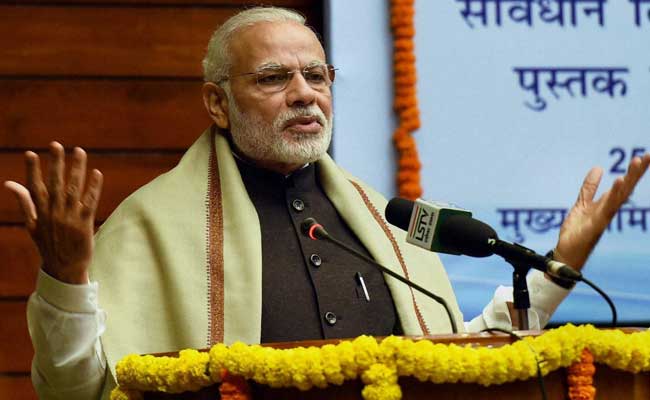
New Delhi: Prime Minister Narendra Modi on Tuesday said advancing the date of budget presentation would help getting funds authorised for different sectors at the start of the financial year.
Addressing economists at Niti Aayog's meeting on 'Economic Policy - The Road Ahead', he said that a change in the budget cycle would have an impact on the real economy.
"The date of budget presentation is being advanced so that expenditure is authorised by the time the new financial year begins," the Prime Minister said.
The government is proposing to present the budget for 2017-18 on February 1 instead of the regular date of February 28. Also, there will be no separate railway budget for the next fiscal as the government has decided to merge it with the general budget.
PM Modi said under the existing budget calendar, the authorisation of expenditure comes with the onset of the monsoon which results in government programmes remaining relatively inactive in the productive pre-monsoon months.
Seeking views of the economists for the forthcoming budget on areas such job creation, agriculture, skill development and education, PM Modi underlined the need for engaging the youth for speeding up economic development.
During the meeting with the Prime Minister, economists shared their views on various themes such as agriculture, job creation, taxation, education, digital technology, housing, tourism, banking, governance reform, data driven policy and future steps for growth.
Farm sector experts suggested incentivising states to undertake market reforms, create corpus fund for promoting farm mechanisation and micro irrigation, and provide interest subvention for term loans, among others, to double farm income by 2022.
The meeting was attended by Finance Minister Arun Jaitley, Niti Aayog Vice Chairman Arvind Panagariya, and senior officers from the Union Government, among others.
The economists and experts who were present included Pravin Krishna, Sukhpal Singh, Vijay Paul Sharma, Neelkanth Mishra, Surjit Bhalla, Pulak Ghosh, Govinda Rao, Madhav Chavan, N K Singh, Vivek Dehejia, Pramath Sinha, Sumit Bose and TN Ninan.
(This story has not been edited by NDTV staff and is auto-generated from a syndicated feed.)

-
High US Salaries, No Green Card Certainty: The Financial Calculation Facing Indian H-1B Families

The suspension of PERM processing at eight technology employers does not cancel existing H-1B visas. What it does is force a question many Indian families have been avoiding: is the US salary worth tying your career and family plans to one employer?
-
Unhedged Position: Can India See An Indonesia-Style Time Correction?
The Nifty is trading below levels it first clocked in 2024. Is there, then, as I have suggested in the headline, potential that the current time correction drags on painfully for the next three-five, even ten years?
-
Navigating Friction And Energy Realities: An Analysis Of Marco Rubio's October Visit To India
Occurring at a critical juncture marked by stalled trade negotiations and escalating geopolitical pressures over global energy supplies, the visit offers a profound window into modern US-India relations.
-
India Exports Capital. Why Not Export Trusteeship?
The big question, then, is whether India can build an institution that global borrowers, investors, banks, and lawyers can trust, even without an Indian connection.
-
France's Economy & Politics Are In Crisis | The Reason Why
Let's look at how the French economy and politics evolved under Nicolas Sarkozy, Franois Hollande and Emmanuel Macron.
-
You May Inherit The Business. You Must Earn Its Credibility.
Succession tests the founder's ability to share authority as much as it tests the next generation's readiness to assume it.
-
Signing Deals Is One Thing; Making Them Work Is Another | The Week In Whys
Sometimes, things don't turn out as planned. Indian companies have lost some bids to rivals, some projects won't produce until 2030.
-
FOMC Wall, PERM Suspension, Hospital Stocks | Talking Points This Week
A PERM suspension would directly affect green-card sponsorship rather than H-1B visas, so the near-term earnings impact could remain relatively limited. The key question is whether this marks a new phase in US scrutiny of Indian IT.
-
Everything, Everywhere, All At Once: Dalal Street's Week To Forget | Joining The Dots
Visa curbs, a Starlink spat and cancer drug caps: what connects this week's shocks for Indian markets
-
India Is Going Abroad For Critical Minerals. But It May Take Years To Pay Off | The Reason Why
Although India's steps are in the right direction, they remain modest compared with India's growing dependence.









