Donald Trump's New Rule Could Cut Legal Immigration In Half, Say Advocates
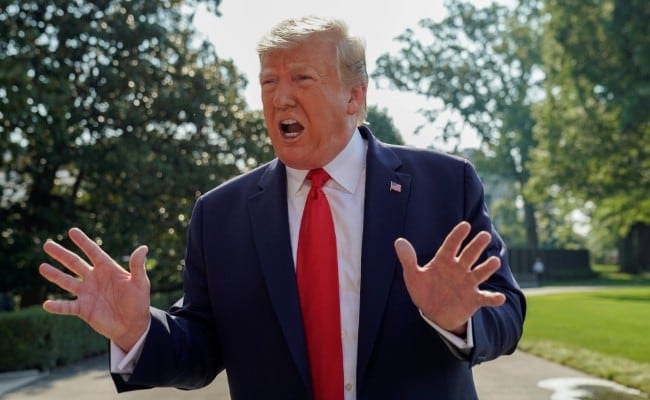
US President Donald Trump's administration unveiled a sweeping rule on Monday that some experts say could cut legal immigration in half by denying visas and permanent residency to hundreds of thousands of people for being too poor.
The long-anticipated rule, pushed by Donald Trump's leading aide on immigration, Stephen Miller, takes effect October 15. It would reject applicants for temporary or permanent visas if they fail to meet high enough income standards or if they receive public assistance such as welfare, food stamps, public housing or Medicaid.
"The Trump administration is trying to bypass Congress and implement its own merit based-immigration system. It's really a backdoor way of prohibiting low-income people from immigrating," said Charles Wheeler of the Catholic Legal Immigration Network Inc.
The rule is part of Republican Trump's efforts to curb both legal and illegal immigration, an issue he has made a cornerstone of his presidency.
After the rule was announced, the National Immigration Law Center (NILC) said it would file a lawsuit to stop it from taking effect. The group's executive director said the rule was racially motivated. The state attorneys general of California and New York threatened to sue.
The 837-page rule, seeking to target those who could become "public charges" in the United States, could be the most drastic of all the Donald Trump administration's policies targeting the legal immigration system, experts have said. It could deny visas to people for not making enough money or who are drawing public benefits.
The government estimates the status of 382,000 immigrants could immediately be reviewed on those grounds. Immigrant advocates fear the real number could be much higher, especially if the rule is extended to the millions of people who apply for US visas at American consulates around the world.
The State Department already changed its foreign affairs manual in January 2018 to give diplomats wider discretion in deciding visa denials on public charge grounds. In the fiscal year that ended last September, the number of visas denied on those grounds quadrupled compared to the previous year.
"This is an end run around Congress to achieve through executive fiat what the administration cannot get through Congress," said Doug Rand, co-founder of Boundless, a pro-migrant group that helps families navigate the US immigration system.
The rule is intended to scare immigrants away from using public benefits to which they are legally entitled, Doug Rand said, adding that a study by Boundless found it could eliminate more than half of visa applicants.
A 2018 study by the Migration Policy Institute found 69 per cent of already established immigrants had at least one negative factor against them under the administration's wealth test, while just 39 per cent had one of the heavily weighed positive factors.
Other immigrant advocates have expressed concern the rule could negatively affect public health by dissuading immigrants from using health or food aid. The Trump administration estimates its rule will save $2.47 billion annually in spending on public benefits.
The rule is derived from the Immigration Act of 1882, which allows the US government to deny a visa to anyone likely to become a "public charge."
DEFINING 'PUBLIC CHARGE'
Ken Cuccinelli, the acting director of US Citizenship and Immigration Services (USCIS), said at a White House media briefing that the law has always required foreign nationals to rely on their own resources, with help from relatives and sponsors, but the term "public charge" was never clearly defined.
"That is what changes today with this rule," Ken Cuccinelli said.
The new rule defines public charge as an immigrant who receives one or more designated public benefits for more than 12 months within any 36-month period.
The definition of public benefits is cash aid including Supplemental Security Income, Temporary Assistance for Needy Families, the Supplemental Nutrition Assistance Program (SNAP), most forms of Medicaid, and a variety of public housing programs, officials said.
"The principle driving it is an old American value and that's self-sufficiency," Ken Cuccinelli said in a Fox News interview.
Whether someone is public charge will be determined on a variety of positive and negative factors. A positive factor would be earning 125 per cent of the poverty line, which is $12,490 for an individual and $25,750 for a family of four, while earning less would be a negative factory.
'HUDDLED MASSES'
Critics have decried the effort to limit legal immigration for lower-income people affront to the ideals of the United States highlighted by the inscription on the Statue of Liberty that reads "Give me your tired, your poor, your huddled masses yearning to breathe free."
Donald Trump aide Miller, asked in 2017 about whether the administration's policies countered that inscription, said the words were not original to the monument.
Ken Cuccinelli was also asked about the inscription at the White House on Monday and said: "I do not think, by any means, we are ready to take anything off the Statue of Liberty."
In early 2018, Donald Trump rejected a bipartisan effort in Congress to reform the immigration system. The effort became embroiled in controversy over accusations by a Democratic senator that the Republican president disparaged African and Caribbean nations with a vulgarity in regard to their immigrants. Donald Trump was reported to have asked why the United States could not get more immigrants form northern Europe.
Donald Trump has denied using that language and said he wanted immigrants to come the United States from all nations.

-
Talking Points This Week: Tech Nerves, FII Buying, And A Faraway Banking Shock

The global markets are not shining this Diwali. The exception in the large markets is, India.
-
Midterm Rally Lasted A Day. The Hard Reality Of A Divided US May Last Two Years | Opinion
Between a contested AI boom, a debt ceiling that arrives in 2027 and a president with every incentive to act alone, the next two years may prove more volatile than the first day's rally suggests.
-
Blue Wave Will Derail the AI Trade but Won't Dismantle the AI Era | Unhedged Position
The Democrats' sweep of the US Congress will see politics collide with economic forces both over the long and short term.
-
It's Time To Take The GST Council's Bet On Trust Global
Payment records can prove India's services exports, and clear, proportionate rules can bring foreign digital sellers into the tax net.
-
Opinion | India at 38: From Innovation Overperformer to Innovation Powerhouse
India now has 453 VC-backed deep science startups, 18 of them late-stage, after 117 percent growth since 2020. Laurus Labs, at USD 9.3 billion, is the most valuable deep science company in any middle-income economy outside China.
-
Navigating Energy Crossroads: S Jaishankar's Call For Diversified Supply Chains At G20 Ministerial Meeting
As geopolitical fault lines continue to test maritime trade routes and commodity flows, Jaishankar's message remains pertinent: true economic resilience requires open markets, protected transit lines, and a genuine commitment to multilateral cooperation rather than coercion.
-
Indians Are Travelling, But Not Every Journey Is A Holiday | The Week In Whys
Pilgrims, patients and working women are the real travellers, and the system hasn't quite caught up with them.
-
Getting To Work Costs Women More | The Reason Why
It is not just about women paying more than men. It is about women paying much more in cities than in villages.
-
AI Bias In Investing Cannot Be Eliminated, But It Can Be Governed
Framing is a particularly important example as identical financial information presented in terms of gains rather than losses can lead an LLM to reach a different assessment.









