Dollar At 3-Week Low On Less Hawkish Fed Outlook
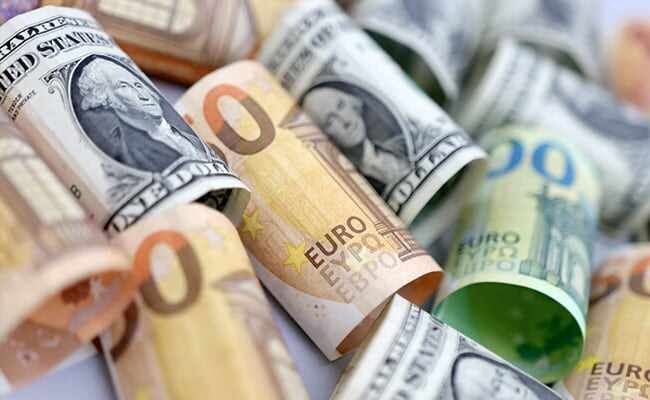
The dollar wallowed near a three-week low versus major peers on Wednesday as more signs of economic weakness in the United States fanned speculation about a less hawkish Federal Reserve.
Sterling hung close to the six-week peak reached on Tuesday after new British Prime Minister Rishi Sunak pledged to lead the country out of an economic crisis.
The euro also remained near a six-week high, trading less than half a cent from parity with the greenback. The European Central Bank decided policy on Thursday and is widely expected to raise rates by 75 basis points.
The dollar index - which measures the currency against six peers, including sterling, the euro and the yen - was little changed at 111.01, near the previous session's trough of 110.75, the lowest level since Oct. 5.
Data overnight showed that U.S. home prices sank in August as surging mortgage rates sapped demand, amid recent signs that Fed rate increases are already working to slow the world's biggest economy.
Traders and economists predict another 75 basis point increase next Wednesday, but the view is growing for a slowing to half a point in December.
"I'm still in two minds as to whether we can say we've seen a peak in the U.S. dollar," but "evidence of a slowdown is building," said Ray Attrill, head of FX strategy at National Australia Bank.
"If the market gets really comfortable with a Fed pivot - if that's what stepping down to 50 basis points is, and potentially ending a tightening cycle south of 5% early next year - then it will be time to call time on U.S. dollar strength, but I'd like to get through the Fed messaging next week before coming to that conclusion."
U.S. long-term Treasury yields continued their descent from last week's multi-year highs at 4.338%, sliding to 4.0833% in Tokyo.
That put particular pressure on the dollar versus the yen, due to its sensitivity to U.S. rates, with the pair steady at 147.99 following a 0.7% slide from Tuesday.
The dollar reached a 32-year top at 151.94 yen on Friday, but was then beaten back as far as 144.55 amid two bouts of suspected Bank of Japan intervention either side of the weekend.
Even so, fundamentals still favor a weaker yen with the BOJ expected on Friday to keep stimulus settings unchanged, running counter to monetary tightening by developed-market peers.
Sterling eased 0.21% to $1.1448, but was still close to Tuesday's high of $1.1500, a level last seen on Sept. 15.
The euro slipped 0.14% to $0.99545, after jumping to its highest since Oct. 5 on Tuesday at $0.9995.
The Australian dollar was 0.13% lower at $0.6386, despite getting a short-lived pop to as high as $0.6412 after quarterly consumer inflation data narrowly topped economists' estimates, putting some pressure on the Reserve Bank ahead of a policy meeting on Tuesday.
The Aussie reached the highest since Oct. 7 at $0.6412 in the previous session.
"The Aussie's weak attempt to rally on above-expectations core CPI is not a promising sign for its near term prospects," said Sean Callow, a senior FX strategist at Westpac.
"A further pullback in the U.S. dollar seems to be the Aussie's best chance of sustaining pushes above $0.64. Otherwise, it's back to trading either side of $0.63."
Cryptocurrencies were also firm after sharp rallies on Tuesday amid dollar weakness. Bitcoin was 0.14% higher at $20,116 after a 3.9% jump overnight. Ether was up 0.45% at $1,466.30, building on Tuesday's 8.7% surge.
(Except for the headline, this story has not been edited by NDTV staff and is published from a syndicated feed.)

-
High US Salaries, No Green Card Certainty: The Financial Calculation Facing Indian H-1B Families

The suspension of PERM processing at eight technology employers does not cancel existing H-1B visas. What it does is force a question many Indian families have been avoiding: is the US salary worth tying your career and family plans to one employer?
-
Swiggy vs Eternal: Food Delivery's Two Rivals Are No Longer In The Same Race
Eternal is building a private AI assistant, dark.ai. Swiggy is still working out how to make Instamart pay, with an operating loss of Rs 895 crore in the July-September quarter while Blinkit stayed profitable.
-
Where You Live Shapes How You Get To Work | The Reason Why
Two-wheelers are the most popular way to get to work in India, accounting for nearly 43% of workplace commutes.
-
Unhedged Position: Can India See An Indonesia-Style Time Correction?
The Nifty is trading below levels it first clocked in 2024. Is there, then, as I have suggested in the headline, potential that the current time correction drags on painfully for the next three-five, even ten years?
-
Navigating Friction And Energy Realities: An Analysis Of Marco Rubio's October Visit To India
Occurring at a critical juncture marked by stalled trade negotiations and escalating geopolitical pressures over global energy supplies, the visit offers a profound window into modern US-India relations.
-
India Exports Capital. Why Not Export Trusteeship?
The big question, then, is whether India can build an institution that global borrowers, investors, banks, and lawyers can trust, even without an Indian connection.
-
France's Economy & Politics Are In Crisis | The Reason Why
Let's look at how the French economy and politics evolved under Nicolas Sarkozy, Franois Hollande and Emmanuel Macron.
-
You May Inherit The Business. You Must Earn Its Credibility.
Succession tests the founder's ability to share authority as much as it tests the next generation's readiness to assume it.
-
Signing Deals Is One Thing; Making Them Work Is Another | The Week In Whys
Sometimes, things don't turn out as planned. Indian companies have lost some bids to rivals, some projects won't produce until 2030.
-
FOMC Wall, PERM Suspension, Hospital Stocks | Talking Points This Week
A PERM suspension would directly affect green-card sponsorship rather than H-1B visas, so the near-term earnings impact could remain relatively limited. The key question is whether this marks a new phase in US scrutiny of Indian IT.









