Dollar Resilient, Euro Wallows At Two-Decade Low On Economy Trouble
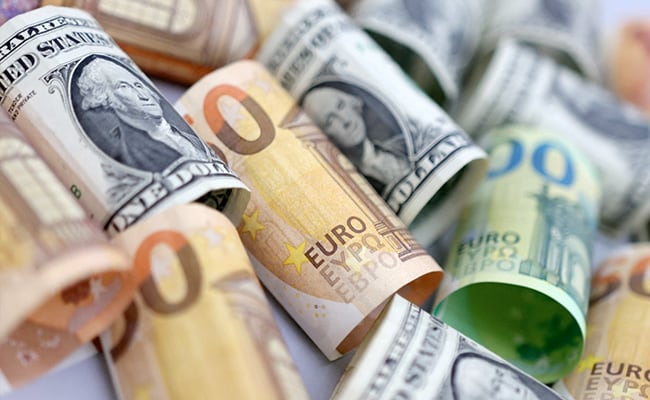
The dollar held firm on Tuesday on safe haven flows, while the euro languished around a two-decade low as Europe confronts energy supply and broader economic growth concerns.
The euro touched its lowest since late 2002 of $0.9926 overnight and was last barely higher at $0.9941.
Russia will halt natural gas supplies to Europe via the Nord Stream 1 pipeline for three days at the end of the month, the latest reminder of the precarious state of the continent's energy supply.
Heatwaves in the continent have already put a strain on energy supplies and worries are growing that any disruption during the winter months could be devastating for business activity.
"Given the current mood, there's obviously concerns as to whether that's going to be three days or whether it's going to be three years," said Ray Attrill, head of FX strategy at National Australia Bank (NAB).
"Is it really just going to be a three-day maintenance or is this just another example of weaponisation of gas supply into Europe?"
The pound was also dragged to a new 2.5-year low overnight, and hobbled near that level at $1.17715 in Asia trade. The Japanese yen steadied at 137.265 per dollar after touching a one-month low of 137.705.
Conversely, the Australian and New Zealand dollars were relatively steady, which NAB's Attrill attributed to the market's attention being drawn to the weakness of Europe's outlook.
Chief on investors' minds for Tuesday will be flash manufacturing PMI readings out in the euro zone and Britain later in the day, which will provide further clarity on the growth trajectory for the respective economies.
Investors are also waiting on minutes of the European Central Bank's (ECB) last policy meeting on Thursday that are likely to sound hawkish even as the continent faces a downturn in growth.
The Aussie was up 0.28% at $0.6898, while the kiwi also gained 0.28% to $0.6190.
Elsewhere in Asia, the dollar traded at 6.8652 against the offshore yuan, not far from a nearly two-year high of 6.8752 hit on Monday.
Against a basket of currencies, in which the euro is the most heavily weighted, the U.S. dollar index stood firm at 108.9, attempting to breach a two-decade high of 109.29 hit in July.
Another reason investors have sought shelter in dollars is the growing risk of a hawkish message from the Federal Reserve's Jackson Hole symposium, flagged by several officials last week.
"Bonds sold off, led by the front-end," said analysts at ANZ. "That's possibly in anticipation that Chair (Jerome)Powell's speech on Friday is likely to reiterate hawkish messaging."
Yields on the benchmark 10-year Treasury note have risen about 4 basis points for the week and last stood at 3.0165%. Yields on the two-year Treasury note were up around 5 bps at 3.3102% as investors remained on inflation and Fed-watch mode.
(This story has not been edited by NDTV staff and is auto-generated from a syndicated feed.)

-
Why Amazon And Flipkart Are Struggling To Beat Meesho In India's Smaller Cities

With 274 million users and lowest-cost logistics, Meesho is defending its value commerce crown against giants like Amazon and Flipkart.
-
High US Salaries, No Green Card Certainty: The Financial Calculation Facing Indian H-1B Families
The suspension of PERM processing at eight technology employers does not cancel existing H-1B visas. What it does is force a question many Indian families have been avoiding: is the US salary worth tying your career and family plans to one employer?
-
Swiggy vs Eternal: Food Delivery's Two Rivals Are No Longer In The Same Race
Eternal is building a private AI assistant, dark.ai. Swiggy is still working out how to make Instamart pay, with an operating loss of Rs 895 crore in the July-September quarter while Blinkit stayed profitable.
-
Where You Live Shapes How You Get To Work | The Reason Why
Two-wheelers are the most popular way to get to work in India, accounting for nearly 43% of workplace commutes.
-
Unhedged Position: Can India See An Indonesia-Style Time Correction?
The Nifty is trading below levels it first clocked in 2024. Is there, then, as I have suggested in the headline, potential that the current time correction drags on painfully for the next three-five, even ten years?
-
Navigating Friction And Energy Realities: An Analysis Of Marco Rubio's October Visit To India
Occurring at a critical juncture marked by stalled trade negotiations and escalating geopolitical pressures over global energy supplies, the visit offers a profound window into modern US-India relations.
-
India Exports Capital. Why Not Export Trusteeship?
The big question, then, is whether India can build an institution that global borrowers, investors, banks, and lawyers can trust, even without an Indian connection.
-
France's Economy & Politics Are In Crisis | The Reason Why
Let's look at how the French economy and politics evolved under Nicolas Sarkozy, Franois Hollande and Emmanuel Macron.
-
You May Inherit The Business. You Must Earn Its Credibility.
Succession tests the founder's ability to share authority as much as it tests the next generation's readiness to assume it.
-
Signing Deals Is One Thing; Making Them Work Is Another | The Week In Whys
Sometimes, things don't turn out as planned. Indian companies have lost some bids to rivals, some projects won't produce until 2030.










