Dollar Profits From Yield Allure, Nikkei Hits One-Year High
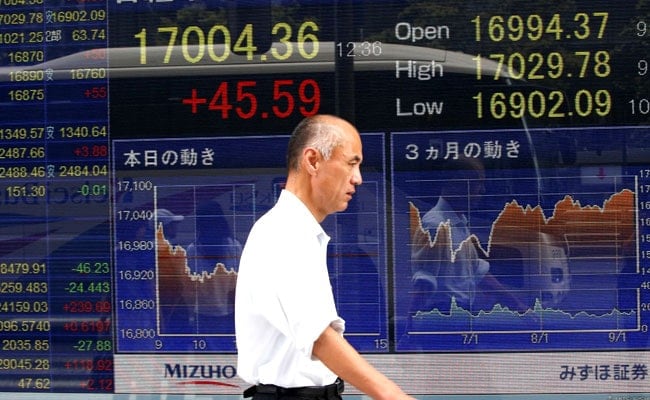
Sydney: The US dollar was encamped near 14-year peaks on Wednesday as global yield spreads moved inexorably in its favour, while a falling yen lifted Japanese shares to a one-year top.
Japan's Nikkei added 0.4 per cent in early trade, while Australia's main index climbed to its highest in almost 17 months after Wall Street racked up more records.
The dollar revelled in its rapidly widening yield premium, with the Federal Reserve set on a tightening course even as its peers in Europe and Japan act to keep their short-term rates deep in negative territory.
The dollar index, which measures it against a basket of currencies, stood at 103.260 having touched 103.65, its highest since December 2002.
The dollar had also edged back up to 117.80 yen , within sight of its recent peak at 118.66, while the euro stayed pinned at $1.0394 .
On Wall Street, the Dow ended just 25 points shy of the magical 20,000 barrier helped by a 1.68 percent gain in Goldman Sachs .
Stocks have been on a tear since the November 8 presidential election, with the Dow up 9 per cent and the S&P 500 6 per cent on bets that President-elect Donald Trump's plans for deregulation and infrastructure spending might boost profits and growth.
The Dow rose 0.46 per cent on Tuesday, while the S&P 500 gained 0.36 per cent and the Nasdaq 0.49 per cent. Eight of the 11 major S&P sectors rose, led by a 1.23 per cent jump in the financial index.
After the bell, Nike rose 3 per cent on a strong quarterly report from the sports apparel seller.
Not thrilled
European shares scaled 11-month highs on Tuesday as Italy's banking index rose 2.3 per cent after the government decided to seek parliamentary approval to borrow 20 billion euros to underwrite the stability of its banks.
Emerging markets have not been nearly as thrilled by Mr Trump's win, as the threat of tariffs has stirred fears of a trade war while rising US yields have attracted funds away.
Benchmark 10-year US yields have climbed almost 80 basis points since early November to reach 2.56 per cent.
Data from the Institute for International Finance showed non-resident investors had pulled $23 billion from emerging market portfolios since early October.
The outflows have triggered the longest continuous "reversal alert" since the organization began issuing the notice in 2005.
Chinese markets have also been unsettled by Beijing's move to tighten supervision of shadow banking activities and on liquidity concerns.
MSCI's broadest index of Asia-Pacific shares outside Japan inched up 0.3 per cent in early trade, but that followed several days of losses.
In commodity markets, oil prices nudged higher for a fourth session to defy news Libya had reopened pipelines after a two-year blockade that ended earlier this month.
US crude futures were up 24 cents at $52.54 a barrel. Benchmark Brent crude futures had settled 43 cents firmer at $55.35.
Gold held at $1,132.90 an ounce as a firm US dollar kept it pinned near last week's ten-and-a-half-month low of $1,122.35.

-
Navigating Energy Crossroads: S Jaishankar's Call For Diversified Supply Chains At G20 Ministerial Meeting

As geopolitical fault lines continue to test maritime trade routes and commodity flows, Jaishankar's message remains pertinent: true economic resilience requires open markets, protected transit lines, and a genuine commitment to multilateral cooperation rather than coercion.
-
Indians Are Travelling, But Not Every Journey Is A Holiday | The Week In Whys
Pilgrims, patients and working women are the real travellers, and the system hasn't quite caught up with them.
-
Getting To Work Costs Women More | The Reason Why
It is not just about women paying more than men. It is about women paying much more in cities than in villages.
-
AI Bias In Investing Cannot Be Eliminated, But It Can Be Governed
Framing is a particularly important example as identical financial information presented in terms of gains rather than losses can lead an LLM to reach a different assessment.
-
Joining The Dots | Dark Skies, Steady Diya: Why Hope Holds This Diwali
With war, a weak rupee and foreign outflows weighing on sentiment, policymakers at the NDTV World Summit and market veterans at NDTV Profit Ignite: Diwali Edition offered the same advice: stay invested and filter out the noise.
-
The Curious Case of Equitas Small Finance Bank And A CEO Who Quit For Stock
PN Vasudevan believes persistent investor concerns over a perceived conflict of interest had become a governance overhang on Equitas Small Finance Bank's stock, even as the lender improved profitability and asset quality.
-
Talking Points This Week: AI Cash Burn, A Tiger Comeback And An India That Still Finds Its Own Path
India is not immune to higher oil or tighter global liquidity, yet its earnings base is broader, its domestic policy levers are still available.
-
Foreign Investors Own Half Of HDFC Bank and ICICI Bank. An LTCG Cut Could Matter Most Here
Foreign portfolio investors have US$115 billion parked in HDFC Bank, ICICI Bank. If the government cuts long-term capital gains tax, Jefferies says returning foreign money could land here first.
-
'Never Seen This Level Of Negativity': Sandeep Tandon Says The Next Rally May Be Closer Than You Think
Veteran investor Sandeep Tandon says foreign selling is easing, large-caps are due a comeback and mid-caps are crowded, while he turns positive on gold, power and pharma this Diwali.
-
Indians Stay With Family, Not In Hotels | The Reason Why
India still lacks enough clean, reliable and affordable hotels for budget-conscious travellers.










