Do We Need New Rules To Rein In High Debt States?
The Indian economy may soon be moving towards a new fiscal framework. A committee headed by former Revenue Secretary NK Singh has suggested that the debt-to-GDP ratio should become the principal anchor for fiscal policy. The fiscal deficit would still be the operational target but the central and state governments would need to bring debt levels down to a certain percentage of the gross domestic product.
An overall ceiling of 60 percent has been suggested for the combined debt-to-GDP ratio. The target is to be achieved by 2023. There are, however, sub-targets and state debt has to be brought down to 20 percent of gross state domestic product (GSDP) over this period. The recommendations come at a time when concerns around state finances are rising due to widening deficits and increasing borrowings.
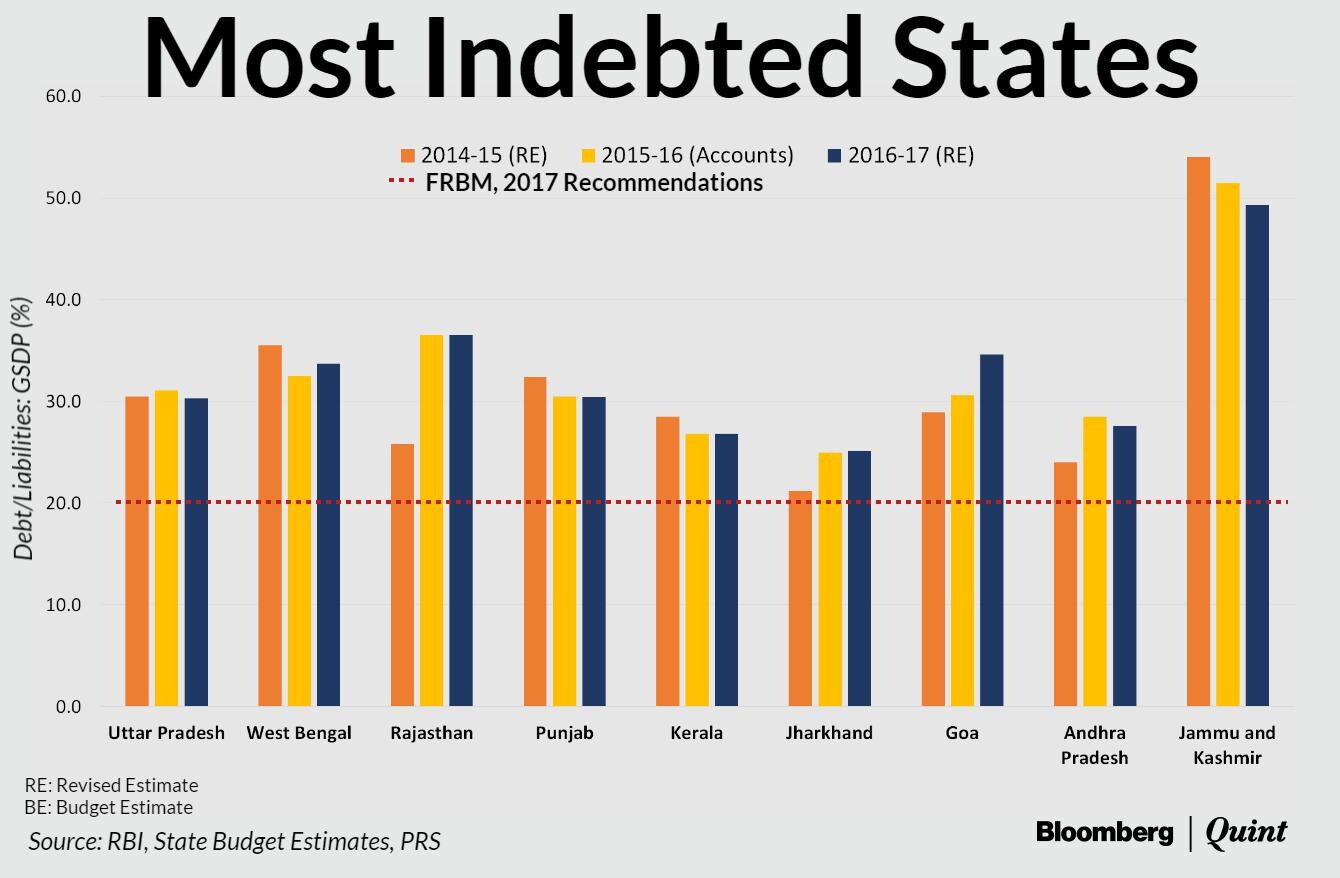
The debt stock of states, at 21 percent currently, is close to the prescribed aggregate levels. However, a closer look shows wide variations in the performance of individual states.
Analysis of data from state budget estimates and non-profit research organisation PRS Legislative Research shows that 12 of 29 states had debt-to-GSDP ratios above 25 percent in fiscal 2017. The variation in debt reflects the different growth trajectories followed by individual states and the manner in which they have managed their expenses and borrowings.
According to Jayanta Roy, group head for corporate sector ratings at ICRA Ltd. and Aditi Nayar, principal economist at ICRA, state government indebtedness and leverage levels (inclusive of guarantees) differ widely at present. While certain states, such as Maharashtra and Karnataka, have indebtedness well below 20 percent of GSDP already, there are others that are well above that level.
In a response to an email query from BloombergQuint, Roy and Nayar wrote that this divergence could widen. Factors that would add to the stress, in different degrees across states, in the near term include servicing of UDAY (Ujwal DISCOM Assurance Yojana) bonds, pay revisions, as well as loan waivers that a few states may choose to announce, they said.
UDAY bonds are being used to substitute debt held by state electricity distribution companies (DISCOMS) with state government bonds. While this may ease the burden for DISCOMS, state debt levels may rise. States will also need to absorb pay hikes recommended by the Seventh Pay Commission.
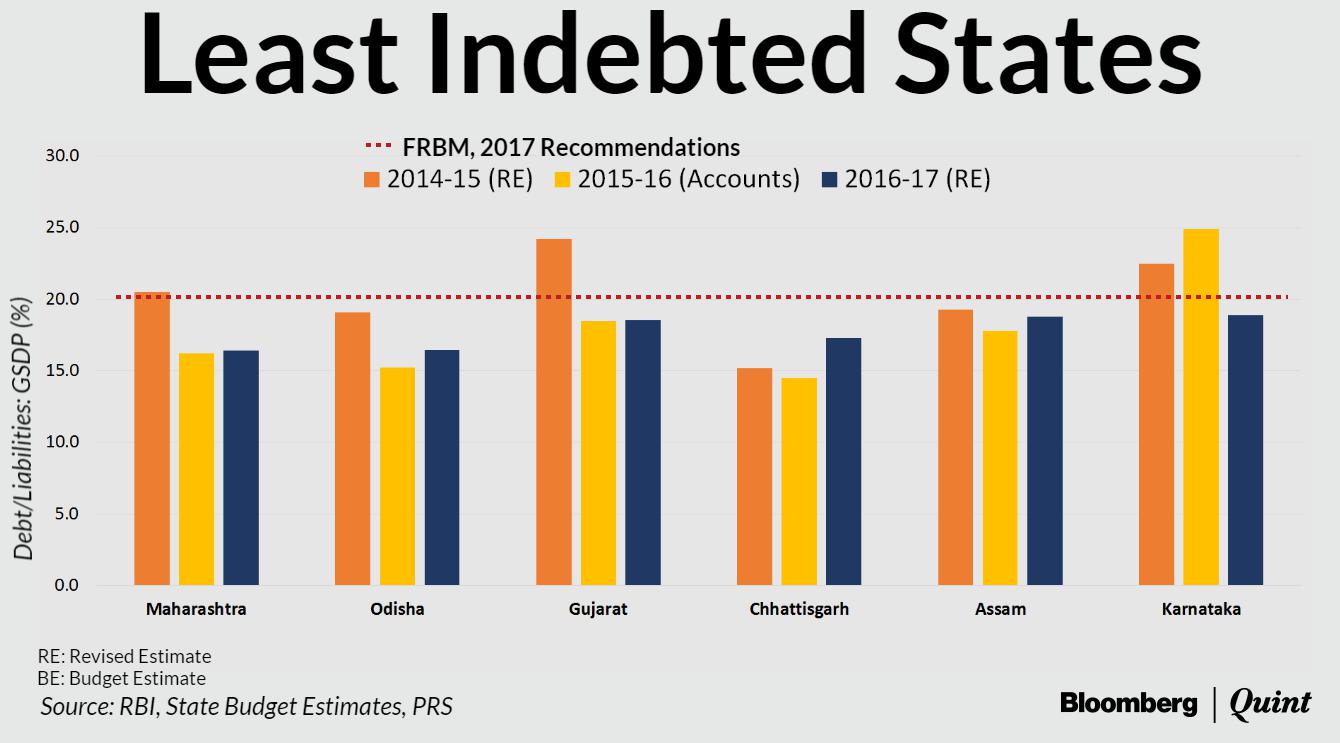
The committee reviewing the Fiscal Responsibility and Budget Management (FRBM) Act recognized this divergence and the consequent need for a more granular fiscal framework for states, said committee chairman NK Singh in an interview with BloombergQuint last week.
The committee has recommended that the one of the terms of reference for the Fifteenth Finance Commission should be to set rules for the inter se management of state debt.
“There are two aspects to it. One is the overall debt of the states which is 20 percent, which the report has pointed out. The other, of course, is the inter se balancing between the states and that responsibility and obligation we feel is best left to the Fifteenth Finance Commission,” said Singh
Roy and Nayar say that the Finance Commission may need to draw out different trajectories for individual states to ensure that the burden of bringing down state debt is shared fairly. An enforcement mechanism may also be needed.
Depending on the current debt levels, differing trajectories may have to be drawn up for different states, with greater debt compression to be attempted by more indebted states. An enforcement mechanism would need to be instituted, perhaps by the Fifteenth Finance Commission, to ensure that the aggregate state debt levels decline to below 20 percent of GSDP by FY2023, despite the looming stress factors such as servicing of UDAY bonds, pay revisions as well as potential loan waivers.Jayanta Roy, Group Head - Corporate Sector Ratings, ICRA & Aditi Nayar, Principal Economist, ICRA Ltd.
Such a framework is essential because the markets tend to treat all states at par. State government debt is priced at a certain spread above central government debt, and there is no distinction made between states that have high levels of debt and those who do not.
In a February 22 report, Sajjid Chinoy, chief Asia economist at JPMorgan, wrote that this can be attributed to the market perception of an implicit sovereign guarantee on state debt as well as a largely captive investor base.
The corollary, of course, is that there is little incentive for states to consolidate, because prudent states are not rewarded and profligate states are not disciplined. With the fiscal center of gravity moving to the states and State debt/GDP poised to inflect and secularly increase, finding ways to inject greater market discipline into the state bond market needs to become a key policy imperative.Sajjid Chinoy, Chief Asia Economist, JPMorgan
Chinoy, like others, says that unless state deficits are brought back down, “state debt dynamics could quickly get on to an explosive path.” This, in turn, could derail the FRBM Review Committee's recommendation to bring consolidated debt down to 60 percent by 2023.

-
Navigating Energy Crossroads: S Jaishankar's Call For Diversified Supply Chains At G20 Ministerial Meeting

As geopolitical fault lines continue to test maritime trade routes and commodity flows, Jaishankar's message remains pertinent: true economic resilience requires open markets, protected transit lines, and a genuine commitment to multilateral cooperation rather than coercion.
-
Indians Are Travelling, But Not Every Journey Is A Holiday | The Week In Whys
Pilgrims, patients and working women are the real travellers, and the system hasn't quite caught up with them.
-
Getting To Work Costs Women More | The Reason Why
It is not just about women paying more than men. It is about women paying much more in cities than in villages.
-
AI Bias In Investing Cannot Be Eliminated, But It Can Be Governed
Framing is a particularly important example as identical financial information presented in terms of gains rather than losses can lead an LLM to reach a different assessment.
-
Joining The Dots | Dark Skies, Steady Diya: Why Hope Holds This Diwali
With war, a weak rupee and foreign outflows weighing on sentiment, policymakers at the NDTV World Summit and market veterans at NDTV Profit Ignite: Diwali Edition offered the same advice: stay invested and filter out the noise.
-
The Curious Case of Equitas Small Finance Bank And A CEO Who Quit For Stock
PN Vasudevan believes persistent investor concerns over a perceived conflict of interest had become a governance overhang on Equitas Small Finance Bank's stock, even as the lender improved profitability and asset quality.
-
Talking Points This Week: AI Cash Burn, A Tiger Comeback And An India That Still Finds Its Own Path
India is not immune to higher oil or tighter global liquidity, yet its earnings base is broader, its domestic policy levers are still available.
-
Foreign Investors Own Half Of HDFC Bank and ICICI Bank. An LTCG Cut Could Matter Most Here
Foreign portfolio investors have US$115 billion parked in HDFC Bank, ICICI Bank. If the government cuts long-term capital gains tax, Jefferies says returning foreign money could land here first.
-
'Never Seen This Level Of Negativity': Sandeep Tandon Says The Next Rally May Be Closer Than You Think
Veteran investor Sandeep Tandon says foreign selling is easing, large-caps are due a comeback and mid-caps are crowded, while he turns positive on gold, power and pharma this Diwali.
-
Indians Stay With Family, Not In Hotels | The Reason Why
India still lacks enough clean, reliable and affordable hotels for budget-conscious travellers.










