Demonetisation Leaves An Imprint On GDP Growth In FY17
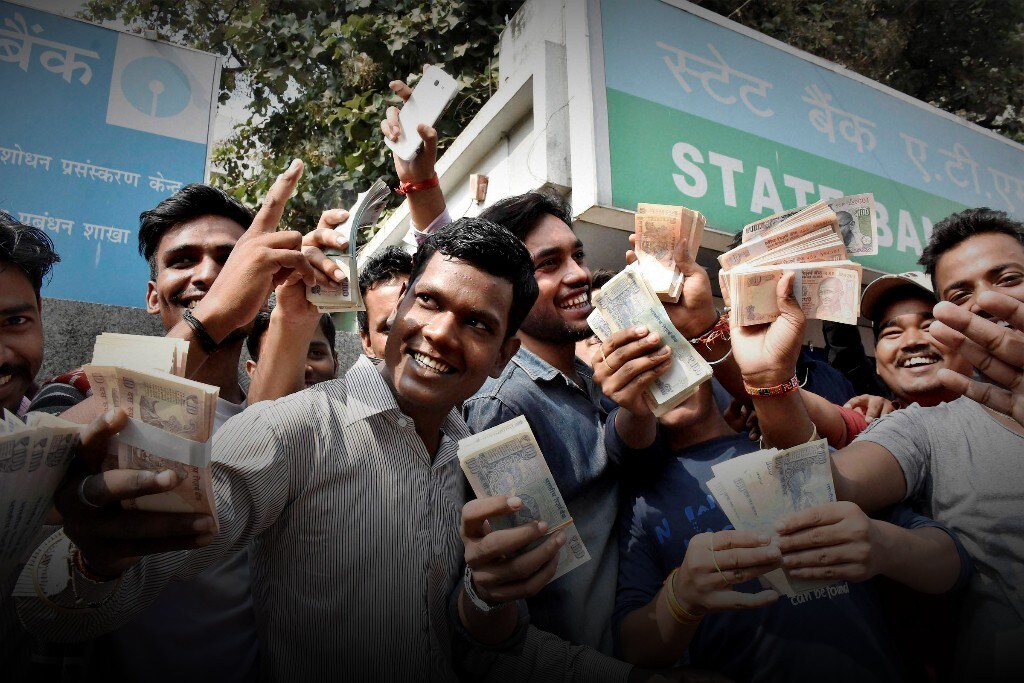
On November 8, the government decided to withdraw nearly 86 percent of the economy's currency in circulation by saying that Rs 500 and Rs 1,000 notes would no longer be legal tender.
At its worst, the cash shortage had pushed down currency in circulation to a low of 5.9 percent of GDP in January compared to the pre-demonetisation levels of 11.8 percent of GDP. Seven months later, while the worst of the cash crunch is over, the currency withdrawn from the system has still not been fully replaced.
The shortage of currency, in an economy which has always been considered cash dependent, prompted analysts to say that growth would be severely impacted. While the extent of the expected impact varied, most expected at least a one percentage point knock-down in the growth rate.
Analysts and economists, however, were forced to eat humble pie when, in February, the government's statistical arm put out data suggesting that growth during the December ended quarter remained at a respectable 7 percent, with full year growth pegged at 7.1 percent.
Prime Minister Narendra Modi even used that strong growth data to poke fun at prominent economists.
"Well known intellectuals from Harvard and Oxford, who have been at key positions in the Indian economic system, had said the GDP would go down by 2 percent, some others said it would go down by 4 percent...On one hand, there are these intellectuals who talk about Harvard, and on the other, there is this son of a poor mother, who is trying to change the economy of the country through hard work," Modi said.
Three months later, analysts have an opportunity, armed with data, to get their own back.
The national income data released on Wednesday tells us two things about the economy. The first is that economic momentum had started to slacken even before demonetisation. The second is that demonetisation made this worse.
Also Read: India's Growth Slows Sharply In Fourth Quarter
Both the gross domestic product (GDP) and gross value added (GVA) measures show that growth has been on the decline. The GDP data shows that growth, which was close to 8 percent in the first quarter of the year, had slipped to 6 percent by the end of the financial year. The GVA measure holds a similar message, with growth sliding from 7.6 percent in the first quarter to 5.6 percent. The sequential drop in growth rates appears to have been the most extreme in the fourth quarter.
Full year GDP growth slipped to 7.1 percent in fiscal 2017 compared to 8 percent the previous quarter. In GVA terms, the economy grew at 6.6 percent in fiscal 2017 compared to 7.9 percent last year.
The data released on Wednesday has all been adjusted for the revised wholesale price index and index of industrial production. GVA growth is a measure of economic growth which takes out the impact of subsidies and indirect taxes.
.jpg)
Of course, there could be many reasons for the sharp fall in growth in the fourth quarter and some may have nothing to do with demonetisation.
The first, as stated by Chief Economic Adviser Arvind Subramanian, could be the base effect since growth was exceptionally strong in the fourth quarter of fiscal 2016.
Soumya Kanti Ghosh, chief economist at State Bank of India (SBI) also highlights the unusually high GDP deflator in the fourth quarter, which pushed real growth down. The GDP deflator, which is linked to the wholesale price index, is used to ‘deflate' nominal GDP growth to arrive at the real GDP growth. A high deflator means lower real growth.
Still, it would be tough to deny the imprint of demonetisation on economic growth, if you glance at the sectoral break-up of GVA growth. The sectors that saw the steepest slowdown are ones that were expected to be the worst hit by the currency replacement exercise.
Manufacturing, for instance, saw growth decline to 5.3 percent in the fourth quarter compared to 8.2 percent in the third quarter. This decline is consistent with the drop off reported in the purchasing managers' index (PMI) which slipped sharply in November and December before starting a slow recovery between January and March.
Construction, where anecdotal reports suggested that activity has dropped sharply due to demonetisation, also showed a decline in the fourth quarter. This segment saw a contraction of 3.7 percent in the January-March quarter compared to a growth of 3.4 percent in the previous quarter.
The financial services, real estate and professional services segment showed a steep slowdown in the third and fourth quarter with growth slowing from 9.4 percent in the first quarter, to 7 percent in second quarter and then further to 3.3 percent and 2.2 percent in the third and fourth quarters respectively.
The expenditure side data, too, shows some possible impact of demonetisation with personal final consumption growth slowing between the third and the fourth quarter. This, however, could also be because of the festive spending in the third quarter.
The slowdown reflected in the national income data also appears to fit better with other data points like the revised IIP data, which showed a slowdown in industrial activity after November, and core inflation data, which points to some decline in pricing power after demonetisation.
Subramanian, while speaking to journalists after the data was released, acknowledged that demonetisation had, in fact, had some impact on the economy.
“The quarter which you'd expect to be the weakest is the fourth quarter because that's when, if you did the arithmetic correctly on how the monetary aggregates
were behaving, the fourth quarter would be the one which would have the biggest impact,” Subramanian said. Remonetisation would dull some of this impact, he added.
Economists, in their initial response to the data, said that demonetisation pulled down an already weak economy.
“The GDP slowdown is both a pre and post demonetisation phenomenon,” said Ghosh of SBI.
“The distinct downtrend in GDP growth over the quarters of FY2017 suggests that the slowdown in growth that had already set, was intensified by the note ban,” said Aditi Nayar, principal economist at rating agency ICRA.
“...on the annual basis, the impact of demonetisation is still visible with the economy growing at a slower pace in FY17 than the previous year,” said Madan Sabnavis, chief economist at CARE Ratings.
Ira Dugal is Editor - Banking, Finance & Economy at BloombergQuint.

-
Navigating Energy Crossroads: S Jaishankar's Call For Diversified Supply Chains At G20 Ministerial Meeting

As geopolitical fault lines continue to test maritime trade routes and commodity flows, Jaishankar's message remains pertinent: true economic resilience requires open markets, protected transit lines, and a genuine commitment to multilateral cooperation rather than coercion.
-
Indians Are Travelling, But Not Every Journey Is A Holiday | The Week In Whys
Pilgrims, patients and working women are the real travellers, and the system hasn't quite caught up with them.
-
Getting To Work Costs Women More | The Reason Why
It is not just about women paying more than men. It is about women paying much more in cities than in villages.
-
AI Bias In Investing Cannot Be Eliminated, But It Can Be Governed
Framing is a particularly important example as identical financial information presented in terms of gains rather than losses can lead an LLM to reach a different assessment.
-
Joining The Dots | Dark Skies, Steady Diya: Why Hope Holds This Diwali
With war, a weak rupee and foreign outflows weighing on sentiment, policymakers at the NDTV World Summit and market veterans at NDTV Profit Ignite: Diwali Edition offered the same advice: stay invested and filter out the noise.
-
The Curious Case of Equitas Small Finance Bank And A CEO Who Quit For Stock
PN Vasudevan believes persistent investor concerns over a perceived conflict of interest had become a governance overhang on Equitas Small Finance Bank's stock, even as the lender improved profitability and asset quality.
-
Talking Points This Week: AI Cash Burn, A Tiger Comeback And An India That Still Finds Its Own Path
India is not immune to higher oil or tighter global liquidity, yet its earnings base is broader, its domestic policy levers are still available.
-
Foreign Investors Own Half Of HDFC Bank and ICICI Bank. An LTCG Cut Could Matter Most Here
Foreign portfolio investors have US$115 billion parked in HDFC Bank, ICICI Bank. If the government cuts long-term capital gains tax, Jefferies says returning foreign money could land here first.
-
'Never Seen This Level Of Negativity': Sandeep Tandon Says The Next Rally May Be Closer Than You Think
Veteran investor Sandeep Tandon says foreign selling is easing, large-caps are due a comeback and mid-caps are crowded, while he turns positive on gold, power and pharma this Diwali.










