Delayed Monsoon Hits Dairies, Souring Inflation Outlook
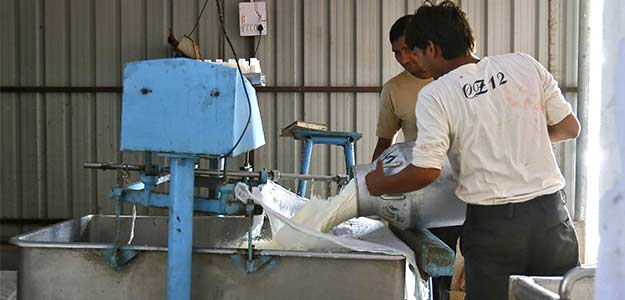
Jai Prakash Sharma looked gloomily into the chilling tanks at the Mewat milk cooperative: they are only half full these days, thanks to a delay in India's annual monsoon rains that has robbed cattle fodder of nutritious moisture.
"If there are not sufficient rains in the next few days, some farmers may start selling animals for slaughtering," said Sharma, manager of a cooperative in Haryana that supplies milk to the capital, New Delhi.
As dairy farmers fret over the risk to earnings due to the vagaries of the monsoon, the squeeze in supplies of milk is adding to inflationary pressures that Prime Minister Narendra Modi's government inherited when it came to power in May.
Even without unpredictable weather, ensuring supplies of dairy products is emerging as a long-term policy headache in a country of 1.2 billion people where a sustained period of rising incomes has changed diets and lifted demand for protein.
India's much-acclaimed dairy co-operative model helped it to emerge as the world's largest milk producer in what became known as a "white revolution".
But a system that relies on millions of farmers each owning a few low-yielding cattle, is now not enough, as India's cows' average milk yield of 2 to 3 litres per day is about one-tenth of the global average.
Earlier this month the government imposed export restrictions on a raft of farm commodities and ordered a crackdown on hoarding to control rising food prices, after wholesale price inflation hit a five-month high.
Soaring prices of basic goods such as milk and potatoes lifted retail food inflation in May to 9.40 per cent and there are fears of worse to come, with rains so far 42 per cent below normal due to the sluggish progress of the monsoon towards agricultural belts in the northwest.
Prices for dairy products, which account for nearly one-sixth of the goods in the retail food price index basket, rose by more than 11 per cent in May from the same month a year earlier.
High food inflation could persuade the Reserve Bank of India's (RBI) to prolong its hawkish monetary policy even if weather conditions eventually improve and supply pressures ease, HSBC said in a recent research report.
"To be sure, the RBI cannot address food inflation via interest rates," it said. "But the RBI still needs to contain inflation expectations in the interim, and prevent second-round effects from driving up core prices."
Long-term Supply Crisis
According to dairy industry estimates, India is facing a 1.5-2.0 per cent gap between supply and demand this summer despite total milk production increasing to 140 million tonnes in financial 2013/14, up 6 per cent from the previous year.
At the Mewat cooperative outside the capital, Sharma said that his dairy has been unable to meet demand, even after raising prices paid to farmers by 30 per cent.
Amul, the country's largest dairy cooperative with an annual turnover of more than $3 billion, raised retail prices by 5 per cent in May, but still can't match supply and demand.
"We are again considering raising procurement prices in a week or so, as there has been almost zero increase in milk supplies due to the delay in the monsoon," K. Rathnam, managing director of Amul Dairy, told Reuters by phone from the company's headquarters in the prime minister's home state, Gujarat.
Some government officials have suggested cutting the import duty on skimmed milk powder to 15-20 per cent from 60 per cent to curb rising prices, but such a step would be politically difficult because it would introduce competition for dairy farmers who are already struggling with a jump in fodder costs.
India's dairy market, of which cooperatives and companies like Nestle control about one quarter, with a host of smaller dairies supplying rural areas and small towns, has been tightening for years.
Amul says it has raised milk prices 19 times since 2006.
Farmers in Aakera village, one of the largest suppliers of milk in Mewat district, are now selling their milk to Sharma's cooperative for Rs 41.10 ($0.68) a litre, up from Rs 30.80 a year ago.
"We need big cattle farms with high-yielding cows to meet the growing demand," said Sharma. "Otherwise, we may find it difficult to buy milk even at Rs 50 a litre from farmers."
Copyright: Thomson Reuters 2014

-
Navigating Energy Crossroads: S Jaishankar's Call For Diversified Supply Chains At G20 Ministerial Meeting

As geopolitical fault lines continue to test maritime trade routes and commodity flows, Jaishankar's message remains pertinent: true economic resilience requires open markets, protected transit lines, and a genuine commitment to multilateral cooperation rather than coercion.
-
Indians Are Travelling, But Not Every Journey Is A Holiday | The Week In Whys
Pilgrims, patients and working women are the real travellers, and the system hasn't quite caught up with them.
-
Getting To Work Costs Women More | The Reason Why
It is not just about women paying more than men. It is about women paying much more in cities than in villages.
-
AI Bias In Investing Cannot Be Eliminated, But It Can Be Governed
Framing is a particularly important example as identical financial information presented in terms of gains rather than losses can lead an LLM to reach a different assessment.
-
Joining The Dots | Dark Skies, Steady Diya: Why Hope Holds This Diwali
With war, a weak rupee and foreign outflows weighing on sentiment, policymakers at the NDTV World Summit and market veterans at NDTV Profit Ignite: Diwali Edition offered the same advice: stay invested and filter out the noise.
-
The Curious Case of Equitas Small Finance Bank And A CEO Who Quit For Stock
PN Vasudevan believes persistent investor concerns over a perceived conflict of interest had become a governance overhang on Equitas Small Finance Bank's stock, even as the lender improved profitability and asset quality.
-
Talking Points This Week: AI Cash Burn, A Tiger Comeback And An India That Still Finds Its Own Path
India is not immune to higher oil or tighter global liquidity, yet its earnings base is broader, its domestic policy levers are still available.
-
Foreign Investors Own Half Of HDFC Bank and ICICI Bank. An LTCG Cut Could Matter Most Here
Foreign portfolio investors have US$115 billion parked in HDFC Bank, ICICI Bank. If the government cuts long-term capital gains tax, Jefferies says returning foreign money could land here first.
-
'Never Seen This Level Of Negativity': Sandeep Tandon Says The Next Rally May Be Closer Than You Think
Veteran investor Sandeep Tandon says foreign selling is easing, large-caps are due a comeback and mid-caps are crowded, while he turns positive on gold, power and pharma this Diwali.
-
Indians Stay With Family, Not In Hotels | The Reason Why
India still lacks enough clean, reliable and affordable hotels for budget-conscious travellers.










