Deep Concern, Dismay And Distress – Why R Chandrashekhar Quit Yes Bank’s Board

It was clear in November itself that R Chandrashekhar's exit from the Yes Bank Ltd. board was no ordinary exit. Most independent directors cite shortage of time, other commitments or such generic reasons for stepping down even when the real reasons may be quite different.
But Chandrashekhar, in a comment to Bloomberg soon after he stepped down as an independent director on Nov. 19, said, “I wasn't happy with the developments taking place in the recent past and the way it was handled.”
BloombergQuint now has a copy of the full resignation letter and it doesn't paint a pretty picture of the events that preceded the veteran bureaucrat's resignation.
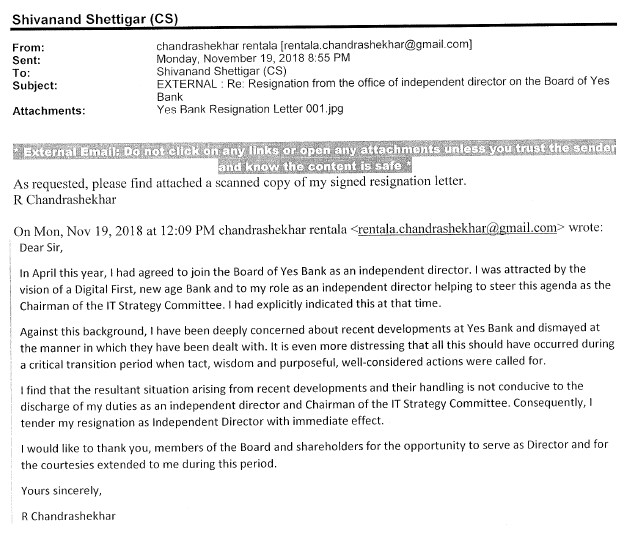
...I have been deeply concerned about recent developments at Yes bank and dismayed at the manner in which they have been dealt with. It is even more distressing that all this should have occurred during a critical transition period when tact, wisdom and purposeful, well considered actions were called for.R Chandrashekhar's Resignation Letter - MCA website
Chandrashekhar joined the Yes Bank board in April this year. The Indian Administrative Services officer has served as information technology and telecommunications secretary to the union government. He was also once the chairman of Nasscom, the IT industry body.
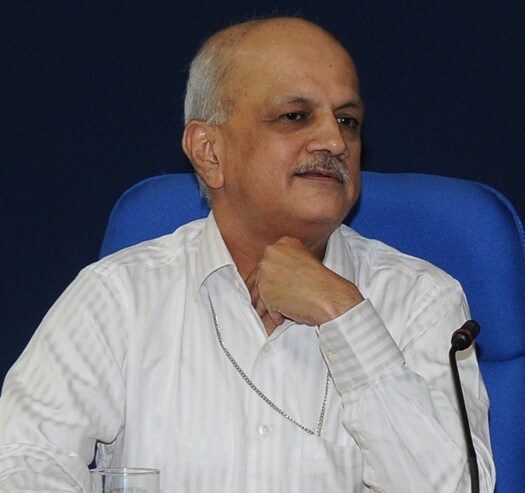
He joined the Yes Bank board “attracted by the vision of a digital first, new age bank” and the task of helping steer this vision as the an independent director and chairman of the IT Strategy Committee, his resignation letter said.
Appointed for a five-year term, Chandrashekhar's exit in seven months is an alarming turn of events. Though it's thin on specifics, the letter makes clear his dissatisfaction with the running of the board and the bank.
I find that the resultant situation arising from recent developments and their handling is not conducive to the discharge of my duties as an independent director and chairman of the IT Strategy Committee. Consequently, I tender my resignation as independent director with immediate effect.R Chandrashekhar's Resignation Letter - MCA website
Chandrashekhar's candour seems to have caught Yes Bank on the backfoot. It had first informed the stock exchanges that Chandrashekhar stepped down due to personal reasons. That statement was revised later to mention just the resignation and offered no reason for it.
When the Bombay Stock Exchange queried Yes Bank on news reports suggesting Chandrashekhar stepped down due to governance issues, the bank informed the stock exchange that it had made relevant disclosures regarding the director's resignation and that it did not comment on media speculation.
Churn At Yes Bank
Ashok Chawla
Five days before Chandrashekhar stepped down, two other independent directors did the same. One of them was the chairman of the board, also a veteran bureaucrat and a former regulator .
Ashok Chawla was appointed as independent director for a five -year term in March 2016 and then appointed non-executive part-time chairman for a three year period starting October 2016. He had a year to go as chairman and three as independent director when he stepped down.
During his time as chairman Yes Bank faced flak for two big reasons—NPA divergence issue and Rana Kapoor's leadership.
In October, RBI refused to extend the term of Rana Kapoor, the bank's co-founder and its managing director and chief executive officer.
Chawla's resignation letter said he was stepping down because the bank was going through an “organisational transition” and required somebody “who would be able to devote more time and attention to lead it through this critical phase”.
Recently, his name cropped up in a chargesheet filed by the Central Bureau of Investigation alleging wrongdoing in the purchase of shares in Aircel by Malaysian telecom major Maxis.
Vasant Gujarathi
Curiously, on the same day as Chawla's resignation, another independent director on the Yes Bank board stepped down. Vasant Gujarathi, chartered accountant and former PWC partner, was appointed to the board in April 2014 and headed the bank's audit committee.
He resigned on Nov. 14 with immediate effect, five months before his term would have ended.
Due to my personal and other professional commitments, I am not in a position to devote time as a director on the Yes Bank board. Hence I am submitting my resignation with immediate effect.Vasant Gujarathi's Resignation Letter - MCA website
He continues as director in Yes Bank Securities Ltd.
OP Bhatt
On Nov. 15, OP Bhatt, a former chairman of State Bank of India, stepped down as external expert on the Search and Selection Committee, appointed to find Kapoor's successor, with immediate effect “citing that there may be a potential conflict of interest”.
The committee was constituted on Oct. 5, on the recommendation of the bank's Nominations and Remuneration Committee. The other external member appointed was former LIC and IRDAI chairman TS Vijayan.
TS Vijayan
Curiously, Vijayan has now been appointed as a director on the Yes Bank board. That indicates there are no external members on the Search and Selection Committee. In effect, it now mirrors the NRC.

-
High US Salaries, No Green Card Certainty: The Financial Calculation Facing Indian H-1B Families

The suspension of PERM processing at eight technology employers does not cancel existing H-1B visas. What it does is force a question many Indian families have been avoiding: is the US salary worth tying your career and family plans to one employer?
-
Swiggy vs Eternal: Food Delivery's Two Rivals Are No Longer In The Same Race
Eternal is building a private AI assistant, dark.ai. Swiggy is still working out how to make Instamart pay, with an operating loss of Rs 895 crore in the July-September quarter while Blinkit stayed profitable.
-
Where You Live Shapes How You Get To Work | The Reason Why
Two-wheelers are the most popular way to get to work in India, accounting for nearly 43% of workplace commutes.
-
Unhedged Position: Can India See An Indonesia-Style Time Correction?
The Nifty is trading below levels it first clocked in 2024. Is there, then, as I have suggested in the headline, potential that the current time correction drags on painfully for the next three-five, even ten years?
-
Navigating Friction And Energy Realities: An Analysis Of Marco Rubio's October Visit To India
Occurring at a critical juncture marked by stalled trade negotiations and escalating geopolitical pressures over global energy supplies, the visit offers a profound window into modern US-India relations.
-
India Exports Capital. Why Not Export Trusteeship?
The big question, then, is whether India can build an institution that global borrowers, investors, banks, and lawyers can trust, even without an Indian connection.
-
France's Economy & Politics Are In Crisis | The Reason Why
Let's look at how the French economy and politics evolved under Nicolas Sarkozy, Franois Hollande and Emmanuel Macron.
-
You May Inherit The Business. You Must Earn Its Credibility.
Succession tests the founder's ability to share authority as much as it tests the next generation's readiness to assume it.
-
Signing Deals Is One Thing; Making Them Work Is Another | The Week In Whys
Sometimes, things don't turn out as planned. Indian companies have lost some bids to rivals, some projects won't produce until 2030.
-
FOMC Wall, PERM Suspension, Hospital Stocks | Talking Points This Week
A PERM suspension would directly affect green-card sponsorship rather than H-1B visas, so the near-term earnings impact could remain relatively limited. The key question is whether this marks a new phase in US scrutiny of Indian IT.









