War On Bad Loans Being Fought By A Headless Warrior
Banks' efforts to recover Rs 51,000 crore in bad loans haven't made much headway at a debts recovery tribunal in Mumbai as it hasn't had a full-time chief to pass decrees for nearly nine months.
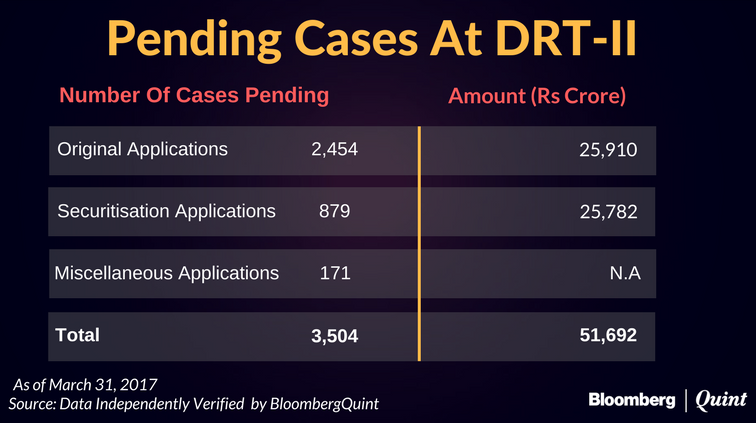
DRT II, one of the three such tribunals in the country's financial capital, had a backlog of 3,500 cases as of March 31, according to data independently verified by BloombergQuint. DRT III, too, has been without a full-time presiding officer for six months, and the head of DRT I shares the additional charge of the other two. Officials at DRT I and III refused to share the data on pending cases and recoveries involved.
DRTs are part of the debt-recovery framework in India. They are a key adjudication forum for the recovery of assets underlying bad loans at Indian banks, which at 17 percent of the total advances are the highest among major economies.
The government makes a noise about recoveries and non-performing assets but hasn't appointed presiding officers, said Menino Dias, a lawyer in a number of cases at the tribunals.
How can one expect any progress? I have seen cases in the system for 15 years.Menino Das, Lawyer
Also Read: Ordinance Gives RBI Sweeping Powers For Bad Loan Resolution
The administrative arm of each tribunals which is headed by a registrar is also not functioning at full capacity, as the post is vacant at all the three tribunals. Assistant registrars have taken charge as a stop-gap measure.
DRTs and appellate tribunals were established under the Recovery of Debts Due to Banks and Financial Institutions Act (RDDBFI Act), 1993 to expedite adjudication and recovery of banks' debts, according to its website. They are also the main adjudication forum under the The Securitisation and Reconstruction of Financial Assets and Enforcement of Security Interest Act, 2002 (SARFESI). There are 38 DRTs and five appellate tribunals in India. Appointments are made by the department of financial services of the Union Ministry of Finance.
The ministry did not respond to BloombergQuint's emailed queries.
.png "Debts recovery tribunals are housed at Scindia House in Mumbai. (Source: BloombergQuint)")
Also Read: NPA Ordinance: Extraordinary Measures For Extraordinary Times
Raghuram Rajan, then RBI governor, too had in 2014 highlighted the slow progress at DRTs.
A low disposal rate has been a perennial problem, said Deep Roy, partner, banking and finance at law firm Economic Laws Practice.
Many of our clients, being financial institutions, are exploring the resolution of disputes under the insolvency and bankruptcy code, after having tried recovery with the Debts Recovery Tribunals, through the civil procedure code and arbitration, enforcement under SARFAESI and restructuring under the various schemes provided by RBI. Such processes have been time consuming and have also not lead to resolution.Deep Roy, Partner, Banking-Finance, Economic Laws Practice
As a result there has been no respite in the stressed assets in India, Roy said. The recently enacted Insolvency and Bankruptcy Code is preferred because it provides for reviving a company and not just winding it down to recover dues, he said.
The mandate of the tribunals is to pass orders within 180 days. A public sector bank official involved in the recovery process said to BloombergQuint, on condition of anonymity, that lenders would be happy if the orders are passed even in six years. Lack of co-ordination between recovery officers and banks only adds to the delay, the official said.
Another reason for the delay could be the routine interference of the higher judiciary despite Section 18 of the RDDBFI Act which aims to prevent this from happening. Raghuram Rajan had mentioned the Supreme Court's observations regarding this practice in his 2014 speech.
It is a matter of serious concern that despite the pronouncements of this Court, high courts continue to ignore the availability of statutory remedies under the RDDBFI Act and (The Securitisation and Reconstruction of Financial Assets and Enforcement of Security Interests Act) SARFAESI Act and exercise jurisdiction under Article 226 for passing orders which have serious adverse impact on the right of banks and other financial institutions to recover their dues.Raghuram Rajan In 2014 Speech
(The DRT website as on June 6 mentioned Hari Venkata Subba Rao as the presiding officer of DRT I with additional charge of DRT II, and VN Lothey Patil as the presiding officer of DRT III. BloombergQuint has verified that Patil retired in December 2016.)

-
Navigating Energy Crossroads: S Jaishankar's Call For Diversified Supply Chains At G20 Ministerial Meeting

As geopolitical fault lines continue to test maritime trade routes and commodity flows, Jaishankar's message remains pertinent: true economic resilience requires open markets, protected transit lines, and a genuine commitment to multilateral cooperation rather than coercion.
-
Indians Are Travelling, But Not Every Journey Is A Holiday | The Week In Whys
Pilgrims, patients and working women are the real travellers, and the system hasn't quite caught up with them.
-
Getting To Work Costs Women More | The Reason Why
It is not just about women paying more than men. It is about women paying much more in cities than in villages.
-
AI Bias In Investing Cannot Be Eliminated, But It Can Be Governed
Framing is a particularly important example as identical financial information presented in terms of gains rather than losses can lead an LLM to reach a different assessment.
-
Joining The Dots | Dark Skies, Steady Diya: Why Hope Holds This Diwali
With war, a weak rupee and foreign outflows weighing on sentiment, policymakers at the NDTV World Summit and market veterans at NDTV Profit Ignite: Diwali Edition offered the same advice: stay invested and filter out the noise.
-
The Curious Case of Equitas Small Finance Bank And A CEO Who Quit For Stock
PN Vasudevan believes persistent investor concerns over a perceived conflict of interest had become a governance overhang on Equitas Small Finance Bank's stock, even as the lender improved profitability and asset quality.
-
Talking Points This Week: AI Cash Burn, A Tiger Comeback And An India That Still Finds Its Own Path
India is not immune to higher oil or tighter global liquidity, yet its earnings base is broader, its domestic policy levers are still available.
-
Foreign Investors Own Half Of HDFC Bank and ICICI Bank. An LTCG Cut Could Matter Most Here
Foreign portfolio investors have US$115 billion parked in HDFC Bank, ICICI Bank. If the government cuts long-term capital gains tax, Jefferies says returning foreign money could land here first.
-
'Never Seen This Level Of Negativity': Sandeep Tandon Says The Next Rally May Be Closer Than You Think
Veteran investor Sandeep Tandon says foreign selling is easing, large-caps are due a comeback and mid-caps are crowded, while he turns positive on gold, power and pharma this Diwali.










