Debt Restructuring Talks With India Were "Successful": Sri Lanka President
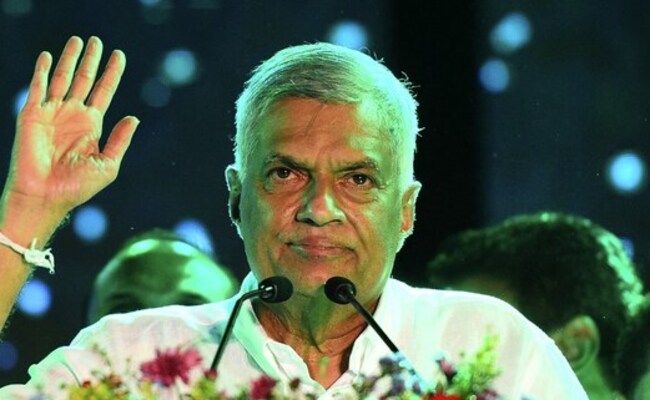
Forex-starved Sri Lanka has held "successful" talks with India on debt restructuring and it will also begin discussions with China, President Ranil Wickremesinghe has said, as the island nation scrambles to get assurances from major bilateral creditors to close a crucial deal with the IMF.
Sri Lanka, which is trying to secure a $2.9 billion bridge loan from the International Monetary Fund (IMF), is also looking at financial assurances from its major creditors -- China, Japan and India -- which is the requisite for Colombo to get the bailout package.
"We have initiated discussions with our bilateral creditors. Had very successful talks with India, and will also begin talks with China," Ranil Wickremesinghe said during the inaugural session of the Sri Lanka Economic Summit 2022 on Monday.
Sri Lanka has large debt rollover volumes (Gross Financing Need) running up to 37 per cent of GDP in 2022, which the IMF wants to bring down, according to the EconomyNext news portal.
The exact GFN target is not known, but other countries under restructuring have levels around 15 per cent, and some less, it said.
China, however, continues to be ambivalent about its stand on loans to Sri Lanka as it is set for talks with the IMF for debt restructuring of several recipient countries of Chinese finances, which are defaulting on their external debt.
Sri Lanka, which went bankrupt earlier this year, had announced a default on over $51 billion in foreign loans, including that of China.
China has also announced assistance of 500 million RMB (about $74 million) for the supply of essential goods, but it remained silent about former Lanka president Gotabaya Rajapaksa's request to defer the loan repayment.
When asked about its stand during talks with the IMF to restructure Chinese loans to Sri Lanka, Chinese Foreign Ministry spokesperson, Mao Ning reiterated Beijing's stand that it supports financial institutions to solve Colombo's financial crisis.
"On Sri Lanka's debt issue, I would like to stress that China attaches high importance to Sri Lanka's difficulties and challenges," she told a media briefing here on Monday.
"We support the financial institutions in working out ways with Sri Lanka to properly solve the issue. We also hope relevant countries and international financial institutions will work with China and continue to play a constructive role in helping Sri Lanka overcome the current difficulties, ease its debt burden and realise sustainable development," she added.
India has rushed about $4 billion in assistance in the form of line credit and other modes to help Sri Lanka this year, which has virtually declared insolvency and defaulted on all foreign loans.
In November, Sri Lanka said it held a "productive" second round of crucial talks with its bilateral creditors.
Sri Lanka is going through its worst economic crisis since its independence in 1948, triggered by a severe paucity of foreign exchange reserves.
In mid-April, Sri Lanka declared its international debt default due to the forex crisis.
The Sri Lankan government in May appointed international legal and debt advisors for debt restructuring after the country declared its international debt default for the first time in history.
Sri Lanka is nearly bankrupt and has suspended repaying its $51 billion foreign debt, of which it must repay $28 billion by 2027.
Sri Lanka, a country of 22 million people, plunged into financial and political turmoil earlier this year as it faced a shortage of foreign currencies.
Due to this, the country has been unable to afford key imports, including fuel, fertilisers and medicine, leading to serpentine queues
(Except for the headline, this story has not been edited by NDTV staff and is published from a syndicated feed.)

-
Swiggy vs Eternal: Food Delivery's Two Rivals Are No Longer In The Same Race

Eternal is building a private AI assistant, dark.ai. Swiggy is still working out how to make Instamart pay, with an operating loss of Rs 895 crore in the July-September quarter while Blinkit stayed profitable.
-
Where You Live Shapes How You Get To Work | The Reason Why
Two-wheelers are the most popular way to get to work in India, accounting for nearly 43% of workplace commutes.
-
High US Salaries, No Green Card Certainty: The Financial Calculation Facing Indian H-1B Families
The suspension of PERM processing at eight technology employers does not cancel existing H-1B visas. What it does is force a question many Indian families have been avoiding: is the US salary worth tying your career and family plans to one employer?
-
Unhedged Position: Can India See An Indonesia-Style Time Correction?
The Nifty is trading below levels it first clocked in 2024. Is there, then, as I have suggested in the headline, potential that the current time correction drags on painfully for the next three-five, even ten years?
-
Navigating Friction And Energy Realities: An Analysis Of Marco Rubio's October Visit To India
Occurring at a critical juncture marked by stalled trade negotiations and escalating geopolitical pressures over global energy supplies, the visit offers a profound window into modern US-India relations.
-
India Exports Capital. Why Not Export Trusteeship?
The big question, then, is whether India can build an institution that global borrowers, investors, banks, and lawyers can trust, even without an Indian connection.
-
France's Economy & Politics Are In Crisis | The Reason Why
Let's look at how the French economy and politics evolved under Nicolas Sarkozy, Franois Hollande and Emmanuel Macron.
-
You May Inherit The Business. You Must Earn Its Credibility.
Succession tests the founder's ability to share authority as much as it tests the next generation's readiness to assume it.
-
Signing Deals Is One Thing; Making Them Work Is Another | The Week In Whys
Sometimes, things don't turn out as planned. Indian companies have lost some bids to rivals, some projects won't produce until 2030.
-
FOMC Wall, PERM Suspension, Hospital Stocks | Talking Points This Week
A PERM suspension would directly affect green-card sponsorship rather than H-1B visas, so the near-term earnings impact could remain relatively limited. The key question is whether this marks a new phase in US scrutiny of Indian IT.









