Debt Ceiling in Focus as Banking Turmoil Persists: Credit Weekly
(Bloomberg) -- As the regional bank turmoil continues and markets digest the Federal Reserve's latest rate hike, investors and executives are turning to the next big question: What if lawmakers fail to resolve the standoff around the US debt ceiling?
That scenario — though considered unlikely by many — is attracting attention as the outlook for the economy darkens. With ongoing pressures on smaller lenders, slowing growth and rising financing costs, the wrangling over increasing the $31.4 trillion statutory limit could roil markets further.
President Joe Biden has invited congressional leaders for a May 9 meeting after Treasury Secretary Janet Yellen suggested that the so-called X-date, after which the US might exhaust its options to fund itself, could come as early as June 1 — less than a month away.
Bank analysts and ratings firms are forecasting a substantial hit to credit markets, depending on how long the political standoff lasts, and how it ends.
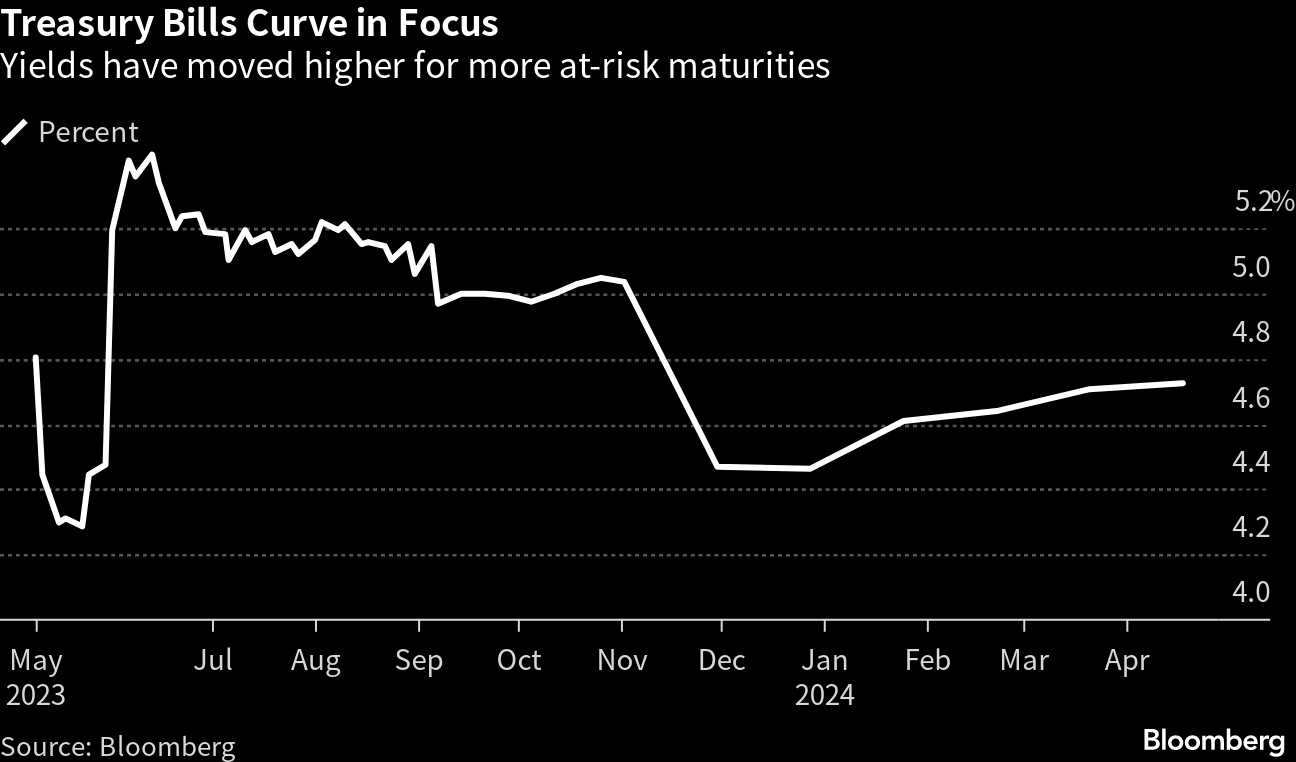
Bank of America Corp. analysts expect market stress around the borrowing limit to build in the coming weeks, potentially resulting in risk-off sentiment among investors. Treasury bill markets are already showing significant signs of worry around the potential for non-payment of US debts in early June.
“The bill curve now shows a more pronounced ‘hump' the first week of June,” Bank of America analysts Mark Cabana, Katie Craig and Ralph Axel wrote in a May 4 note to clients.
Market participants will likely revise their forecasts and models in the coming weeks as the date nears. Traders are weighing a range of scenarios, including a suspension or a temporary extension of the limit.
But, even if there is an agreement to raise the ceiling before the cutoff date, there will be an impact on vulnerable issuers, especially if there are cuts to government spending, Moody's Investors Service said.
“We see the debt ceiling as a tactical risk to our more bullish call on spreads,” analysts at CreditSights Inc. wrote, pointing to previous standoffs that caused spreads to widen even after they were resolved.
Asset owners already appear to be preparing for spreads to move out. US junk-bond funds saw $1.58 billion in outflows during the week ended May 3, while investment-grade funds added $321.6 million, according to Refinitiv Lipper.
A missed interest payment in a no-deal scenario would cause a downgrade in the US AAA rating and have widespread rating impacts on government-sponsored enterprises such as Fannie Mae, Freddie Mac and the Federal Home Loan Banks system, as well as not-for-profit hospitals and public entities, Moody's said.
Wider knock-on effects on banks, insurers, clearing houses, bond funds and money markets are also expected, the ratings firm said, pointing to the risk of elevated redemptions, which would put pressure on liquidity.
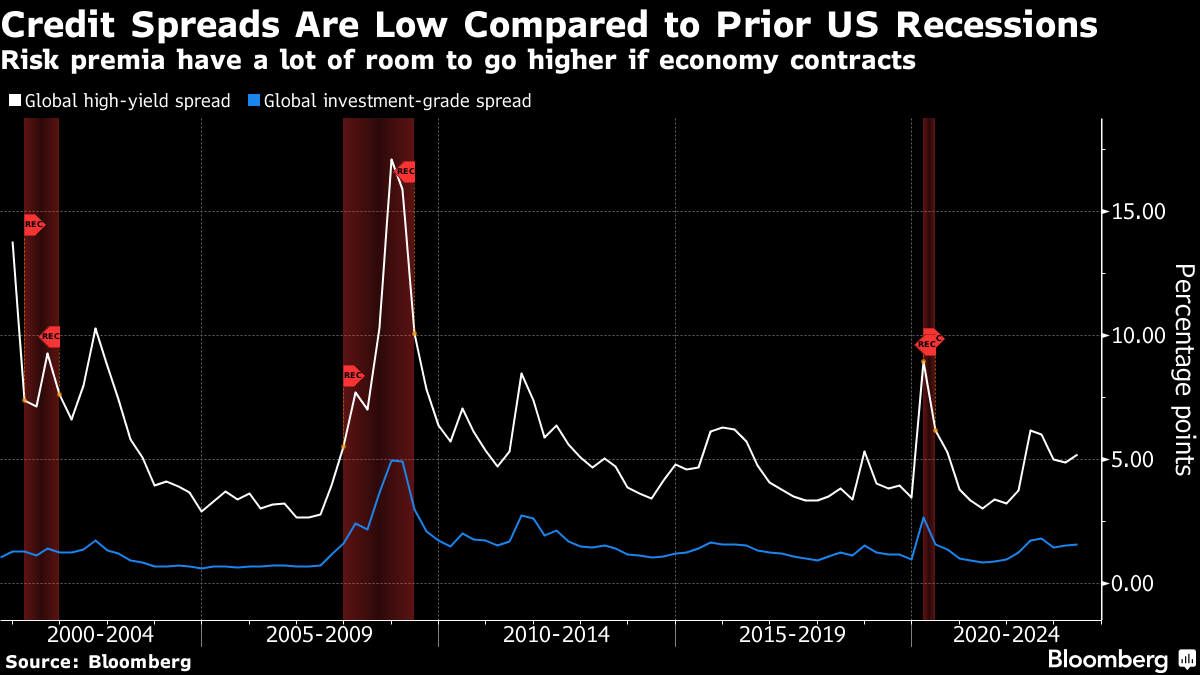
High quality investment-grade rated bonds however could become more appealing compared with other asset classes, as investors seek safe havens. Those names will likely see little to no credit impact, according to Moody's. Investment-grade credit spreads stood at 146 basis points more than Treasuries on Friday — up from 138 basis points on May 1 — while high-yield spreads rose to 471 basis points, up from 439 basis points on May 1.
Corporate executives so far have said they remain confident that lawmakers will figure out a solution for the issue around the debt ceiling. “I do think it will resolve itself, but there'll be a lot of noise up until that occurs,” said Kevan Krysler, the finance chief of Pure Storage Inc., a data storage firm, echoing comments from other company leaders.
For more on how tighter money is crushing credit markets, listen to the latest episode of the Credit Edge Podcast.
Elsewhere:
- Participants in the $1.4 trillion private-credit industry acknowledged this week at the Milken Institute Global Conference in Beverly Hills that their business is facing its biggest challenge yet. Many companies that relied heavily on direct lenders for funding in recent years are now wrestling with a dramatic increase in the cost of servicing their loans. Read more here about the mood at the Milken Institute Global Conference in Beverly Hills.
- KWG Group became the latest Chinese builder to default on yuan-denominated borrowings, sending its shares and dollar bonds to a record decline. The default could continue to test the shaky liquidity of KWG's developer peers, according to Bloomberg Intelligence analyst Kristy Hung. An affiliate of Chinese developer Sino Ocean Group is proposing to extend a coupon due in April to October.
- Another Chinese developer, Logan Group, shared fresh details with some creditors about a possible offshore-debt restructuring proposal that could include a debt-to-equity swap option, Bloomberg News reported.
- Adani Transmission Ltd., part of Indian billionaire Gautam Adani's conglomerate, plans to buy back as much as $100 million of bonds issued by a unit in an effort to boost investor confidence, P R Sanjai and Saikat Das reported.
- Holders of about 86% of eligible bonds from WeWork Inc. agreed to swap their notes for new debt and equity as the office-sharing company looks to cut debt to move toward profitability.
- Europe's technology, media and telecommunications companies are set to struggle when it comes to refinancing after several years of heavy investment swelled debt loads in the sector, according to research by Boston Consulting Group. The firm highlighted TMT, along with leisure and tourism, as industries that will find it most difficult to refinance in an environment of higher interest rates.
--With assistance from Lorretta Chen, Bruce Douglas, Benjamin Purvis, James Crombie and Natalie Harrison.
More stories like this are available on bloomberg.com
©2023 Bloomberg L.P.

-
Ten Things I Learnt This Samvat

Patience can be a trap. Cheap stocks can stay cheap. Leverage can wipe you out. What did Samvat 2082 teach us? Niraj Shah writes on 10 lessons from the year gone by.
-
Talking Points This Week: Tech Nerves, FII Buying, And A Faraway Banking Shock
The global markets are not shining this Diwali. The exception in the large markets is, India.
-
Midterm Rally Lasted A Day. The Hard Reality Of A Divided US May Last Two Years | Opinion
Between a contested AI boom, a debt ceiling that arrives in 2027 and a president with every incentive to act alone, the next two years may prove more volatile than the first day's rally suggests.
-
Blue Wave Will Derail the AI Trade but Won't Dismantle the AI Era | Unhedged Position
The Democrats' sweep of the US Congress will see politics collide with economic forces both over the long and short term.
-
It's Time To Take The GST Council's Bet On Trust Global
Payment records can prove India's services exports, and clear, proportionate rules can bring foreign digital sellers into the tax net.
-
Opinion | India at 38: From Innovation Overperformer to Innovation Powerhouse
India now has 453 VC-backed deep science startups, 18 of them late-stage, after 117 percent growth since 2020. Laurus Labs, at USD 9.3 billion, is the most valuable deep science company in any middle-income economy outside China.
-
Navigating Energy Crossroads: S Jaishankar's Call For Diversified Supply Chains At G20 Ministerial Meeting
As geopolitical fault lines continue to test maritime trade routes and commodity flows, Jaishankar's message remains pertinent: true economic resilience requires open markets, protected transit lines, and a genuine commitment to multilateral cooperation rather than coercion.
-
Indians Are Travelling, But Not Every Journey Is A Holiday | The Week In Whys
Pilgrims, patients and working women are the real travellers, and the system hasn't quite caught up with them.
-
Getting To Work Costs Women More | The Reason Why
It is not just about women paying more than men. It is about women paying much more in cities than in villages.









