Banking Crises Are a Bad Look for Louis Vuitton and Gucci
(Bloomberg Opinion) -- When a butterfly flaps its wings on a Gucci bag in San Francisco, shoppers in Shanghai feel the breeze.
The recent banking drama, starting with Silicon Valley Bank earlier in the month and spreading to Credit Suisse Group AG last week, has roiled markets, sparking fears of further contagion. None of this is good news for the big European luxury companies, led by the world's largest, LVMH Moet Hennessy Louis Vuitton SE.
With European and US consumers under pressure, there is even more need for Chinese shoppers to pick up the bling baton, and there is no guarantee they will revenge-spend like they did three years ago.
Although European markets stabilized on Monday after early falls, stock gyrations are never good.
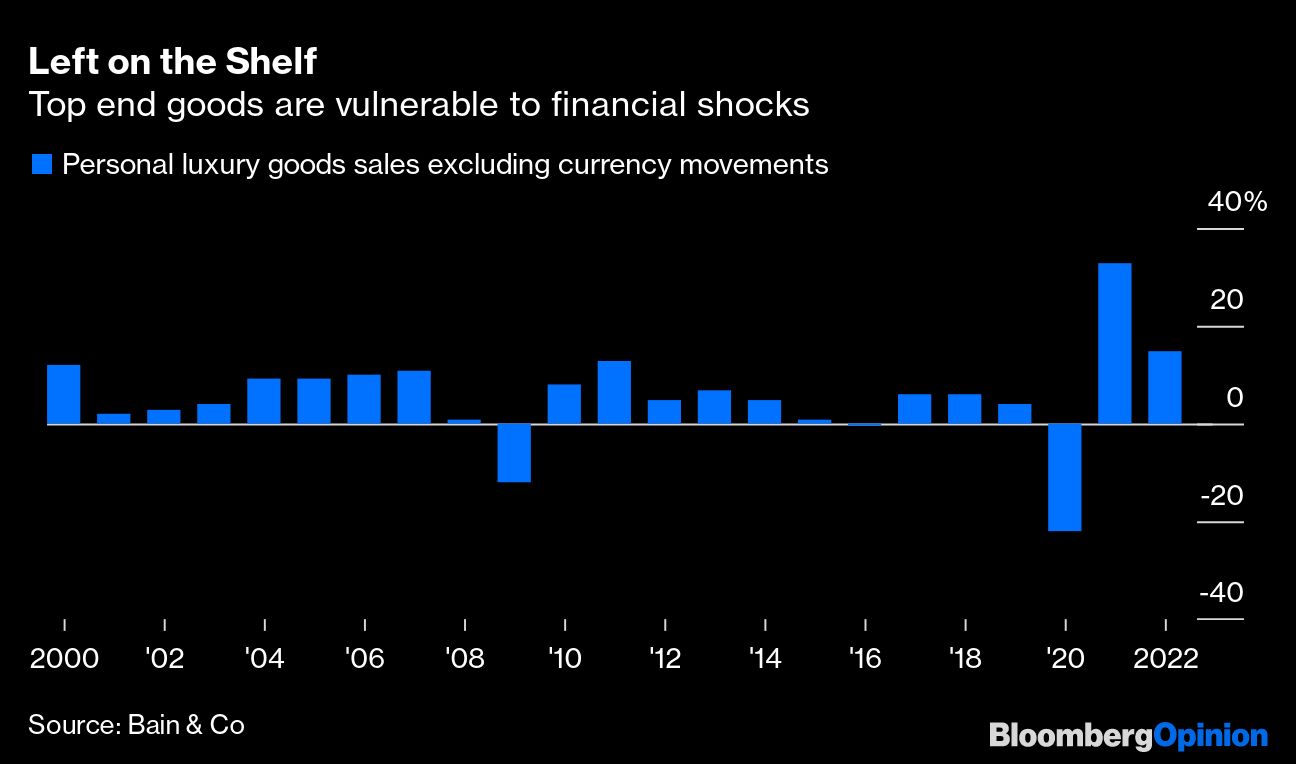
The luxury industry does well when its customers feel happy and wealthy. Shocks are particularly painful. Shoppers reined in their appetite for Louis Vuitton bags and Prada shoes after both the 2008 financial crisis and China's crackdown on conspicuous consumption in 2015.

Already, companies such as Burberry Group Plc and Gucci-owner Kering SA have pointed to a slowdown in demand among younger, more aspirational customers, particularly in the US. Potential job losses in finance on top of the cuts in tech make the outlook for the middle class even more uncertain. That's bad news for the sorts of retailers that cater to them, such as Hugo Boss AG.
The big danger is if this caution spreads to the super-wealthy. So far, they have been living in a different economic world, seemingly undisturbed by inflation and the threat of a major downturn. But their propensity to buy is closely correlated to the performance of asset classes such as property and stocks. Amid a backdrop of financial turbulence or recession, they may not want to splurge even if they can afford to.
So far, luxury companies have seen little impact beyond the slowdown in the US that was already in evidence. But whether the picture deteriorates over the next days or weeks is worth watching. Much will depend on whether banking-sector troubles are contained.
LVMH reports sales next month. In the meantime, one indicator of how the richest are feeling may be the prices of Rolex watches on the secondary market. These have stabilized over the past few months, along with Bitcoin. But the recent jitters could encourage a fresh wave of selling by leveraged collectors.
Another signpost may be whether companies can continue to raise prices in their retail stores. New luxury goods, from Rolex watches to Chanel handbags, have gotten more expensive over the past year or so. It may become harder to push costs further if there are no queues outside stores in high-end shopping streets.

If concerns about financial stability do weigh on top-end demand, not all luxury groups will be hit equally.
Hermes International looks best placed. It has a high exposure to Asia — almost 60% of sales last year, according to Bloomberg data — and with long waiting lists for its Kelly and Birkin bags, it can keep consumption stable even if broader appetite dips.
LVMH, meanwhile, is particularly exposed to the pressured US market: 27% of its sales came from the US last year. But it owns two of the industry's biggest names, Louis Vuitton and Dior, and its scale dwarfs rivals. That gives it scope to invest to keep its brands at the forefront of consumers' minds. It is also diversified through beauty retailer Sephora and its drinks business.
Companies in turnaround mode, such as Burberry and Kering, look more vulnerable.
Even before recent events, investors expected demand in both Europe and the US to moderate this year. But the turbulence risks a harder landing. That puts more pressure on Chinese shoppers to step in to purchase Cartier watches and Dior bags.
So far, China's reopening looks promising, with Prada SpA the latest to point to strong trading in the country. But this needs to continue apace to keep up big bling's momentum. After the chaos in Zurich, European luxury is counting on Chinese consumers to hop on a plane to Paris or Milan and spend with abandon.
More From Bloomberg Opinion:
- What You Can and Can't Criticize UBS For on Credit Suisse: Chris Hughes
- Credit Suisse Bailout Crosses a Debt Rubicon: Marcus Ashworth
- Why Fed Rate Increases Are Hitting All at Once: Paul J. Davies
This column does not necessarily reflect the opinion of the editorial board or Bloomberg LP and its owners.
Andrea Felsted is a Bloomberg Opinion columnist covering consumer goods and the retail industry. Previously, she was a reporter for the Financial Times.
More stories like this are available on bloomberg.com/opinion
©2023 Bloomberg L.P.

-
Opinion | India at 38: From Innovation Overperformer to Innovation Powerhouse

India now has 453 VC-backed deep science startups, 18 of them late-stage, after 117 percent growth since 2020. Laurus Labs, at USD 9.3 billion, is the most valuable deep science company in any middle-income economy outside China.
-
Navigating Energy Crossroads: S Jaishankar's Call For Diversified Supply Chains At G20 Ministerial Meeting
As geopolitical fault lines continue to test maritime trade routes and commodity flows, Jaishankar's message remains pertinent: true economic resilience requires open markets, protected transit lines, and a genuine commitment to multilateral cooperation rather than coercion.
-
Indians Are Travelling, But Not Every Journey Is A Holiday | The Week In Whys
Pilgrims, patients and working women are the real travellers, and the system hasn't quite caught up with them.
-
Getting To Work Costs Women More | The Reason Why
It is not just about women paying more than men. It is about women paying much more in cities than in villages.
-
AI Bias In Investing Cannot Be Eliminated, But It Can Be Governed
Framing is a particularly important example as identical financial information presented in terms of gains rather than losses can lead an LLM to reach a different assessment.
-
Joining The Dots | Dark Skies, Steady Diya: Why Hope Holds This Diwali
With war, a weak rupee and foreign outflows weighing on sentiment, policymakers at the NDTV World Summit and market veterans at NDTV Profit Ignite: Diwali Edition offered the same advice: stay invested and filter out the noise.
-
The Curious Case of Equitas Small Finance Bank And A CEO Who Quit For Stock
PN Vasudevan believes persistent investor concerns over a perceived conflict of interest had become a governance overhang on Equitas Small Finance Bank's stock, even as the lender improved profitability and asset quality.
-
Talking Points This Week: AI Cash Burn, A Tiger Comeback And An India That Still Finds Its Own Path
India is not immune to higher oil or tighter global liquidity, yet its earnings base is broader, its domestic policy levers are still available.
-
Foreign Investors Own Half Of HDFC Bank and ICICI Bank. An LTCG Cut Could Matter Most Here
Foreign portfolio investors have US$115 billion parked in HDFC Bank, ICICI Bank. If the government cuts long-term capital gains tax, Jefferies says returning foreign money could land here first.










