Credit Suisse Shows Banks Still Need More Capital
(Bloomberg Opinion) -- Yet again, trouble at a big European bank, this time Credit Suisse Group AG, is roiling markets. Concerns about the cost of an expected restructuring have sent its share price gyrating wildly, leading both executives and analysts to appeal for calm and emphasize that the bank is among the best capitalized of its peers.
If only that comparison were more reassuring. As the tempest surrounding Credit Suisse demonstrates, the world's largest banks remain too fragile — a long-running shortcoming that policy makers must address.
Bank capital plays a crucial role in the financial system and the broader economy. It's not, as often portrayed, cash set aside for a rainy day. It's equity from shareholders, money that can be used to make loans and other investments. As opposed to debt, it has the advantage of absorbing losses. The more banks have, the better they're able to take risks, make loans, prevent contagion, transmit monetary policy and generally promote prosperity.
The biggest global banks have a lot more capital than they did when the last major crisis hit in 2008, and Credit Suisse does indeed stand out. As of June, its leverage ratio — a relatively simple measure of capital as a share of assets — was 6.1%, significantly higher than those of systemically important European peers such as BNP Paribas SA and Deutsche Bank AG.
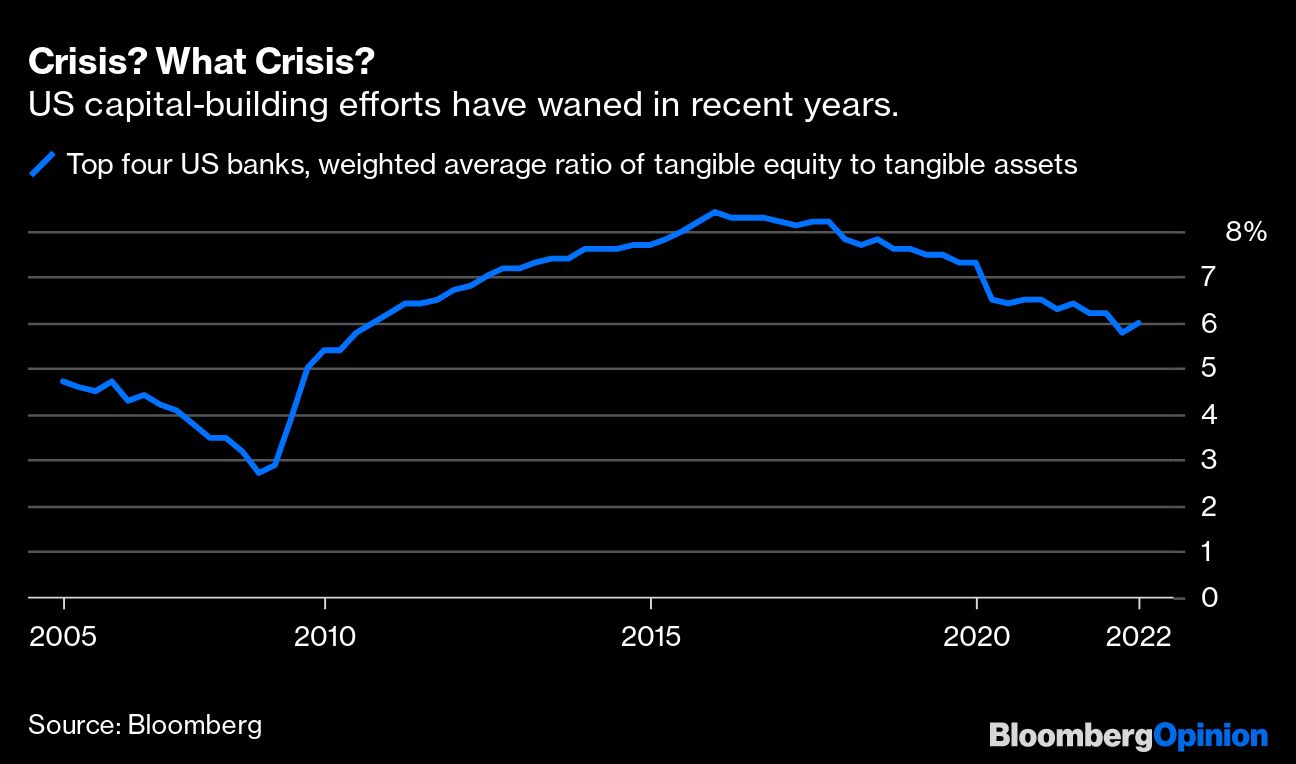
In the US, levels are likewise much improved since the financial crisis, though they've declined somewhat in recent years. For the four largest US banks, the weighted average ratio of tangible equity to tangible assets stood at 6% in June, down from a peak of 8.4% in 2015. (That's not exactly comparable to European banks, due to differing definitions of assets and capital.)

Problem is, experience and research suggest they'd all need a lot more to survive a severe crisis and still have enough left to inspire confidence. Back in 2009, during the darkest days of the subprime mortgage bust, the International Monetary Fund projected that total losses on loans and securities would amount, on average, to almost 8% in the US and Europe. Some research suggests they'd need about twice that much capital to bring the probability of bailouts down to an acceptable level.
This fragility has consequences even in relatively calm times, allowing what could have been manageable issues — such as the possible multi-billion-dollar cost of Credit Suisse's yet-to-be-detailed restructuring, coming after last year's $5.5 billion loss related to the implosion of Archegos Capital Management — to morph into mini-crises. And at a moment when the combination of a global pandemic, an energy emergency and the war in Ukraine have increased governments' debts and reduced their capacity to undertake bailouts, it leaves the whole financial system unduly vulnerable.
The prescription for policy makers in the US and Europe is simple: Hold the line on capital, and keep pushing for more. The danger of having too little far exceeds that of demanding too much.
More From Bloomberg Opinion:
- No, Credit Suisse Isn't on the Brink: Paul J. Davies
- RBA Sends Up an Interest-Rate Flare. Let's Hope It's Seen: Daniel Moss
- Do You Know How Much Parenthood Will Cost You?: Erin Lowry
The Editors are members of the Bloomberg Opinion editorial board.
More stories like this are available on bloomberg.com/opinion
©2022 Bloomberg L.P.

-
Love, Sex Aur Dhokha: The Audacious Plot To Spy On Jensen Huang

A Taipei dinner, a Singapore chip buyer and a suspected Chinese asset: inside the alleged spy operation that got close to NVIDIA's Jensen Huang.
-
Ten Things I Learnt This Samvat
Patience can be a trap. Cheap stocks can stay cheap. Leverage can wipe you out. What did Samvat 2082 teach us? Niraj Shah writes on 10 lessons from the year gone by.
-
Talking Points This Week: Tech Nerves, FII Buying, And A Faraway Banking Shock
The global markets are not shining this Diwali. The exception in the large markets is, India.
-
Midterm Rally Lasted A Day. The Hard Reality Of A Divided US May Last Two Years | Opinion
Between a contested AI boom, a debt ceiling that arrives in 2027 and a president with every incentive to act alone, the next two years may prove more volatile than the first day's rally suggests.
-
Blue Wave Will Derail the AI Trade but Won't Dismantle the AI Era | Unhedged Position
The Democrats' sweep of the US Congress will see politics collide with economic forces both over the long and short term.
-
It's Time To Take The GST Council's Bet On Trust Global
Payment records can prove India's services exports, and clear, proportionate rules can bring foreign digital sellers into the tax net.
-
Opinion | India at 38: From Innovation Overperformer to Innovation Powerhouse
India now has 453 VC-backed deep science startups, 18 of them late-stage, after 117 percent growth since 2020. Laurus Labs, at USD 9.3 billion, is the most valuable deep science company in any middle-income economy outside China.
-
Navigating Energy Crossroads: S Jaishankar's Call For Diversified Supply Chains At G20 Ministerial Meeting
As geopolitical fault lines continue to test maritime trade routes and commodity flows, Jaishankar's message remains pertinent: true economic resilience requires open markets, protected transit lines, and a genuine commitment to multilateral cooperation rather than coercion.
-
Indians Are Travelling, But Not Every Journey Is A Holiday | The Week In Whys
Pilgrims, patients and working women are the real travellers, and the system hasn't quite caught up with them.