Covid-19 Second Wave: Food, Cash Transfers First Line Of Defence
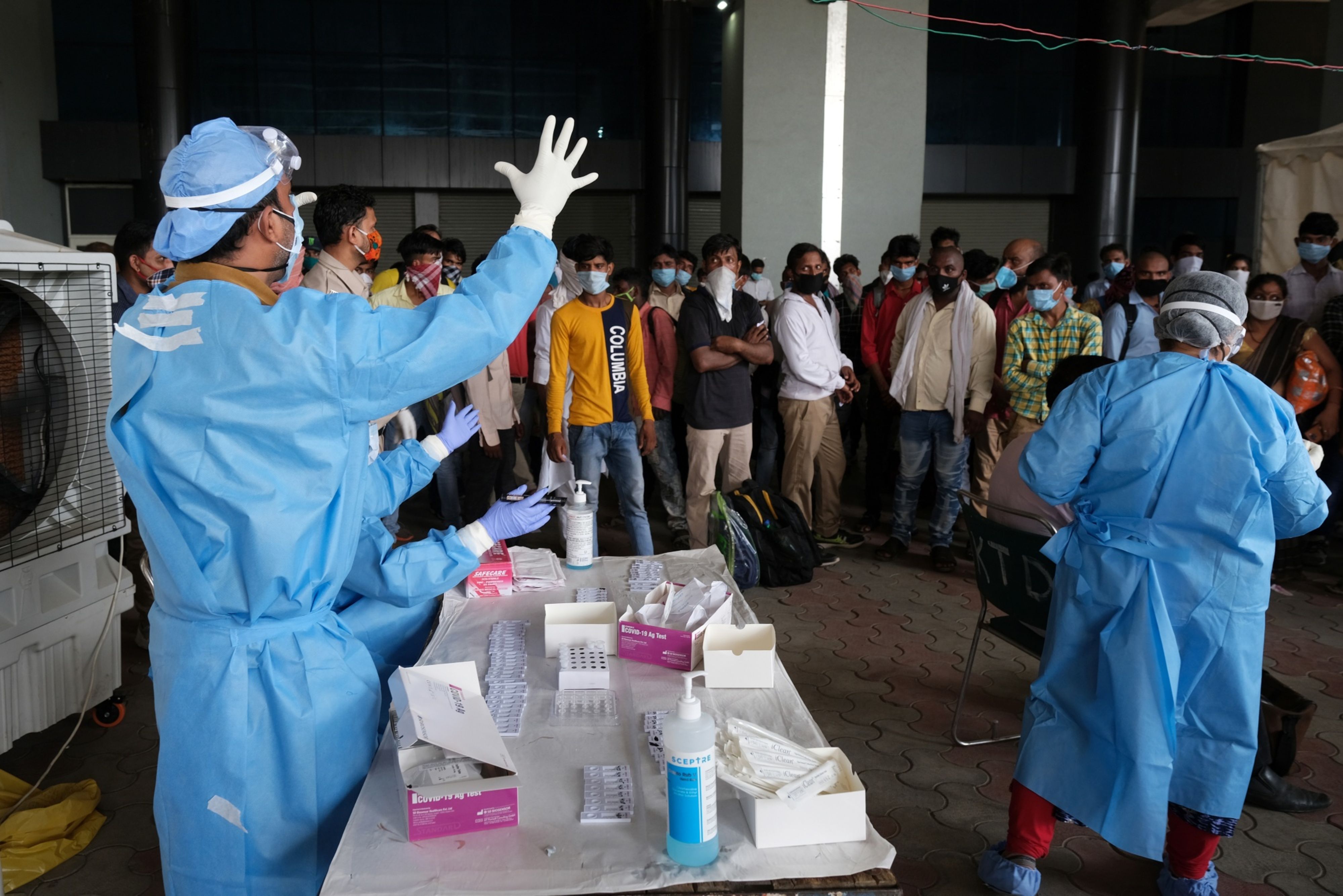
As the second wave of Covid-19 infections stretches out and spreads across the country, policymakers will need to use food and cash transfers to help out the most vulnerable sections of society. While the government has stayed away from a nationwide lockdown, local curbs and the fear of a spreading virus are having an impact on daily wage earners across a number of sectors.
So far, the central government has announced an extension of its food transfer scheme. Five kilograms of food grains per-person per-month will be given out to an estimated 800 million Indians free of cost in May and June. The transfers are expected to cost the government Rs 26,000 crore. No cash transfers have been announced as yet by the central government.
“There is economic distress and hardship that is not visible right now because the health crisis has (rightly so) occupied mainstream media,” said Reetika Khera, associate professor of economics at IIT-Delhi, arguing in favour of an expanded food transfer programme. The stocks of grains with the Food Corporation of India are plenty and the government has the ability to provide more relief, said Khera.
Khera, who has long argued that free food transfers need to go beyond grains, said that dal, rice and cooking oil should be provided as a norm or at least in the current scenario.
For urban workers who do not have ration cards, the government should consider setting up community kitchens to help those who have yet again lost their livelihoods...It could provide dry ration kits or cooked food to prevent overcrowding.Reetika Khera, Associate Professor-Economics, IIT-Delhi
Some states have done so.
Maharashtra has announced that it would provide free meals under it's Shiv Bhojan scheme over the next month. States such as Chhattisgarh and Tamil Nadu have been running community kitchens even before the pandemic.
Experience With Food Transfers
Research has shown that the government's food transfer programme last year reached the targeted segment of the population, albeit with some glitches.
About 91% of rural and 67% of urban households with ration cards reported receiving at least some food via the public distribution system, according to a survey by the Centre of Sustainable Employment at the Azim Premji University. But only 27% of the eligible households reported receiving the full entitlement under the Pradhan Mantri Garib Kalyan Yojana.
The lessons to be drawn are that PDS had a wide reach (wider in rural areas) and overall 68% of households did receive at least some extra grains, though, obviously, the number should have been higher.Amit Basole, Associate Professor-Economics, School of Arts and Sciences, Azim Premji University
Need For Cash Transfers
With the second wave of infections spreading, economists say that transfers may be needed as well.
So far, only a few states like Maharashtra have announced cash transfer of Rs 1,500 targeted towards construction workers, registered hawkers, rickshaw drivers, among others. The Delhi government has disbursed Rs 5,000 to registered construction workers.
The experience with the central government's cash transfer programme was mixed. The APU survey showed that about 70% of the survey's respondents said they had received some cash. The transfer was conditional on households having a woman owned Jan-Dhan account. Also, only 32% of account holding households had received all three transfers as of October-November 2020.
Himanshu, associate professor at the School of Social Sciences at JNU, said the past year has been a difficult one with several employment intensive sectors unable to recover completely from the first wave. This had left workers in much need of assistance. He recommends that, as a first step, the food transfers be extended for a year.
Room For Support
Last year, the nationwide shutdown had led to a sharp fall in government revenues, making it tougher for the administration to extend support. However, an economic recovery helped improve the fiscal position of the central and state governments. This should allow for greater room to provide any support needed.
In particular, the fiscal position of states is better than anticipated with a fiscal deficit of 3.3% of GDP being targeted for FY22. This is below the 4% deficit that states can go up to as per the Finance Commission's recommendations.
Greater fiscal headroom, together with the localised nature of lockdowns, mean that states may be best placed to be the first line of defence amid the second wave.
Last time we had a national lockdown and so it made sense for a central fiscal and monetary policy led response, said Sajjid Chinoy, chief India economist at JPMorgan. This time the shock is so asymmetric that state specific relief seems to be the optimal response, he said.
The focus in the next two months needs to be to impart relief urgently, said Chinoy, adding that this should be done by states, backstopped by the central government.

-
Opinion | India at 38: From Innovation Overperformer to Innovation Powerhouse

India now has 453 VC-backed deep science startups, 18 of them late-stage, after 117 percent growth since 2020. Laurus Labs, at USD 9.3 billion, is the most valuable deep science company in any middle-income economy outside China.
-
Navigating Energy Crossroads: S Jaishankar's Call For Diversified Supply Chains At G20 Ministerial Meeting
As geopolitical fault lines continue to test maritime trade routes and commodity flows, Jaishankar's message remains pertinent: true economic resilience requires open markets, protected transit lines, and a genuine commitment to multilateral cooperation rather than coercion.
-
Indians Are Travelling, But Not Every Journey Is A Holiday | The Week In Whys
Pilgrims, patients and working women are the real travellers, and the system hasn't quite caught up with them.
-
Getting To Work Costs Women More | The Reason Why
It is not just about women paying more than men. It is about women paying much more in cities than in villages.
-
AI Bias In Investing Cannot Be Eliminated, But It Can Be Governed
Framing is a particularly important example as identical financial information presented in terms of gains rather than losses can lead an LLM to reach a different assessment.
-
Joining The Dots | Dark Skies, Steady Diya: Why Hope Holds This Diwali
With war, a weak rupee and foreign outflows weighing on sentiment, policymakers at the NDTV World Summit and market veterans at NDTV Profit Ignite: Diwali Edition offered the same advice: stay invested and filter out the noise.
-
The Curious Case of Equitas Small Finance Bank And A CEO Who Quit For Stock
PN Vasudevan believes persistent investor concerns over a perceived conflict of interest had become a governance overhang on Equitas Small Finance Bank's stock, even as the lender improved profitability and asset quality.
-
Talking Points This Week: AI Cash Burn, A Tiger Comeback And An India That Still Finds Its Own Path
India is not immune to higher oil or tighter global liquidity, yet its earnings base is broader, its domestic policy levers are still available.
-
Foreign Investors Own Half Of HDFC Bank and ICICI Bank. An LTCG Cut Could Matter Most Here
Foreign portfolio investors have US$115 billion parked in HDFC Bank, ICICI Bank. If the government cuts long-term capital gains tax, Jefferies says returning foreign money could land here first.










