Indian Companies' Profits Rebound After World's Biggest Lockdown

Profits at Indian companies have rebounded from the worst decline in at least a decade amid signs of an economic recovery.
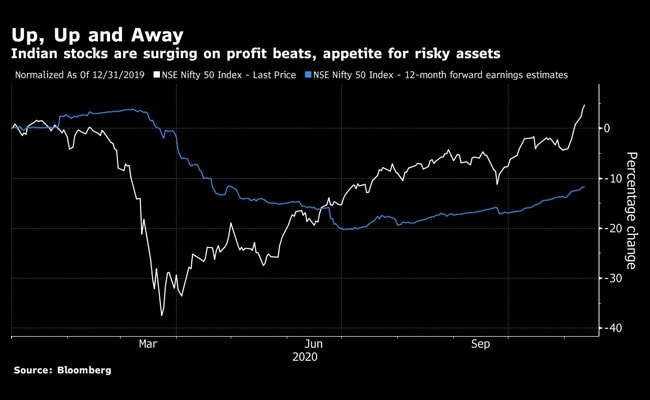
Aggregate net income of 46 NSE Nifty 50 members grew 4.8 per cent from a year earlier in the quarter through September, according to data compiled by Bloomberg. About two-thirds of the earnings beat or matched analyst estimates, compared with double-digit profit declines in the two previous quarters. By contrast, combined profit for MSCI Asia Pacific constituents remains below year-ago levels.
Lenders including ICICI Bank Ltd. and technology firms such as Infosys Ltd. are among those that beat estimates, signaling business conditions are recovering faster than analysts had predicted. Still, while cost-cuts shored up operating profits, sales dipped for many companies from a year ago and the central bank cautioned risks remain even as prospects brightened in October.
"The worst seems to be over with regards to earnings for corporate India," said Abhimanyu Sofat, head of research at IIFL Securities Ltd. "Companies are cutting costs, discretionary spending has rebounded, and a broad-based recovery is driving markets."
India's emergence from the world's biggest lockdown triggered a revival in demand, even as Asia's third-largest economy may contract this year for the first time in about four decades. A combination of better-than-expected earnings, completion of US presidential voting and progress toward a Covid-19 vaccine helped propel the Nifty 50 index to new highs for the first three days this week.
Earnings estimates for the Nifty 50 members have climbed by about 11 per cent from a July low, and the gauge is trading at its highest ever price-to-estimated earnings multiple. Still, analysts expect the index to rise about 8 per cent from Wednesday's close within a year.
While India has the world's second-largest coronavirus case count, new daily infections are less than half the peak in mid-September, according to data from Johns Hopkins University.
Key Highlights
- Energy and financials posted the best profit growth on average.
- State-run refiner Indian Oil Corp.'s net income of Rs 623 crore ($840 million) compares with Rs 563 crore a year earlier as its refineries operated at an average capacity of 93 per cent.
- Materials and consumer discretionary companies posted the biggest earnings surprises.
- Most banks beat estimates, buoyed by interest income and lower provisioning as retail lending recovered.
- ICICI Bank Ltd. posted a record quarterly profit as it set aside fewer provisions for bad loans.
- Continuing a trend seen in the previous quarter, four of India's five biggest technology companies beat earnings estimates as clients' IT spending recovered.
- Bharti Airtel Ltd. posted one of the biggest earnings disappointments: a surprise quarterly loss as competition hindered tariff increases.
Analyst Comments
Analysts expect banks, among the biggest laggards this year, and IT shares to gain as the economy improves and companies continue to digitize their operations.
"The economic recovery continues and Covid-19 cases have seen a meaningful decline," said Gautam Duggad, head of research at Motilal Oswal Securities Ltd. The brokerage remains overweight on IT, banks, health care, telecom and automotive stocks.
The "scope for further rerating remains" for India's top five IT firms, given the demand outlook and potential for companies to adopt cloud storage, Jefferies Financial Group Inc. analysts Akshat Agarwal and Ankur Pant wrote in a note published Sunday.
"Private banks should do well considering the risk-reward as they are still at a significant discount to their highs," said IIFL's Mr Sofat.

-
Blue Wave Will Derail the AI Trade but Won't Dismantle the AI Era | Unhedged Position

The Democrats' sweep of the US Congress will see politics collide with economic forces both over the long and short term.
-
It's Time To Take The GST Council's Bet On Trust Global
Payment records can prove India's services exports, and clear, proportionate rules can bring foreign digital sellers into the tax net.
-
Opinion | India at 38: From Innovation Overperformer to Innovation Powerhouse
India now has 453 VC-backed deep science startups, 18 of them late-stage, after 117 percent growth since 2020. Laurus Labs, at USD 9.3 billion, is the most valuable deep science company in any middle-income economy outside China.
-
Navigating Energy Crossroads: S Jaishankar's Call For Diversified Supply Chains At G20 Ministerial Meeting
As geopolitical fault lines continue to test maritime trade routes and commodity flows, Jaishankar's message remains pertinent: true economic resilience requires open markets, protected transit lines, and a genuine commitment to multilateral cooperation rather than coercion.
-
Indians Are Travelling, But Not Every Journey Is A Holiday | The Week In Whys
Pilgrims, patients and working women are the real travellers, and the system hasn't quite caught up with them.
-
Getting To Work Costs Women More | The Reason Why
It is not just about women paying more than men. It is about women paying much more in cities than in villages.
-
AI Bias In Investing Cannot Be Eliminated, But It Can Be Governed
Framing is a particularly important example as identical financial information presented in terms of gains rather than losses can lead an LLM to reach a different assessment.
-
Joining The Dots | Dark Skies, Steady Diya: Why Hope Holds This Diwali
With war, a weak rupee and foreign outflows weighing on sentiment, policymakers at the NDTV World Summit and market veterans at NDTV Profit Ignite: Diwali Edition offered the same advice: stay invested and filter out the noise.
-
The Curious Case of Equitas Small Finance Bank And A CEO Who Quit For Stock
PN Vasudevan believes persistent investor concerns over a perceived conflict of interest had become a governance overhang on Equitas Small Finance Bank's stock, even as the lender improved profitability and asset quality.










