Government Offers Soft Loans, Tax Concessions To Rescue Economy
The government announced collateral-free loans to some businesses and lowered tax rates for service providers as part of a Rs 20 lakh crore ($265 billion) package to rescue an economy hit by the coronavirus outbreak.
Unsecured loans totaling Rs 3 lakh crore will be offered to as many as 45 lakh small businesses until October 31, Finance Minister Nirmala Sitharaman said in New Delhi on Wednesday. Tax rates for service providers will be cut from the current level and the government will put Rs 50,000 crore of cash in the hands of people, she said.
"Essentially this is to spur growth and to build a very self-reliant India," she said. "It addresses ease of doing business, compliance and due diligence and the intention is also to build local brands."
The measures also include an "emergency liquidity infusion" of Rs 90,000 crore to power-distribution companies to help tide over the cash-flow problems, Ms Sitharaman said, adding that market borrowings will partly finance the stimulus.
The government this month raised its borrowing target to Rs 12 lakh crore from Rs 7.8 lakh crore for the year that began April 1, and the fiscal package follow calls from companies for aid as many ran out of cash during the nationwide lockdown that began March 25 and were forced to cut jobs.
Prime Minister Narendra Modi is under pressure to rescue businesses and save jobs after strict social distancing measures he imposed to beat the pandemic hurt economic activity. That halted all non-essential consumption and left more than 10 crore people jobless, while putting Asia's third-largest economy on course for its first annual contraction in four decades.
Small businesses, or the so-called micro-, small- and medium-sized enterprises, are the bedrock of the $2.7 trillion economy and were also the worst hit by the lockdown.
Stocks Jump
Equity futures on the NSE Nifty 50 Index traded in Singapore were in the green after the finance minister's announcement, while the local benchmark S&P BSE Sensex index closed with the biggest gain in almost two weeks. Sovereign bonds, which fell on concerns of the budget gap widening, reversed losses amid speculation the central bank may be buying to help steady yields.
"The actual cash outgo from the budget is not material in today's announcements" said A Prasanna, chief economist at ICICI Securities Primary Dealership in Mumbai. "The steps to improve credit flow to MSMEs, NBFCs and discoms (distribution companies) is likely to improve liquidity in those sectors. However it needs to be seen how quickly the credit guarantee structures will be put in place."
The broader spending plan includes measures already unveiled by the government and also by the central bank such as provision for cheap cash to banks and the reduction in its cash reserve ratio.
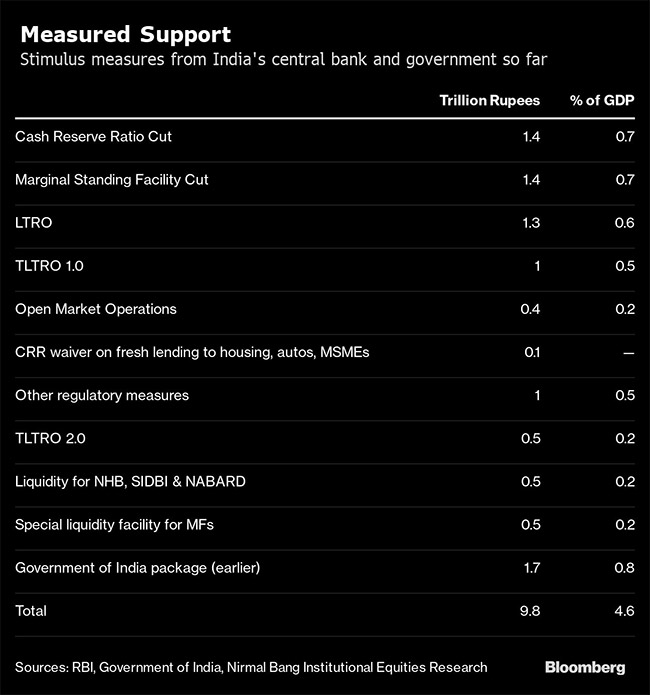
While Wednesday's announcements covers 15 measures, including six pertaining to small businesses, there will be more steps announced over the course of the next few days, Ms Sitharaman said.
As part of the plan unveiled, small firms will be eligible to to borrow an additional 20 per cent of their credit limit for a four-year tenor with 12-month freeze on principal repayments. The loans will be guaranteed by the government.
The plan also includes:
- Injecting Rs 20,000 crore subordinate debt for stressed small firms, wherein banks will lend to founders who will then infuse it as equity into the business
- Small businesses already in default can also avail the facility
- Proposes Rs 50,000 crore injection into these businesses through a fund of funds with corpus of Rs 10,000 crore
Governments across the world have extended support to small businesses. The US last month said it would offer $320 billion to make new loans under the Paycheck Protection Program, which provides forgivable loans to such companies that keep employees on the payroll for eight weeks, while the Philippines plans to give 35 billion pesos ($690 million) to workers of shuttered small businesses.

-
High US Salaries, No Green Card Certainty: The Financial Calculation Facing Indian H-1B Families

The suspension of PERM processing at eight technology employers does not cancel existing H-1B visas. What it does is force a question many Indian families have been avoiding: is the US salary worth tying your career and family plans to one employer?
-
Swiggy vs Eternal: Food Delivery's Two Rivals Are No Longer In The Same Race
Eternal is building a private AI assistant, dark.ai. Swiggy is still working out how to make Instamart pay, with an operating loss of Rs 895 crore in the July-September quarter while Blinkit stayed profitable.
-
Where You Live Shapes How You Get To Work | The Reason Why
Two-wheelers are the most popular way to get to work in India, accounting for nearly 43% of workplace commutes.
-
Unhedged Position: Can India See An Indonesia-Style Time Correction?
The Nifty is trading below levels it first clocked in 2024. Is there, then, as I have suggested in the headline, potential that the current time correction drags on painfully for the next three-five, even ten years?
-
Navigating Friction And Energy Realities: An Analysis Of Marco Rubio's October Visit To India
Occurring at a critical juncture marked by stalled trade negotiations and escalating geopolitical pressures over global energy supplies, the visit offers a profound window into modern US-India relations.
-
India Exports Capital. Why Not Export Trusteeship?
The big question, then, is whether India can build an institution that global borrowers, investors, banks, and lawyers can trust, even without an Indian connection.
-
France's Economy & Politics Are In Crisis | The Reason Why
Let's look at how the French economy and politics evolved under Nicolas Sarkozy, Franois Hollande and Emmanuel Macron.
-
You May Inherit The Business. You Must Earn Its Credibility.
Succession tests the founder's ability to share authority as much as it tests the next generation's readiness to assume it.
-
Signing Deals Is One Thing; Making Them Work Is Another | The Week In Whys
Sometimes, things don't turn out as planned. Indian companies have lost some bids to rivals, some projects won't produce until 2030.
-
FOMC Wall, PERM Suspension, Hospital Stocks | Talking Points This Week
A PERM suspension would directly affect green-card sponsorship rather than H-1B visas, so the near-term earnings impact could remain relatively limited. The key question is whether this marks a new phase in US scrutiny of Indian IT.









