Consumer Goods Stores Are Facing A Sold-Out Crisis This Diwali
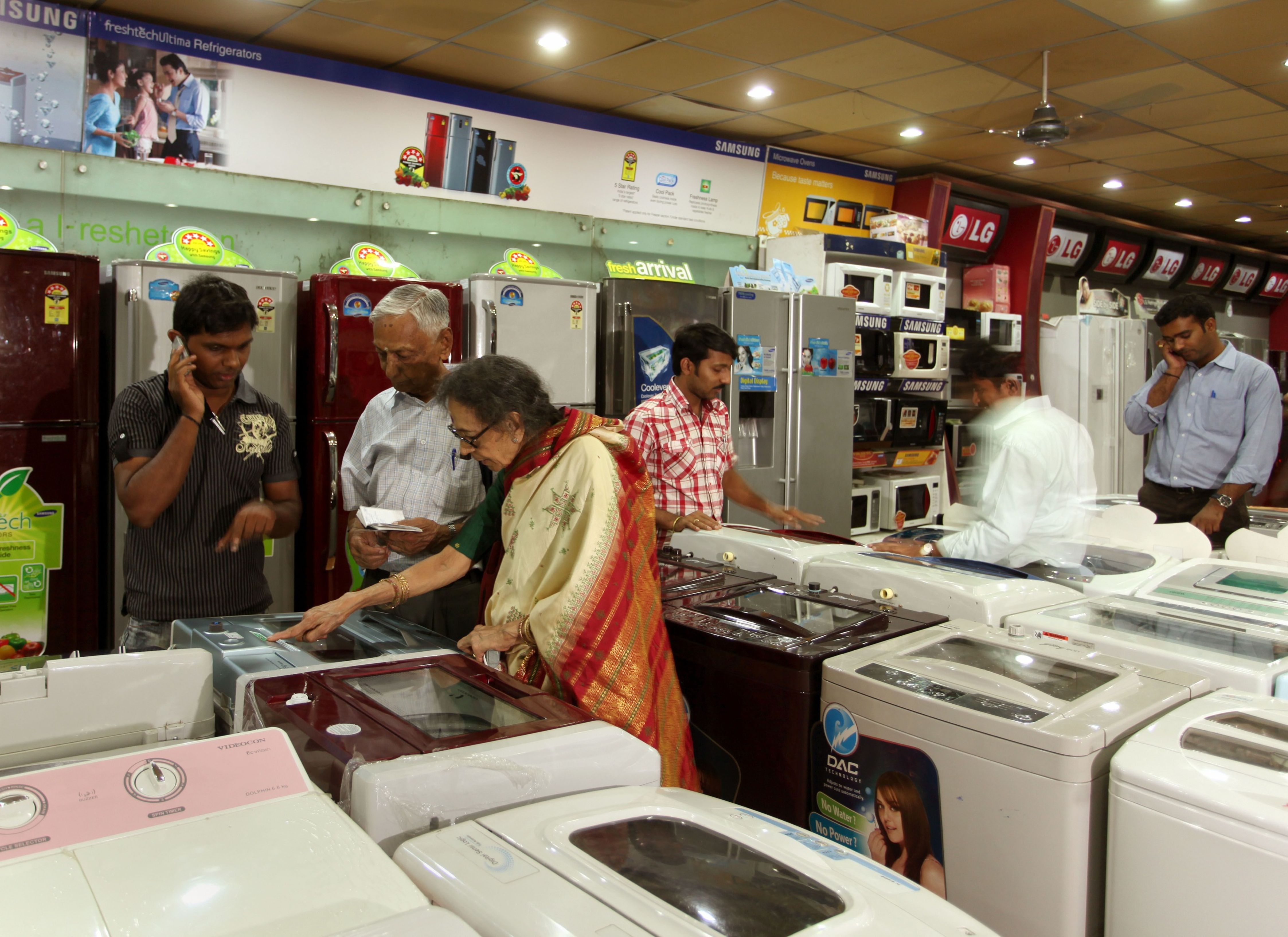
Looking to buy an iPhone or a fridge or any other home appliance this Diwali season? There are great deals available as online and brick-and-mortar retailers lure buyers with incentives, zero-interest EMIs and exchange offers. Yet, your search may prove to be futile.
The global economy has been grappling with a semiconductor shortage, supply-chain disruptions and surging raw material costs during the pandemic. That means the makers of washing machines and smartphones to LED televisions have been unable to supply enough inventory to meet festive demand.
Amazon India said on its website that stocks of its best-selling iPhone 13, Redmi 9A and Redmi 9 Activ will be replenished on Nov. 7, Nov. 9 and Nov. 11, respectively, BloombergQuint found out in a review.
Other appliance makers didn't fare better either.
The “currently unavailable” tag was present for a few LG and Samsung TVs; some others had the message “left with only 1-2 stocks”. Laptops and hard disks from Acer, Hitachi, and Lenovo were also running low on Amazon.
“Only 1 stock left” showed up for Godrej 7.5 kg, 8 kg and LG 9 kg top-loading washing machines.
“Our all four brands are running out of stock because of high demand and another reason is a shortfall in raw materials,” Pallavi Singh, vice-president at Super Plastronics Pvt., the licensee for Kodak, Blaupunkt, Westinghouse TV and Thomson, told BloombergQuint. Currently, raw material shortage is about 30% of the potential demand, Singh said.
Nilesh Gupta, director of the Mumbai-headquartered electronics retailer Vijay Sales, said there is “a severe crisis for iPhones” in the offline market as well. Models such as iPhone 11, 12, 13 which are in high demand, are in shortage, he said, with supply erratic for all brands. High-end and premium models have been hit harder while cheaper models are yet to bear the brunt. While current stocks would suffice for another 8-10 days, Gupta said there could be “a real crisis” post-Diwali if demand picks up further.
The crisis can be traced to the Covid-19 pandemic, when demand for personal computing soared, as people were confined to their homes amid lockdowns around the world.
As laptops to tablets and smartphones started flying off the shelves, a shortage of semiconductors ensued. That stalled production in multiple industries—automobiles to consumer goods, among a few—as they rely heavily on microprocessor chips to control specific functions. Even paintmakers weren't spared, as BloombergQuint reported in September.
The chief executive of a leading electronics retail chain said they haven't seen a situation like this in many years. The CEO, who spoke on the condition of anonymity fearing business repercussions, said they had an inventory for up to 15 days for the festive season this year compared with 30 days in a normal year. Orders would be fulfilled in 10-12 days during usual times, this person said. That has now risen to 15-20 days.
Manufacturers' Pain
For manufacturers, the average time to procure raw materials has risen from 21 days to six weeks, according to Eric Braganza, president of the Consumer Electronics and Appliances Manufacturers Association.
He said there are high chances of current stocks getting exhausted soon and the chip shortage affecting sales in November-end.
Higher costs of components and logistics is also beginning to eat into their profits. Televisions already cost 4-5% more than they did last summer, while appliance prices shot up 13%, the companies and analysts BloombergQuint spoke with said. Smartphone prices have risen 5-6%.
“Rising (shipping) container prices due to the higher cost of inward freight in the last few months resulted in a price increase of ACs and refrigerators by 4-5%,” Manish Sharma, chairman and chief executive officer of Panasonic India and South Asia, told BloombergQuint.
He hinted that there may be no more price hikes this year.
Singh of Super Plastronics, however, differed.
“We're left with no choice but to pass the rising costs to consumers which have led to a decrease in the volumes this year as compared to the last.” The trend, she said, has restricted growth and hit margins.
Among the segments hit hard are smartphones, which traditionally sees higher volumes. Tarun Pathak, research director at the market analyser Counterpoint Research, attributed it to supply constraints that were more severe during the September quarter than in the preceding three months.
“Due to the demand-supply mismatch, most components used in smartphones have seen upward price movements, forcing some major manufacturers to increase the retail prices of some models,” he said. “This led to declines in volumes, especially in the entry tier segment, which limited the growth potential.”
As a result, market demand was met by mid-to high-tier mobiles that helped drive quarterly revenue to a record even amid lower shipments, Pathak said.
India's smartphone shipments fell 2% year-on-year to over 52 million units in the quarter ended September, data from Counterpoint's Market Monitor service showed.
Madhav Sheth, chief executive officer of Realme for India, Latin America and Europe, expects the chip shortage to ease only after the second quarter of 2022.

-
Blue Wave Will Derail the AI Trade but Won't Dismantle the AI Era | Unhedged Position

The Democrats' sweep of the US Congress will see politics collide with economic forces both over the long and short term.
-
It's Time To Take The GST Council's Bet On Trust Global
Payment records can prove India's services exports, and clear, proportionate rules can bring foreign digital sellers into the tax net.
-
Opinion | India at 38: From Innovation Overperformer to Innovation Powerhouse
India now has 453 VC-backed deep science startups, 18 of them late-stage, after 117 percent growth since 2020. Laurus Labs, at USD 9.3 billion, is the most valuable deep science company in any middle-income economy outside China.
-
Navigating Energy Crossroads: S Jaishankar's Call For Diversified Supply Chains At G20 Ministerial Meeting
As geopolitical fault lines continue to test maritime trade routes and commodity flows, Jaishankar's message remains pertinent: true economic resilience requires open markets, protected transit lines, and a genuine commitment to multilateral cooperation rather than coercion.
-
Indians Are Travelling, But Not Every Journey Is A Holiday | The Week In Whys
Pilgrims, patients and working women are the real travellers, and the system hasn't quite caught up with them.
-
Getting To Work Costs Women More | The Reason Why
It is not just about women paying more than men. It is about women paying much more in cities than in villages.
-
AI Bias In Investing Cannot Be Eliminated, But It Can Be Governed
Framing is a particularly important example as identical financial information presented in terms of gains rather than losses can lead an LLM to reach a different assessment.
-
Joining The Dots | Dark Skies, Steady Diya: Why Hope Holds This Diwali
With war, a weak rupee and foreign outflows weighing on sentiment, policymakers at the NDTV World Summit and market veterans at NDTV Profit Ignite: Diwali Edition offered the same advice: stay invested and filter out the noise.
-
The Curious Case of Equitas Small Finance Bank And A CEO Who Quit For Stock
PN Vasudevan believes persistent investor concerns over a perceived conflict of interest had become a governance overhang on Equitas Small Finance Bank's stock, even as the lender improved profitability and asset quality.










