Cognizant Offers ‘Voluntary Separation’ To Top Executives

Cognizant Technology Solutions Corp. has offered some of its top executives a “voluntary separation”, a month after the software services provider indicated that it may let go of some of its employees as part of its performance review.
A spokesperson of the U.S.-based information technology company confirmed the development but declined to divulge how many people have been made the offer, maintaining that it represents a very small percentage of its total workforce. Cognizant employs around 2.6 lakh employees globally, with nearly 75 percent of them based out of India.
Only directors and vice presidents in the company are being offered the separation, that too at the discretion of the leadership.
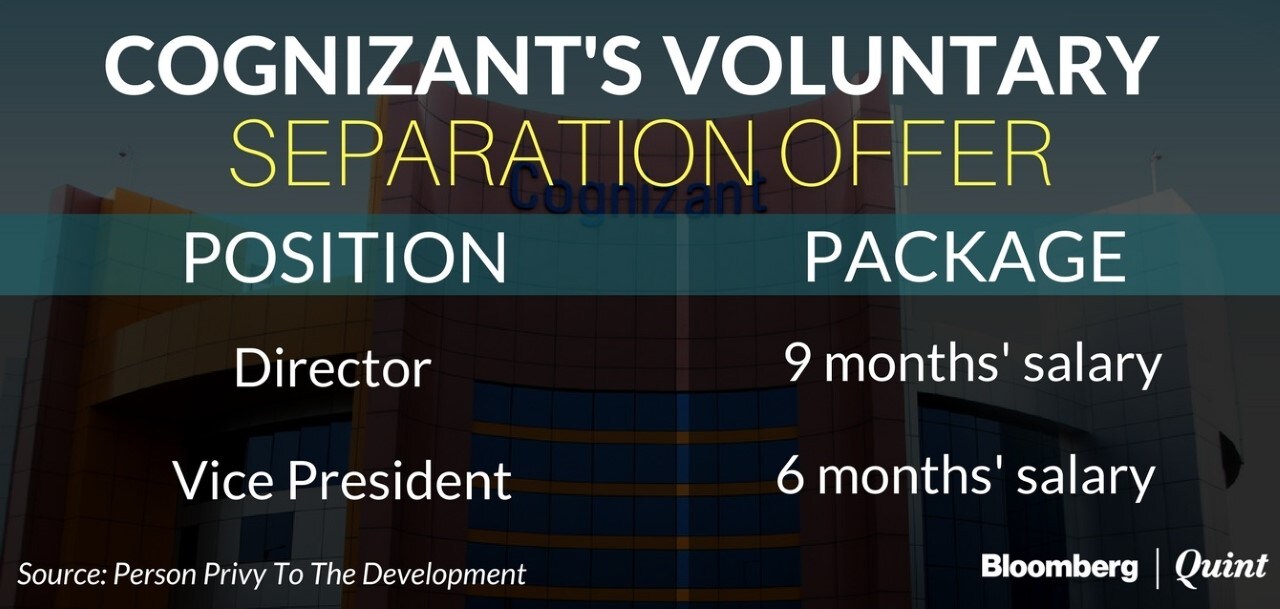
The company is offering up to nine-months' salary as part of the offer, a person privy to the development told BloombergQuint, but didn't reveal what the ‘salary' included. It wants to complete the process by June.
Nearly a month ago, Cognizant had said some of the employees could be “transitioned out of the company” as part of the performance review.
The information technology firm said on Thursday that the voluntary separation offer was in keeping with the overall strategy of accelerating its shift to digital. The company, however, added that it will continue to hire across all its practices and is expanding facilities globally.
Cognizant, which follows a January-December financial year, saw its net profit fall 4.3 percent to $1.55 billion in 2016. Its revenue grew 8.6 percent to $13.49 billion compared to a 21 percent growth the year before.
Its Chief Executive Officer Francisco D'Souza's compensation also fell 31 percent to $8.26 million last year, as per the fillings made to the U.S. Securities and Exchange Commission.
Also Read: Cognizant To Return $3.4 Billion To Shareholders Over Next 2 Years

-
Medicine Pricing: Where Must Profit Stop?

India must confront excessive margins, hidden incentives and regulatory gaps that threaten the integrity of medicine.
-
Why Amazon And Flipkart Are Struggling To Beat Meesho In India's Smaller Cities
With 274 million users and lowest-cost logistics, Meesho is defending its value commerce crown against giants like Amazon and Flipkart.
-
High US Salaries, No Green Card Certainty: The Financial Calculation Facing Indian H-1B Families
The suspension of PERM processing at eight technology employers does not cancel existing H-1B visas. What it does is force a question many Indian families have been avoiding: is the US salary worth tying your career and family plans to one employer?
-
Swiggy vs Eternal: Food Delivery's Two Rivals Are No Longer In The Same Race
Eternal is building a private AI assistant, dark.ai. Swiggy is still working out how to make Instamart pay, with an operating loss of Rs 895 crore in the July-September quarter while Blinkit stayed profitable.
-
Where You Live Shapes How You Get To Work | The Reason Why
Two-wheelers are the most popular way to get to work in India, accounting for nearly 43% of workplace commutes.
-
Unhedged Position: Can India See An Indonesia-Style Time Correction?
The Nifty is trading below levels it first clocked in 2024. Is there, then, as I have suggested in the headline, potential that the current time correction drags on painfully for the next three-five, even ten years?
-
Navigating Friction And Energy Realities: An Analysis Of Marco Rubio's October Visit To India
Occurring at a critical juncture marked by stalled trade negotiations and escalating geopolitical pressures over global energy supplies, the visit offers a profound window into modern US-India relations.
-
India Exports Capital. Why Not Export Trusteeship?
The big question, then, is whether India can build an institution that global borrowers, investors, banks, and lawyers can trust, even without an Indian connection.
-
France's Economy & Politics Are In Crisis | The Reason Why
Let's look at how the French economy and politics evolved under Nicolas Sarkozy, Franois Hollande and Emmanuel Macron.
-
You May Inherit The Business. You Must Earn Its Credibility.
Succession tests the founder's ability to share authority as much as it tests the next generation's readiness to assume it.










