Chipmakers See ‘Breathtaking’ Drop In Demand As Recession Looms

(Bloomberg) -- Signs are piling up that the tech downturn may be deeper and longer-lasting than feared.
After years of record capital spending, chipmakers are warning on a weekly basis that demand is sputtering. In the latest sign of trouble, Samsung Electronics Co. and Advanced Micro Devices Inc. reported disappointing results within hours of each other that widely missed projections.
Samsung -- the world's largest memory chipmaker -- reported a 32% dive in operating income, while PC-processor maker AMD said it will miss its earlier forecast by about $1 billion. Analysts' reactions ranged from “breathtaking” to “Uff-da!”
Those numbers followed grim comments from memory makers Micron Technologies Inc. and Kioxia Holdings Corp., which are slashing spending and output in a bid to stabilize plummeting prices. AMD shares fell in premarket trading, along with chipmakers including Nvidia Corp. and Intel Corp. Chip gear suppliers such as ASML Holding NV and PC makers including Lenovo Group Ltd. also dropped. Japan's Disco Corp., whose equipment grinds, polishes and dices chips, lost the most in more than two years Friday.
“It seems end demand has likely deteriorated markedly in recent weeks, and end customers appear to be aggressively draining inventory,” Bernstein's Stacy Rasgon said. The cut in AMD's client-revenue “is admittedly a bit breathtaking.”
Read: ‘Hard Times' as Big Memory Makers Cut Output on Supply Glut
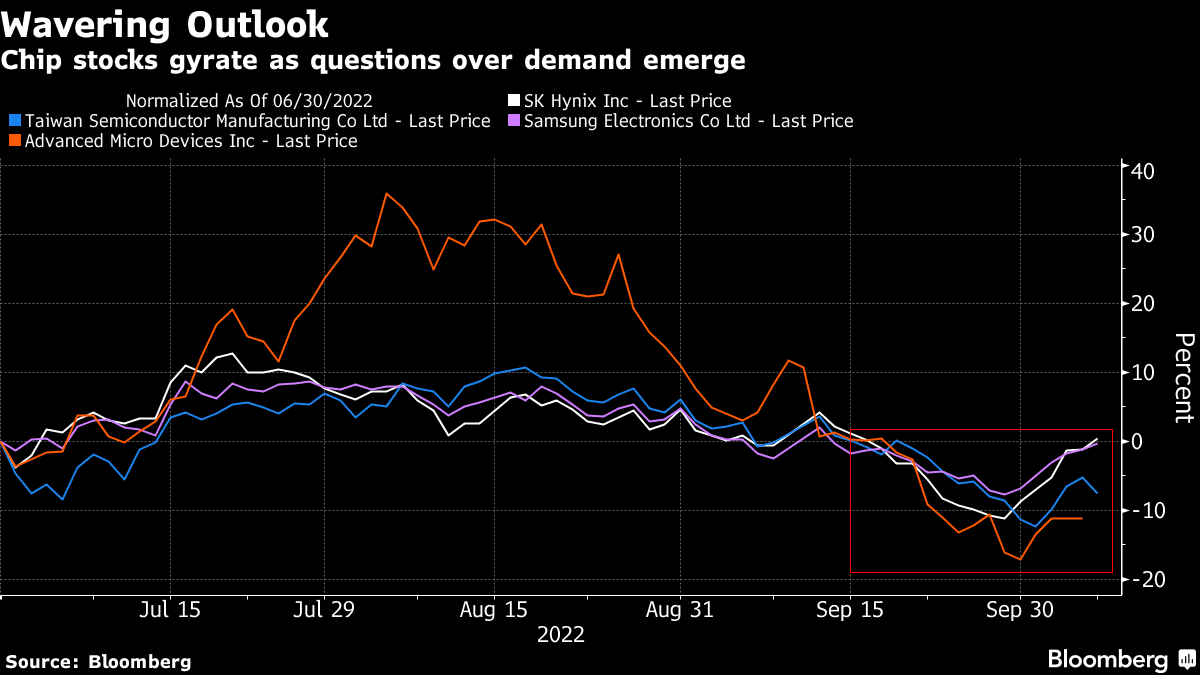
The outlier has been Taiwan Semiconductor Manufacturing Co., which posted a roughly 48% surge in quarterly revenue to about NT$613 billion ($19.4 billion) -- at the top range of its guidance in US dollar terms -- helped by its growing clout as the world's most advanced maker of chips. The downtrend in demand may not have been fully reflected in the numbers, especially given the sharp depreciation of the Taiwan dollar, Haitong International Securities analyst Jeff Pu said.
Consumer electronics companies that had struggled with shortages during the pandemic are now facing a sudden falloff in demand, even while shipping and materials costs remain high. Recession fears are making cost-cuttingthe new norm across the tech industry, and businesses that hoarded chips for two years are now opting to cancel or postpone orders and tap inventory, just as new capacity goes online.
The semiconductor industry is also grappling with export restrictions from the US government, which is ratcheting up pressure on its allies to prevent shipment of cutting-edge chips to a growing list of Chinese companies, as it seeks to contain the Asian country. That's hampering business for chipmakers from AMD to Nvidia in the world's biggest semiconductor market.
Supply and demand are not all that is behind the current downcycle, said Heo Pil-Seok, chief executive officer at Midas International Asset Management in Seoul. “The US government's exports controls would further limit IT companies' sales in China and a large chunk of demand for chips will be weakened. If AMD, Nvidia can't sell their chips in China, memory makers' earnings will deteriorate further.”
The PC segment, which has for years been losing ground to smartphones, looks particularly vulnerable. But a serious recession would hammer demand even in areas that have remained solid, such as in cloud computing, automotives and factory automation.
“We would continue to stay away from PC-centric names, which within our coverage list include AMD, Intel, and Nvidia, due to a likely prolonged PC downturn into next year and continued weakness in consumer gaming,” Baird analysts Tristan Gerra and Tyler Bomba wrote in a note to clients.
Share prices dropped throughout the semiconductor supply chain, from materials makers like JSR Corp. to chip gear makers such as Advantest Corp. and Screen Holdings Co. Even silicon wafer makers such as Shin-Etsu Chemical Co. and Sumco Corp. fell.
Read more: Asia Chip Shares Fall as AMD Sales Miss Estimates by $1 Billion
The companies themselves are bracing for a prolonged downturn. Samsung's chip business head, Kyung Kyehyun, said last month he doesn't see the memory market rebounding throughout next year. Kyung told employees at an internal event that Samsung cut its guidance for chip sales in the second half of this year by 32% compared to a forecast in April, according to the Korea Economic Daily.
What Bloomberg Intelligence Says
PC demand will continue to be soft in 4Q, given heavy PC processor inventory as announced by chipmaker AMD. Won depreciation might not be enough to offset weak sales of memory chips and consumer electronics, such as TVs.
-- Masahiro Wakasugi, BI analyst
Click here for the full research
Delivery times for key components and machinery sometimes exceeded one year during the pandemic, causing companies to stockpile a year's worth of inventory, while chipmakers rushed to ramp up capacity. Now that lead times have dropped, companies are scrambling to reduce stockpiles.
“You build supply for demand that turns out not to be as real as you thought it was,” Rasgon said. “No party lasts forever.”
(Updates with share price reactions in fourth paragraph)
More stories like this are available on bloomberg.com
©2022 Bloomberg L.P.

-
Love, Sex Aur Dhokha: The Audacious Plot To Spy On Jensen Huang

A Taipei dinner, a Singapore chip buyer and a suspected Chinese asset: inside the alleged spy operation that got close to NVIDIA's Jensen Huang.
-
Ten Things I Learnt This Samvat
Patience can be a trap. Cheap stocks can stay cheap. Leverage can wipe you out. What did Samvat 2082 teach us? Niraj Shah writes on 10 lessons from the year gone by.
-
Talking Points This Week: Tech Nerves, FII Buying, And A Faraway Banking Shock
The global markets are not shining this Diwali. The exception in the large markets is, India.
-
Midterm Rally Lasted A Day. The Hard Reality Of A Divided US May Last Two Years | Opinion
Between a contested AI boom, a debt ceiling that arrives in 2027 and a president with every incentive to act alone, the next two years may prove more volatile than the first day's rally suggests.
-
Blue Wave Will Derail the AI Trade but Won't Dismantle the AI Era | Unhedged Position
The Democrats' sweep of the US Congress will see politics collide with economic forces both over the long and short term.
-
It's Time To Take The GST Council's Bet On Trust Global
Payment records can prove India's services exports, and clear, proportionate rules can bring foreign digital sellers into the tax net.
-
Opinion | India at 38: From Innovation Overperformer to Innovation Powerhouse
India now has 453 VC-backed deep science startups, 18 of them late-stage, after 117 percent growth since 2020. Laurus Labs, at USD 9.3 billion, is the most valuable deep science company in any middle-income economy outside China.
-
Navigating Energy Crossroads: S Jaishankar's Call For Diversified Supply Chains At G20 Ministerial Meeting
As geopolitical fault lines continue to test maritime trade routes and commodity flows, Jaishankar's message remains pertinent: true economic resilience requires open markets, protected transit lines, and a genuine commitment to multilateral cooperation rather than coercion.
-
Indians Are Travelling, But Not Every Journey Is A Holiday | The Week In Whys
Pilgrims, patients and working women are the real travellers, and the system hasn't quite caught up with them.









