Chinese Professor Defies Odds On Way to $3.4 Billion Fortune
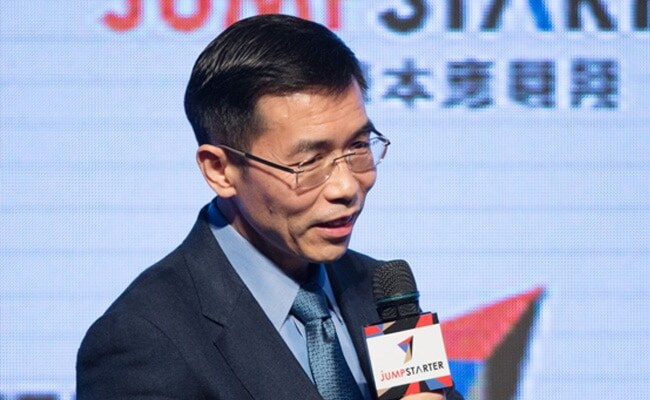
Just weeks after the U.S. placed a unit of SenseTime Group Inc. on a blacklist for alleged human rights violations, the firm is about to make founder Tang Xiao'ou one of the world's richest people. China's largest artificial intelligence company priced its initial public offering at HK$3.85 (49 cents) per share, raising HK$5.55 billion.
That was the bottom of the expected range, but a signal that despite increased tensions with the U.S. and Beijing's crackdown on tech giants, the country, including its vast surveillance machinery, continues to churn out huge fortunes and massive gains for venture capitalists.
Tang, 53, a Massachusetts Institute of Technology graduate and information engineering professor at the Chinese University of Hong Kong, holds a 21% stake in the company and is worth $3.4 billion, according to the Bloomberg Billionaires Index.
A representative for SenseTime declined to comment on Tang's net worth.
SenseTime was long expected to be a blockbuster public offering but has drawn fire in recent years. It was forced to delay the listing this month after the U.S. alleged the company's facial-recognition software is used in the oppression of Uyghur Muslims in the Xinjiang autonomous region of western China. SenseTime has said the accusations, which led to the sanctions, are unfounded.
SenseTime is the first overseas offering by a high-profile Chinese tech unicorn since ride-sharing giant Didi Global Inc.'s July IPO in New York sparked a regulatory backlash by officials in Beijing. The shares are scheduled to start trading Dec. 30 in Hong Kong, giving the company a market value of more than $16 billion.
Tang has long been involved in developing the artificial intelligence required for facial recognition.
He received his undergraduate degree from the University of Science and Technology of China, then graduated from the University of Rochester in New York and got his PhD from MIT in 1996, where he studied underwater robotics and computer vision.
He worked for Microsoft Research Asia for a few years and co-founded Shanghai-based SenseTime in 2014 with Xu Li, then a research scientist at Chinese computer maker Lenovo Group Ltd. The company attracted early investment from IDG Capital and then picked up backers including SoftBank Group Corp., Alibaba Group Holding Ltd. and Silver Lake.
It's now the largest AI software firm in Asia with an 11% market share, according to the prospectus. The technology is deployed in a range of areas, including helping police in China, providing product placements in films and creating an augmented reality scene in a mobile game by Tencent Holdings Ltd.
SenseTime relaunched its IPO process days after the blacklist with a group of cornerstone investors increasing their bets to $512 million from $450 million. These included state-backed Mixed-Ownership Reform Fund and the Shanghai Xuhui Capital Investment Co. Sponsors included China International Capital Corp., Haitong International Securities Group Ltd. and HSBC Holdings Plc.
The company later uploaded a legal opinion to the Hong Kong Stock Exchange, claiming the restrictions didn't apply to the parent company of the sanctioned unit. While the offering size remained the same, retail investors reportedly expressed more caution. Ultimately, the shares
“It makes sense that retail investors who look for short-term gains have become less enthusiastic with the sanction factor,” said Kenny Ng, a strategist at Everbright Sun Hung Kai. “Especially since the overall Hong Kong stock market is not performing well lately.”
SenseTime's revenue increased 14% last year to $3.4 billion yuan ($534 million), though it still posted an operating loss of 1.8 billion yuan.
“Tech companies at an early stage still need to invest more in research and development to keep their technology competitive,” Ng said. “For SenseTime, maintaining a stable income growth is more important than turning profitable in the short-term.”
(This story has not been edited by NDTV staff and is auto-generated from a syndicated feed.)

-
Where You Live Shapes How You Get To Work | The Reason Why

Two-wheelers are the most popular way to get to work in India, accounting for nearly 43% of workplace commutes.
-
High US Salaries, No Green Card Certainty: The Financial Calculation Facing Indian H-1B Families
The suspension of PERM processing at eight technology employers does not cancel existing H-1B visas. What it does is force a question many Indian families have been avoiding: is the US salary worth tying your career and family plans to one employer?
-
Unhedged Position: Can India See An Indonesia-Style Time Correction?
The Nifty is trading below levels it first clocked in 2024. Is there, then, as I have suggested in the headline, potential that the current time correction drags on painfully for the next three-five, even ten years?
-
Navigating Friction And Energy Realities: An Analysis Of Marco Rubio's October Visit To India
Occurring at a critical juncture marked by stalled trade negotiations and escalating geopolitical pressures over global energy supplies, the visit offers a profound window into modern US-India relations.
-
India Exports Capital. Why Not Export Trusteeship?
The big question, then, is whether India can build an institution that global borrowers, investors, banks, and lawyers can trust, even without an Indian connection.
-
France's Economy & Politics Are In Crisis | The Reason Why
Let's look at how the French economy and politics evolved under Nicolas Sarkozy, Franois Hollande and Emmanuel Macron.
-
You May Inherit The Business. You Must Earn Its Credibility.
Succession tests the founder's ability to share authority as much as it tests the next generation's readiness to assume it.
-
Signing Deals Is One Thing; Making Them Work Is Another | The Week In Whys
Sometimes, things don't turn out as planned. Indian companies have lost some bids to rivals, some projects won't produce until 2030.
-
FOMC Wall, PERM Suspension, Hospital Stocks | Talking Points This Week
A PERM suspension would directly affect green-card sponsorship rather than H-1B visas, so the near-term earnings impact could remain relatively limited. The key question is whether this marks a new phase in US scrutiny of Indian IT.
-
Everything, Everywhere, All At Once: Dalal Street's Week To Forget | Joining The Dots
Visa curbs, a Starlink spat and cancer drug caps: what connects this week's shocks for Indian markets









