China To Set Up New Agency To Promote Private Sector Growth

(Bloomberg) -- China's top economic planner is creating a new department to help private businesses, the latest step by the government to revive confidence in the sector and bolster growth.
The private economy development bureau will be responsible for tracking and analyzing the state of the industry, along with coordinating and drafting policies to promote its growth, the National Development and Reform Commission announced Monday.
Beijing has unveiled a drip-feed of policies in recent months intended to revitalize private companies and attract foreign investment, with President Xi Jinping over the weekend vowing to ease market access and create opportunities for global cooperation.
“It is rare for the government to set up an agency specialized in a certain sector. It sends a policy signal for guiding expectations in an institutionalized way,” said Bruce Pang, head of research and chief economist at Jones Lang LaSalle Inc.
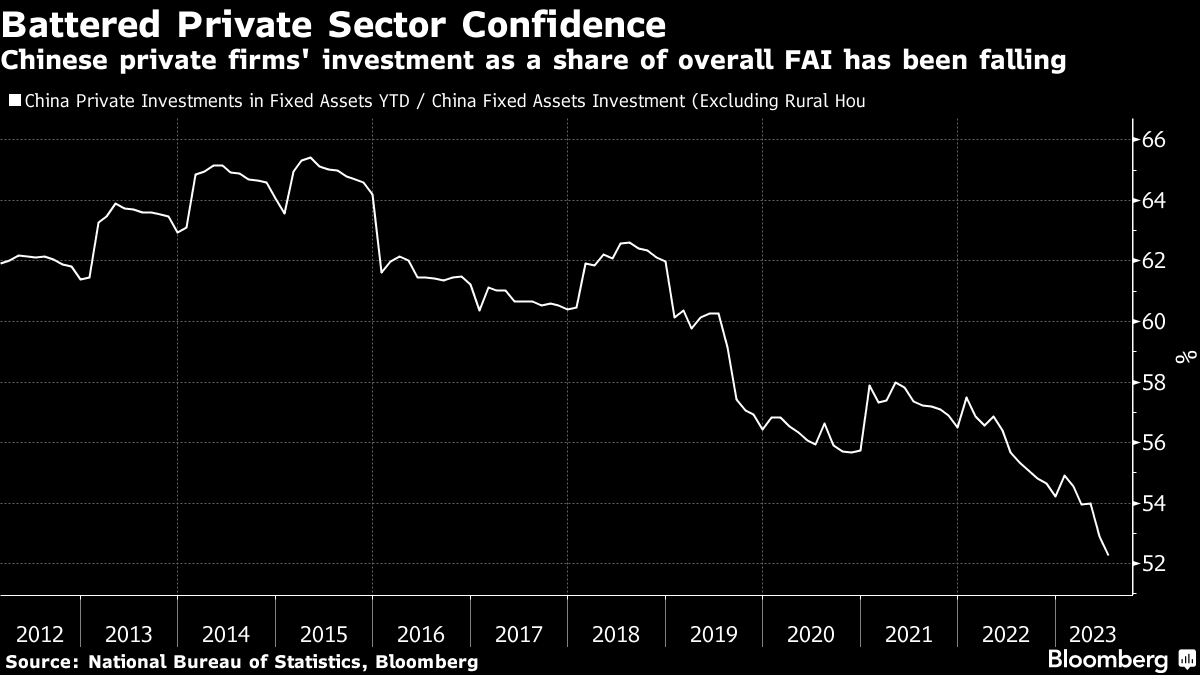
Private firms are major employers in the economy and contribute to more than half of the nation's fixed-asset investment. Years of regulatory crackdowns and pandemic controls shattered confidence in the sector, with once-dominant firms like Alibaba Group Holding Ltd. shrinking dramatically.
Concerns about private enterprise are acute this year as the economy struggles to combat a laundry list of challenges from the property crisis and falling exports to deflationary pressures.
The new bureau will also regularly talk to companies and help them resolve their main problems, as well as support their attempts to improve international competitiveness, said NDRC official Zhang Shixin at a Monday briefing.
In July, the ruling Communist Party and the government pledged to treat private companies the same as state-owned enterprises — a move seen by investors at the time as a framework for future support. The NDRC later issued a 17-point plan to revive private investment, as they sought funding worth trillions of yuan for projects covering everything from transportation and water conservation to clean energy.
That bid to boost private investment is getting more aggressive. Local governments have reported planned private investment worth some 3.7 trillion yuan ($509 billion) for more than 3,500 projects, NDRC Vice Chairman Cong Liang said at the Monday briefing.
The creation of a specialized agency “indicates the work will be a long-term endeavor,” said Ding Shuang, chief economist for greater China and North Asia at Standard Chartered Plc. Though he said key issues remain as to what specific steps will be taken to improve the environment for business operations and “increase policy transparency and predictability,” among other measures.
Policy predictability has been a particularly important issue for foreign firms. US Commerce Secretary Gina Raimondo said last week that companies operating in China told her they consider the country increasingly “uninvestible” because of risks.
Monday's briefing didn't include details about potential support for foreign companies — a sign the bureau appears to mostly be focused on helping domestic ones, according to Pang of Jones Lang LaSalle.
“The new bureau's stated aim of helping to improve the international competitiveness of private companies raises a question as to whether this initiative will include foreign enterprises,” said Jens Eskelund, president of the European Union Chamber of Commerce in Beijing.
The American Chamber of Commerce in China also welcomed the move, with Vice Chair Roberta Lipson saying the new bureau “is one more sign that the government is willing to use all its tools to bolster the economy.”
The NDRC also said Monday that it is encouraging big banks to review private projects and consider financing them, and has recommended 715 such initiatives to lenders including the China Development Bank, the Industrial and Commercial Bank of China Ltd, and China CITIC Bank Corp.
The commission also wants financing for private industry projects to come from real estate investment trusts, or REITs. The nation has experimented with REITs in recent years as a way to tap the equity market to finance infrastructure projects and promote growth.
Cong said the commission has recommended one wind power project to China's securities watchdog, which has the ability to approve the issuance of infrastructure REITs. He said officials hope to do the same for other qualified REIT projects covering industries such as big data, consumption and logistics “as soon as possible.”
The Ministry of Industry and Information Technology at the same briefing said it would conduct nationwide inspections to reduce burdens on businesses and ensure that favorable policies are implemented. That agency will also campaign for the repayment of debts owed to small companies to ease their funding pressures, Vice Minister Xu Xiaolan said.
--With assistance from Colum Murphy.
(Adds additional context, reaction from business chambers and economists.)
More stories like this are available on bloomberg.com
©2023 Bloomberg L.P.

-
Navigating Energy Crossroads: S Jaishankar's Call For Diversified Supply Chains At G20 Ministerial Meeting

As geopolitical fault lines continue to test maritime trade routes and commodity flows, Jaishankar's message remains pertinent: true economic resilience requires open markets, protected transit lines, and a genuine commitment to multilateral cooperation rather than coercion.
-
Indians Are Travelling, But Not Every Journey Is A Holiday | The Week In Whys
Pilgrims, patients and working women are the real travellers, and the system hasn't quite caught up with them.
-
Getting To Work Costs Women More | The Reason Why
It is not just about women paying more than men. It is about women paying much more in cities than in villages.
-
AI Bias In Investing Cannot Be Eliminated, But It Can Be Governed
Framing is a particularly important example as identical financial information presented in terms of gains rather than losses can lead an LLM to reach a different assessment.
-
Joining The Dots | Dark Skies, Steady Diya: Why Hope Holds This Diwali
With war, a weak rupee and foreign outflows weighing on sentiment, policymakers at the NDTV World Summit and market veterans at NDTV Profit Ignite: Diwali Edition offered the same advice: stay invested and filter out the noise.
-
The Curious Case of Equitas Small Finance Bank And A CEO Who Quit For Stock
PN Vasudevan believes persistent investor concerns over a perceived conflict of interest had become a governance overhang on Equitas Small Finance Bank's stock, even as the lender improved profitability and asset quality.
-
Talking Points This Week: AI Cash Burn, A Tiger Comeback And An India That Still Finds Its Own Path
India is not immune to higher oil or tighter global liquidity, yet its earnings base is broader, its domestic policy levers are still available.
-
Foreign Investors Own Half Of HDFC Bank and ICICI Bank. An LTCG Cut Could Matter Most Here
Foreign portfolio investors have US$115 billion parked in HDFC Bank, ICICI Bank. If the government cuts long-term capital gains tax, Jefferies says returning foreign money could land here first.
-
'Never Seen This Level Of Negativity': Sandeep Tandon Says The Next Rally May Be Closer Than You Think
Veteran investor Sandeep Tandon says foreign selling is easing, large-caps are due a comeback and mid-caps are crowded, while he turns positive on gold, power and pharma this Diwali.
-
Indians Stay With Family, Not In Hotels | The Reason Why
India still lacks enough clean, reliable and affordable hotels for budget-conscious travellers.










