China's Fragile Recovery Keeps Policymakers On Alert
(Bloomberg) -- China's trade and inflation data this week will likely signal that the economy's recovery remains fragile, keeping pressure on policymakers to roll out more stimulus.
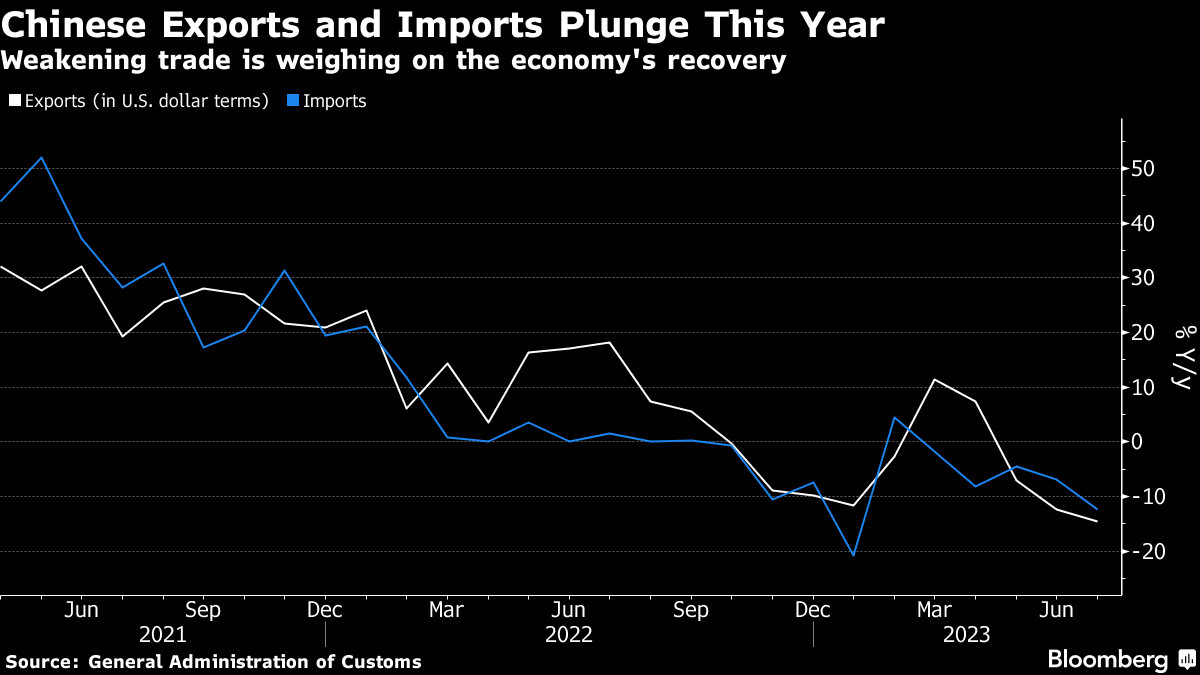
Thursday's trade report is expected to show exports and imports contracted again in August from a year earlier, although at a milder pace than in July, according to the median estimates in a Bloomberg survey of economists.
Deflation may also have eased, with figures due Sept. 9 probably showing an increase in consumer prices, according to state media.
Economists warn that China's growth outlook remains far from certain despite the likely improvement in the data.
Global demand for Chinese goods is still weak, as reflected by the depressed level of manufacturing gauges in the country's main export markets. And an ongoing slump in the property market is curbing China's import demand for building materials.
Beijing has taken more concerted steps in recent days to shore up the ailing housing market, while also stepping up its defense of the currency and expanding some tax breaks to households. It may take some time for those policy measures to show up in the economic data, though.
What Bloomberg Economics Says:
“The mortgage rate cuts announced by China's regulators are bigger than we previously envisaged, and are well designed to stimulate consumption while avoiding inflating more property bubbles.”
—Chang Shu and David Qu. For full analysis, click here
Economists have downgraded growth forecasts for the year closer to Beijing's target of about 5%, while also lowering their expectations for inflation.
Purchasing managers' surveys for August showed a pickup in manufacturers' input and output prices, suggesting an easing in producer-price deflation. Rising food prices and stronger spending on services such as travel and eating out also probably helped to lift consumer inflation in August, according to economists at Citigroup Inc.
Elsewhere, testimony by UK policymakers and key pre-decision speeches by euro-zone and US officials will punctuate the week.
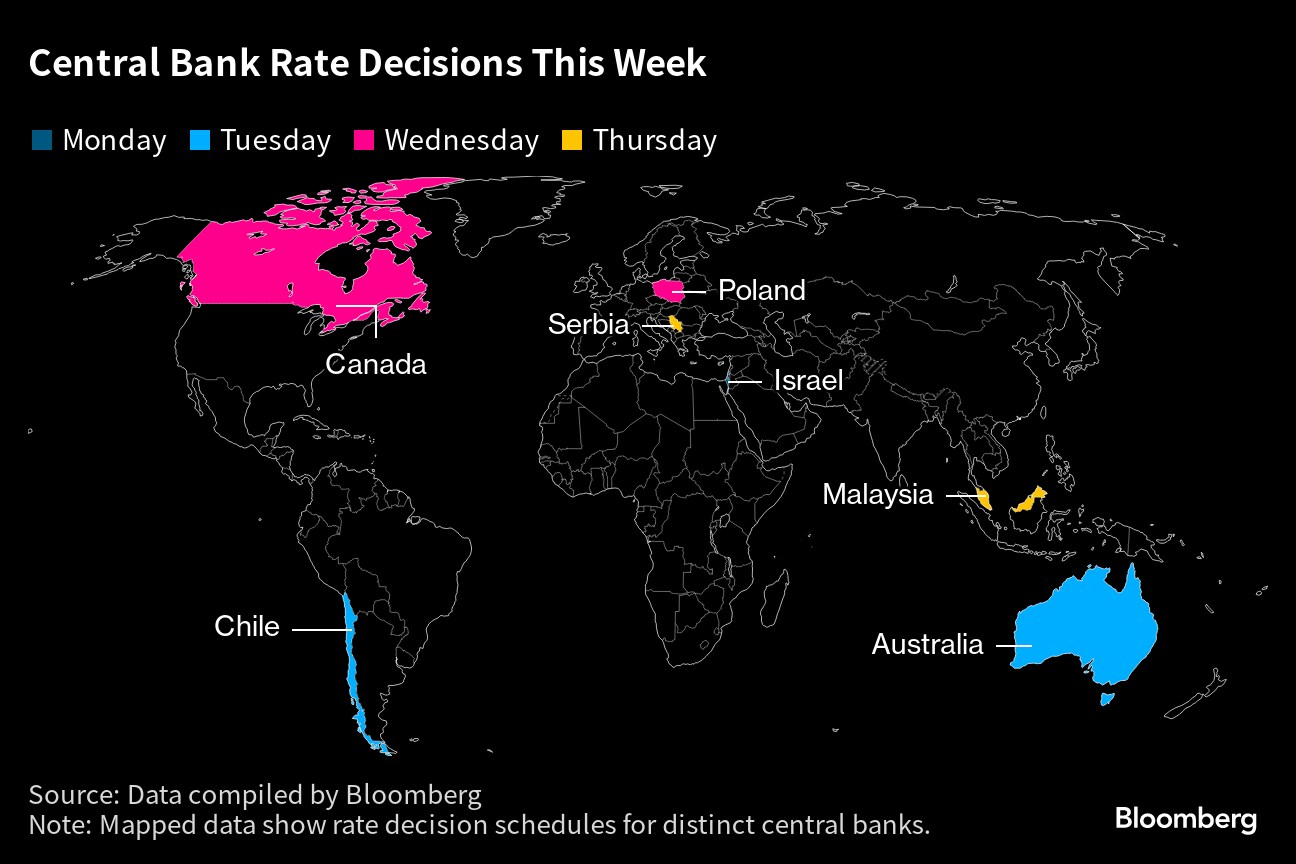
Central banks in Canada, Australia, Malaysia and Israel may keep rates on hold, while officials in Poland and Chile are likely to cut them.
Click here for what happened last week, and below is our wrap of what's coming up in the global economy.
US and Canada
After a hefty dose of labor market data, the US economic calendar gets considerably lighter in the coming week, which is shortened by Monday's Labor Day holiday. The Federal Reserve's Beige Book on Wednesday will offer anecdotes of recent economic activity around the country.
The same day, the Institute for Supply Management releases results of its August survey of service providers. Economists forecast activity expanded at a moderate pace during the month.
A slew of Fed officials, including John Williams, Raphael Bostic and Lorie Logan, are scheduled to speak on Thursday.
Further north, the Bank of Canada is widely expected to hold rates steady at 5% after data on Friday showed the economy unexpectedly shrank in the second quarter.
The central bank's decision on Wednesday will be accompanied by a brief statement. Governor Tiff Macklem will deliver a speech and take questions from reporters the following day in Calgary.
- For more, read Bloomberg Economics' full Week Ahead for the US
Asia
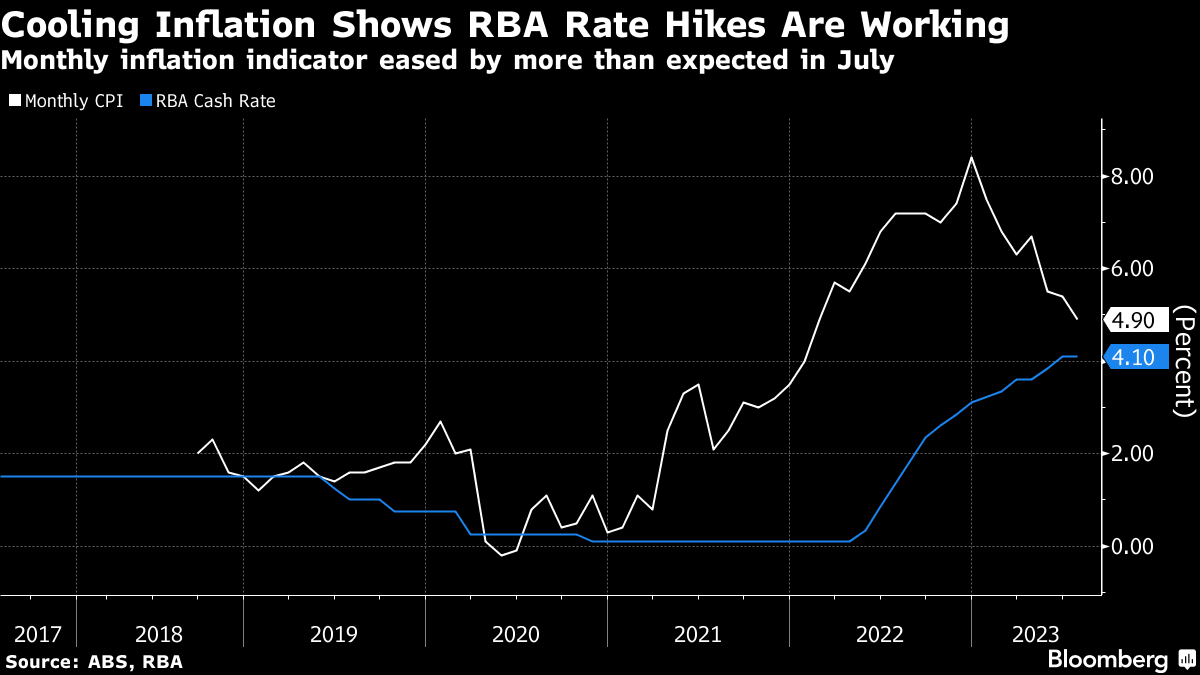
Australia's central bank meets Tuesday to decide on rates, with another hold expected following inflation figures showing a sharper-than-anticipated slowing.
Growth data the following day are likely to point to only a meager expansion of the economy in the second quarter as the impact of a slowdown in China and elevated borrowing costs weigh.
RBA chief Philip Lowe is likely to reflect on his turbulent time at the helm of the central bank in a speech on Thursday as the clock winds down on his governorship.
The Philippines, South Korea, Thailand and Taiwan release price data, with Thai inflation expected to buck a global slowing trend.
Malaysia's central bank is seen standing pat on Thursday at its rate-setting meeting.
Japan updates its GDP figures on Friday by factoring in updated capital spending and inventory figures after stronger-than-expected 2Q growth.
Speeches by two Bank of Japan board members will give the latest views on the monetary policy outlook ahead of a meeting later in the month.
- For more, read Bloomberg Economics' full Week Ahead for Asia
Europe, Middle East, Africa
The European Central Bank will reveal its latest survey of consumer inflation expectations on Tuesday, a significant piece of data ahead of its Sept. 14 rate decision.
ECB officials will get a final chance to comment before their quiet period ahead of the policy meeting begins Thursday. President Christine Lagarde and Bundesbank chief Joachim Nagel both speak on Monday, with Bank of Italy Governor Ignazio Visco due to appear a day later.
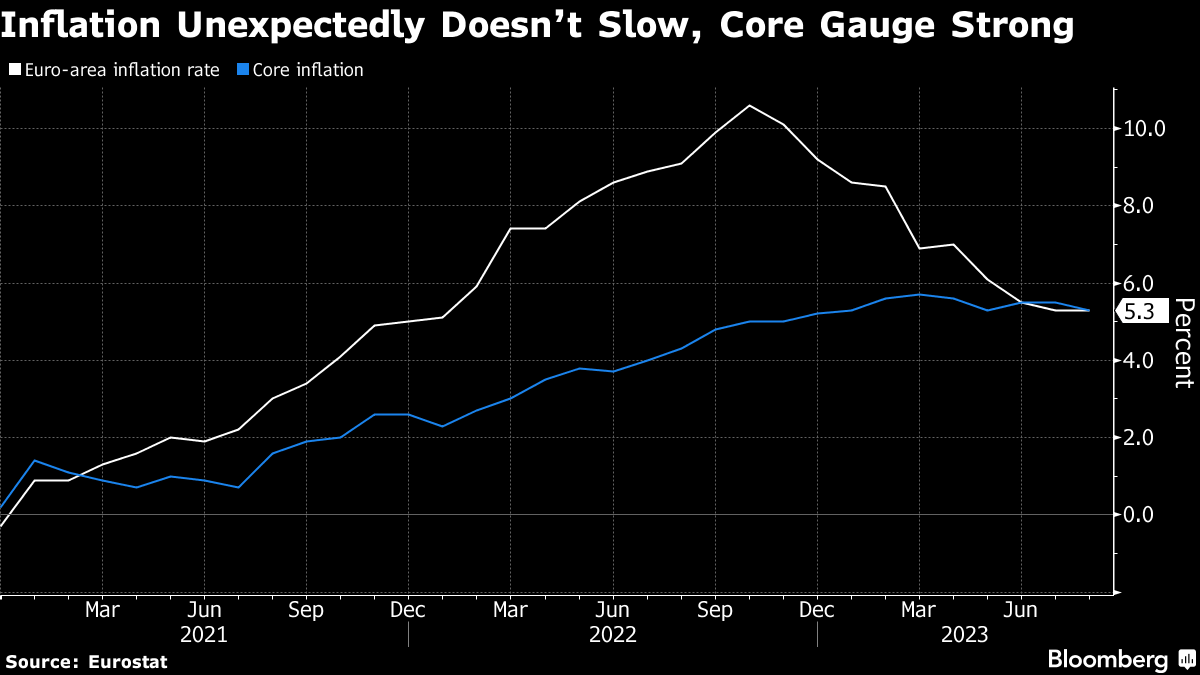
Germany's economic troubles will also be in focus as July data on factory orders and industrial production sheds more light on the downturn in the sector at the start of the third quarter. Survey-based indicators have painted a dire picture lately.
In the UK, testimony in Parliament by Governor Andrew Bailey and other Bank of England officials will be a highlight.
Poland's central bank faces a crunch decision on whether to start cutting rates even after inflation failed to slow into single digits, a key condition previously laid out by Governor Adam Glapinski to start monetary easing.
The National Bank of Serbia makes its monthly decision rate on Thursday, possibly opting for a second straight pause after earlier increases in borrowing costs helped rein in inflation.
Hungary reports closely-watched data, including on inflation that's been the highest in the European Union. Russia will reveal its latest consumer-price data too.
Looking south, Israel's central bank faces a tricky decision on Monday. Inflation has slowed in recent months, suggesting there's room to hold the rate steady for a second meeting, but the shekel has weakened to around a six-year low. That may force officials to tighten monetary policy again.
On the same day, data from Turkey will likely show inflation accelerated back above 50% in July. The country's new central bank governor, Hafize Gaye Erkan, has said inflation won't peak until the second quarter of next year at about 60%.
In South Africa, data on Tuesday will likely show the economy avoided a contraction in the second quarter. The central bank estimates the economy expanded 0.4% in the three months through June, the same as the prior quarter.
- For more, read Bloomberg Economics' full Week Ahead for EMEA
Latin America
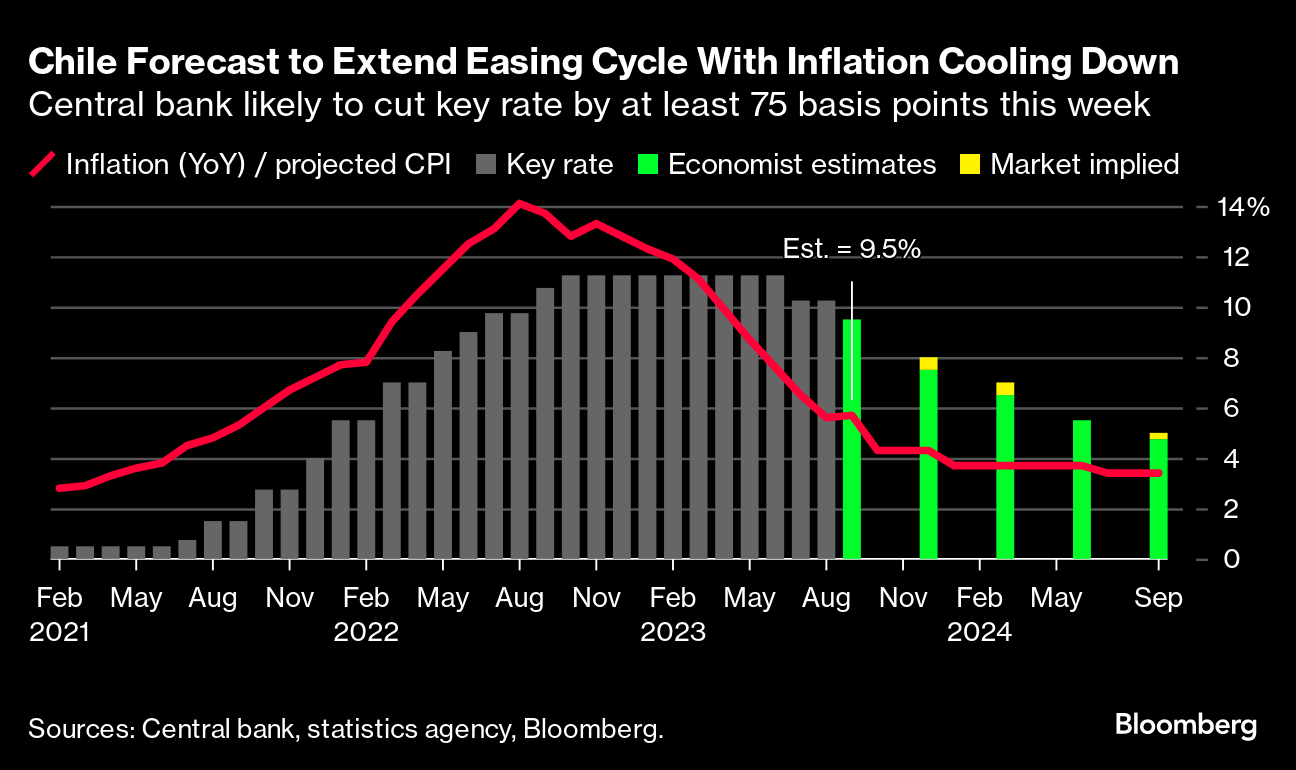
In Chile, central bankers led by governor Rosanna Costa are tipped to deliver a second straight jumbo rate cut after kicking off an easing cycle in July with a 100 basis-point reduction, to 10.25%.
Traders are pricing in another 525 bps in easing over the next year, slightly less than economists.
Brazil's industrial production data for July may begin to show some of the pickup economists expect to yield above-trend results into 2024.
Surveys of analyst expectations in Brazil, Mexico and Argentina are on tap, with the consumer price outlook the front-and-center attraction in all three.
Top of mind for investors and analysts will likely be Brazil's sticky readings for 2025 and 2026, Mexico's core inflation outlook, and gauging the impact of the peso devaluation in Argentina.
Banco Central de la República Argentina expects August's monthly inflation to have accelerated to almost double the pace of July.
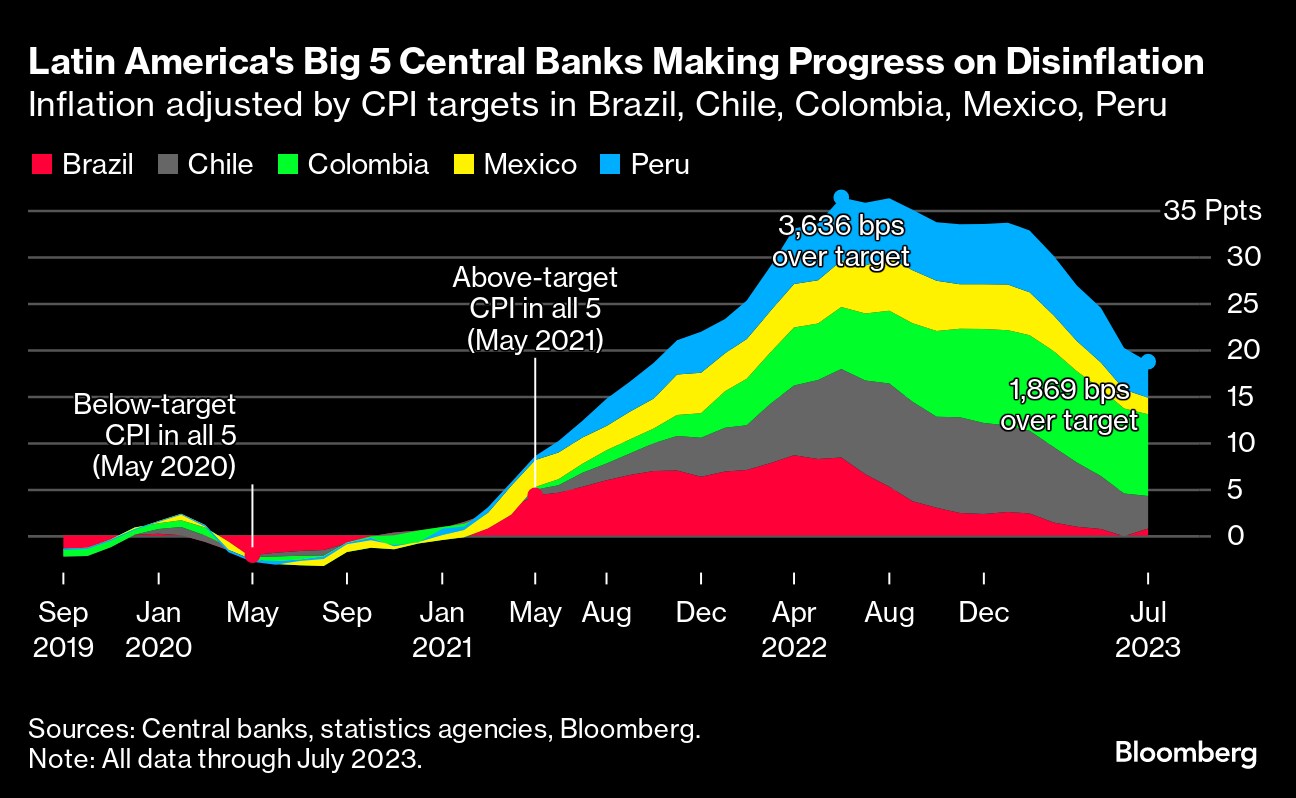
Mexico, Chile and Colombia all report August inflation data, with economists forecasting that consumer prices cooled for a seventh, ninth and fifth straight month, respectively.
None of the region's big inflation-targeting central banks currently has inflation back to target but disinflation is well underway.
- For more, read Bloomberg Economics' full Week Ahead for Latin America
--With assistance from Vince Golle, Paul Jackson, Robert Jameson, Laura Dhillon Kane, Monique Vanek, Paul Wallace and Alexander Weber.
More stories like this are available on bloomberg.com
©2023 Bloomberg L.P.

-
Navigating Energy Crossroads: S Jaishankar's Call For Diversified Supply Chains At G20 Ministerial Meeting

As geopolitical fault lines continue to test maritime trade routes and commodity flows, Jaishankar's message remains pertinent: true economic resilience requires open markets, protected transit lines, and a genuine commitment to multilateral cooperation rather than coercion.
-
Indians Are Travelling, But Not Every Journey Is A Holiday | The Week In Whys
Pilgrims, patients and working women are the real travellers, and the system hasn't quite caught up with them.
-
Getting To Work Costs Women More | The Reason Why
It is not just about women paying more than men. It is about women paying much more in cities than in villages.
-
AI Bias In Investing Cannot Be Eliminated, But It Can Be Governed
Framing is a particularly important example as identical financial information presented in terms of gains rather than losses can lead an LLM to reach a different assessment.
-
Joining The Dots | Dark Skies, Steady Diya: Why Hope Holds This Diwali
With war, a weak rupee and foreign outflows weighing on sentiment, policymakers at the NDTV World Summit and market veterans at NDTV Profit Ignite: Diwali Edition offered the same advice: stay invested and filter out the noise.
-
The Curious Case of Equitas Small Finance Bank And A CEO Who Quit For Stock
PN Vasudevan believes persistent investor concerns over a perceived conflict of interest had become a governance overhang on Equitas Small Finance Bank's stock, even as the lender improved profitability and asset quality.
-
Talking Points This Week: AI Cash Burn, A Tiger Comeback And An India That Still Finds Its Own Path
India is not immune to higher oil or tighter global liquidity, yet its earnings base is broader, its domestic policy levers are still available.
-
Foreign Investors Own Half Of HDFC Bank and ICICI Bank. An LTCG Cut Could Matter Most Here
Foreign portfolio investors have US$115 billion parked in HDFC Bank, ICICI Bank. If the government cuts long-term capital gains tax, Jefferies says returning foreign money could land here first.
-
'Never Seen This Level Of Negativity': Sandeep Tandon Says The Next Rally May Be Closer Than You Think
Veteran investor Sandeep Tandon says foreign selling is easing, large-caps are due a comeback and mid-caps are crowded, while he turns positive on gold, power and pharma this Diwali.
-
Indians Stay With Family, Not In Hotels | The Reason Why
India still lacks enough clean, reliable and affordable hotels for budget-conscious travellers.










