China and India’s Moon Rovers Take Different Paths on Historic Missions
(Bloomberg) --
After making history by becoming the first nation to successfully send a spacecraft near the moon's south pole, India is one of only two countries with active rovers on the lunar surface.
The other in that elite club is India's biggest rival, China.
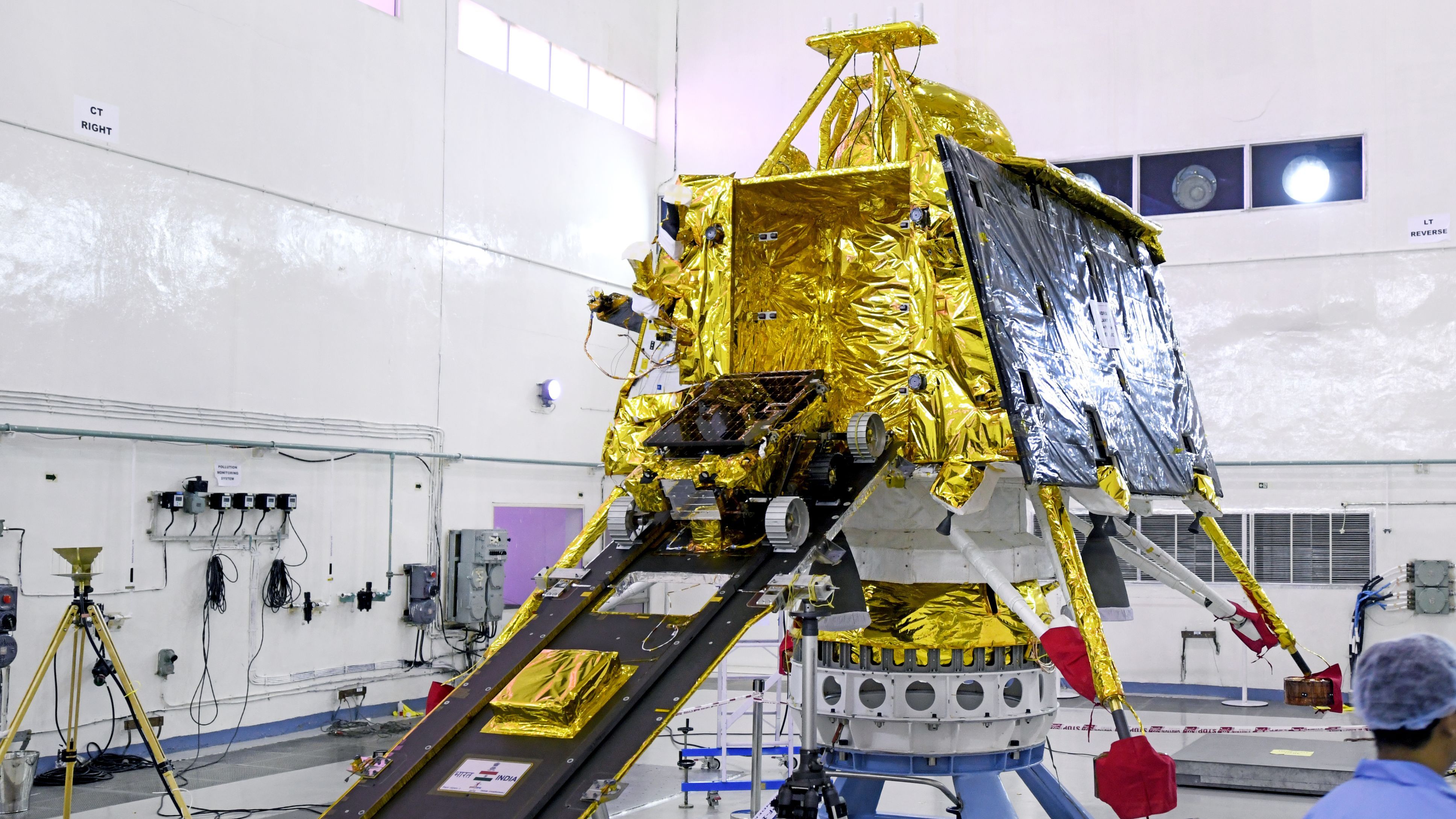
India's rover Pragyan, which means wisdom in Sanskrit, exited the lander, went down a ramp and “took a walk on the moon!” Indian space agency ISRO announced on X, formerly known as Twitter.
Read More: India First to Land Near Moon South Pole After Russia Fails
The six-wheeled vehicle will use its navigation cameras to survey the area and convey images back to Earth, with ISRO then sending instructions to the rover, which can travel as far as 500 meters (1,640 feet) from the lander, named Vikram.
If all goes according to plan, small rocks or dips in the Pragyan's path shouldn't pose major obstacles, since the rover has a suspension mechanism capable of moving up and down 50 millimeters (2 inches).
The successful touch down lifts India's prestige in the global space race, after the country suffered a setback from a failed moon mission in 2019. Prime Minister Narendra Modi wants to bolster the country's place among the world's space faring nations and in June India signed the Artemis Accords, a US-backed initiative with more than two dozen other countries to govern joint missions and civilian space exploration.

There's no chance of the Indian rover bumping into Pragyan's Chinese counterpart, Yutu-2. The Indian rover is near the lunar south pole, while China's hasn't roamed far from where it first touched ground about 45 degrees south latitude.
Compared to China's sturdy rover, India's probably won't last very long. ISRO has said Pragyan has a mission life of just one lunar day, or 14 Earth days, while Yutu-2 has been operating since early 2019, when it reached the lunar surface as part of a Chinese mission that was the first to land on the far side of the moon.
Jade Rabbit
Yutu-2 is still roaming the lunar surface, turning off during the two-week lunar night when temperatures fall to more than minus 170C (minus 274F).
The name , or Jade Rabbit, refers to the rabbit that in Chinese mythology accompanied the goddess Chang'e to the moon.
The first Chinese rover on the moon, Yutu, rolled off the Chang'e 3 lander and onto the lunar surface in December 2013. A six-wheeled vehicle relying on solar power and capable of carrying a 20-kilogram (44 pounds) payload, it had a maximum range of 10 kilometers and could explore an area of 3 square km over 90 Earth days.
It traveled on the lunar surface for 31 months — 19 more than planned — before the Xinhua news agency announced in August 2016 it had ceased operating.
China's next-generation rover, scheduled for the Chang'e 7 mission to be launched around 2026, will be bigger than Yutu-2 but with a similar structure, Tang Yuhua, deputy general designer of Chang'e-7, told state broadcaster CCTV in January.
The new Yutu will also be more autonomous in path planning, relying less on instructions from Earth, Tang said.
Other Asian countries have ambitions to deploy rovers of their own traveling on the lunar surface, with both Japan and South Korea working with their biggest automakers on vehicles that are still under development.
Toyota, Hyundai
Hyundai Motor Co. in April said it had started building a prototype of a lunar rover, part of a partnership with major Korean research institutes first announced last year.
Toyota Motor Corp. has been working with JAXA, the Japanese space agency, since 2019 on a pressurized rover capable of carrying people. They want to be ready by 2029 for use in the Artemis program, NASA's initiative to return astronauts to the moon.
The US space agency “expects Japan to provide it as a contribution” to Artemis, according to a JAXA presentation released last month. The Japanese rover will play “a major role for sustainable lunar exploration under the Artemis program.”
In the meantime, the US is hoping to send its own spacecraft to the moon soon to join the rovers that are already there. Two commercial companies, Astrobotic Technology Inc. and Intuitive Machines Inc., have developed lunar landers through a partnership with NASA's Artemis program, both of which are supposed to launch before the end of the year. If they are successful, they will be the first privately funded spacecraft to touch down on the moon.
--With assistance from Ocean Hou, Ragini Saxena and Loren Grush.
More stories like this are available on bloomberg.com
©2023 Bloomberg L.P.

-
High US Salaries, No Green Card Certainty: The Financial Calculation Facing Indian H-1B Families

The suspension of PERM processing at eight technology employers does not cancel existing H-1B visas. What it does is force a question many Indian families have been avoiding: is the US salary worth tying your career and family plans to one employer?
-
Swiggy vs Eternal: Food Delivery's Two Rivals Are No Longer In The Same Race
Eternal is building a private AI assistant, dark.ai. Swiggy is still working out how to make Instamart pay, with an operating loss of Rs 895 crore in the July-September quarter while Blinkit stayed profitable.
-
Where You Live Shapes How You Get To Work | The Reason Why
Two-wheelers are the most popular way to get to work in India, accounting for nearly 43% of workplace commutes.
-
Unhedged Position: Can India See An Indonesia-Style Time Correction?
The Nifty is trading below levels it first clocked in 2024. Is there, then, as I have suggested in the headline, potential that the current time correction drags on painfully for the next three-five, even ten years?
-
Navigating Friction And Energy Realities: An Analysis Of Marco Rubio's October Visit To India
Occurring at a critical juncture marked by stalled trade negotiations and escalating geopolitical pressures over global energy supplies, the visit offers a profound window into modern US-India relations.
-
India Exports Capital. Why Not Export Trusteeship?
The big question, then, is whether India can build an institution that global borrowers, investors, banks, and lawyers can trust, even without an Indian connection.
-
France's Economy & Politics Are In Crisis | The Reason Why
Let's look at how the French economy and politics evolved under Nicolas Sarkozy, Franois Hollande and Emmanuel Macron.
-
You May Inherit The Business. You Must Earn Its Credibility.
Succession tests the founder's ability to share authority as much as it tests the next generation's readiness to assume it.
-
Signing Deals Is One Thing; Making Them Work Is Another | The Week In Whys
Sometimes, things don't turn out as planned. Indian companies have lost some bids to rivals, some projects won't produce until 2030.
-
FOMC Wall, PERM Suspension, Hospital Stocks | Talking Points This Week
A PERM suspension would directly affect green-card sponsorship rather than H-1B visas, so the near-term earnings impact could remain relatively limited. The key question is whether this marks a new phase in US scrutiny of Indian IT.









