CEO’s Warning of ChatGPT Threat Sparks 38% Rout in Edtech Stock

(Bloomberg) -- Chegg Inc. plummeted as much as 38% after warning that the ChatGPT tool is threatening growth of its homework-help services, one of the most notable market reactions yet to signs that generative AI is upending industries.
The company, which offers online guidance for students taking tests and writing essays, also gave revenue and profit forecasts for the current quarter that fell well short of analysts' estimates. Chegg makes much of its money from subscriptions, which start at $15.95 a month, a revenue source that's in peril if students see AI chatbots as an alternative to paying.
The impact of ChatGPT, an OpenAI tool that surged in popularity last year, began to be felt this spring, Chief Executive Officer Dan Rosensweig said in prepared remarks accompanying Chegg's first-quarter earnings Monday.
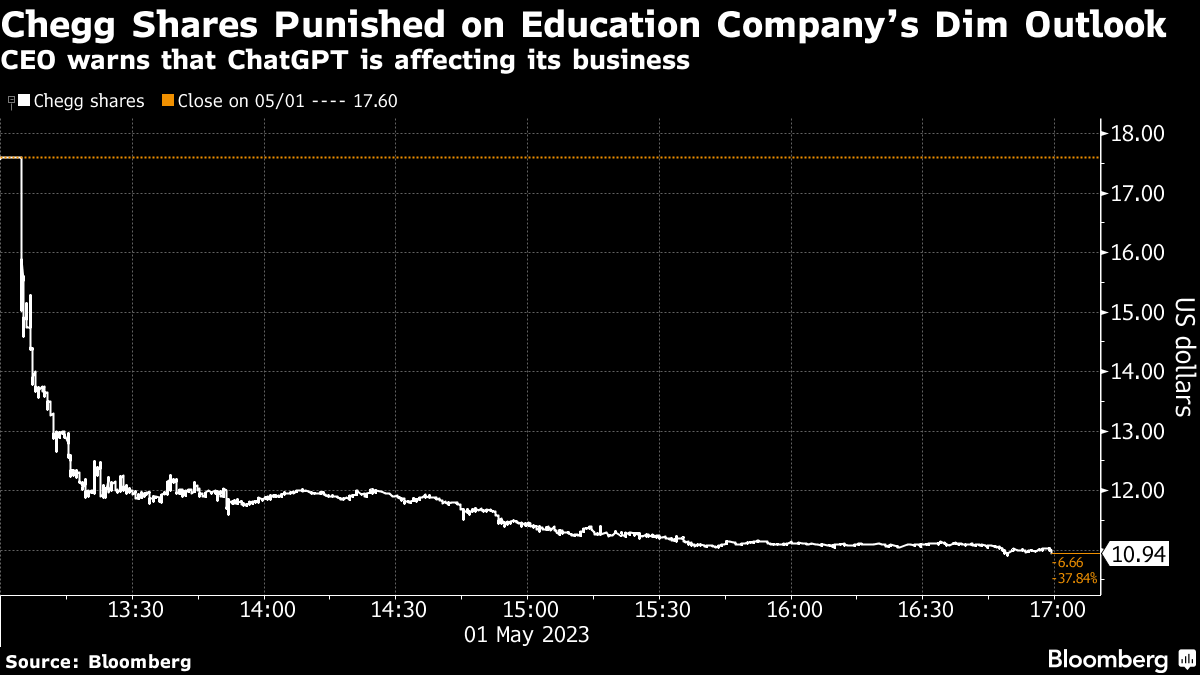
“In the first part of the year, we saw no noticeable impact from ChatGPT on our new account growth and we were meeting expectations on new sign-ups,” he said. “However, since March we saw a significant spike in student interest in ChatGPT. We now believe it's having an impact on our new customer growth rate.”
The remarks, coupled with the gloomy forecast, sent the shares as low as $10.91 in extended trading. Already, they were down 30% this year, closing at $17.60.
Industries from banking to media and education have pondered the ramifications from generative AI development since OpenAI introduced ChatGPT publicly in November. While investors from the US to China have chased stocks that proclaim they're working on similar models, it's rare for CEOs to attribute their company's underperformance to AI — followed by such a significant selloff.
Rosensweig said that retention rates of existing subscribers remain high, and he vowed to embrace AI “aggressively and immediately.”
“Throughout my career, I have witnessed the most significant technology platform shifts — from the creation of the internet to the explosion of mobile, and the movement of software to the cloud — and we believe that AI is the next big shift.”
More stories like this are available on bloomberg.com
©2023 Bloomberg L.P.

-
Ten Things I Learnt This Samvat

Patience can be a trap. Cheap stocks can stay cheap. Leverage can wipe you out. What did Samvat 2082 teach us? Niraj Shah writes on 10 lessons from the year gone by.
-
Talking Points This Week: Tech Nerves, FII Buying, And A Faraway Banking Shock
The global markets are not shining this Diwali. The exception in the large markets is, India.
-
Midterm Rally Lasted A Day. The Hard Reality Of A Divided US May Last Two Years | Opinion
Between a contested AI boom, a debt ceiling that arrives in 2027 and a president with every incentive to act alone, the next two years may prove more volatile than the first day's rally suggests.
-
Blue Wave Will Derail the AI Trade but Won't Dismantle the AI Era | Unhedged Position
The Democrats' sweep of the US Congress will see politics collide with economic forces both over the long and short term.
-
It's Time To Take The GST Council's Bet On Trust Global
Payment records can prove India's services exports, and clear, proportionate rules can bring foreign digital sellers into the tax net.
-
Opinion | India at 38: From Innovation Overperformer to Innovation Powerhouse
India now has 453 VC-backed deep science startups, 18 of them late-stage, after 117 percent growth since 2020. Laurus Labs, at USD 9.3 billion, is the most valuable deep science company in any middle-income economy outside China.
-
Navigating Energy Crossroads: S Jaishankar's Call For Diversified Supply Chains At G20 Ministerial Meeting
As geopolitical fault lines continue to test maritime trade routes and commodity flows, Jaishankar's message remains pertinent: true economic resilience requires open markets, protected transit lines, and a genuine commitment to multilateral cooperation rather than coercion.
-
Indians Are Travelling, But Not Every Journey Is A Holiday | The Week In Whys
Pilgrims, patients and working women are the real travellers, and the system hasn't quite caught up with them.
-
Getting To Work Costs Women More | The Reason Why
It is not just about women paying more than men. It is about women paying much more in cities than in villages.









