Chasing Green Goals, Corporations Push Car Fleet Managers Toward Electric Vehicles
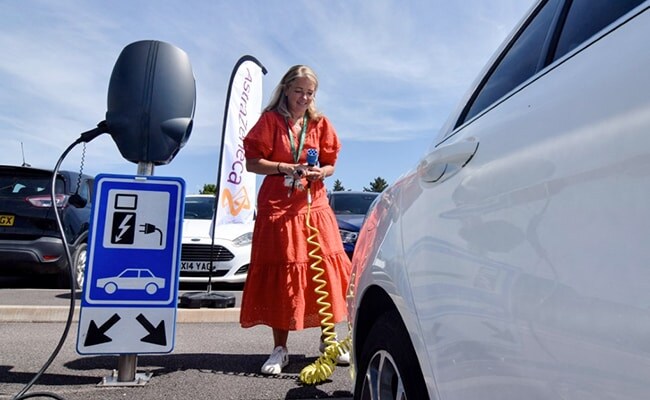
Large corporations are jumping on the "green" bandwagon left and right, which in turn is pushing firms that lease and manage car fleets to convert to electric vehicles (EVs) faster than they had ever thought possible.
In late 2020, fleet management company ALD set a to have 30% of its new cars electrified by 2025 - a goal that seemed like a stretch because as recently as 2019 only one in 200 of ALD's new vehicles was an EV or a hybrid.
But corporate clients chasing environmental, social and governance (ESG) goals pushed the leasing giant, a unit of Societe Generale, past that target in 2021.
ALD has set a new goal that around 50% of its new vehicles will be either EVs or hybrid models by 2025 as corporations' hunger for zero-emission options to meet ESG targets keeps growing, Deputy Chief Executive Officer John Saffrett told Reuters.
Corporate clients are "all sitting there trying to figure out how they're going to meet their sustainability objectives," Saffrett said. "An obvious part of their footprint today that they're trying to address is their vehicle fleet."
Firms like ALD - which replaces its entire fleet every 42 months - play an important role in the auto industry, buying millions of vehicles globally that also help shape the future of the used car market when they come off lease.
ALD also leases cars to both firms and consumers on behalf of some major carmakers including Tesla Inc and Ford Motor Co.
According to industry data, leasing has grown as retail sales have fallen - the share of cars bought at retail in Europe fell to 45% in 2021 versus 55% in 2020.
BANISHING CARBON FROM SUPPLY CHAIN
France-based ALD is taking over Dutch rival LeasePlan, giving it a combined global fleet of around 3.5 million vehicles, as it focuses on scaling up its EV business.
Large ALD customers like AstraZeneca Plc have set electrification targets - the drugmaker wants its global fleet of 17,500 vehicles to be fully electric by 2025 - and are pushing carmakers to make those cars greener.
That intensifies the pressure on the auto industry to squeeze carbon and other harmful materials out of their supply chains.
But electrifying large fleets is easier said than done.
A lack of available public charging infrastructure means that for companies with sales representatives who drive long distances, only plug-in hybrids will work for now.
"The challenge you have with electrification as a corporate is you can't just switch drivers on day one," ALD's Saffrett said. "You'd love to, but it simply doesn't work."
In Africa, some parts of Asia and Europe, companies like AstraZeneca also face a lack of available EV or hybrid models.
In other areas, where a more rugged pickup truck is needed to reach the doctors served by such companies, suitable EVs are in short supply. AstraZeneca, for instance, has no choice but to buy fossil-fuel models in those regions, said Juliette White, the drugmaker's head of global sustainability.
Around 58% of AstraZeneca's global fleet are EVs, hybrids or plug-in hybrids.
"What we're absolutely clear about is if there is a plug-in hybrid or EV available, you're not getting a combustion engine model," White said at AstraZeneca's manufacturing site in Macclesfield in Northern England.
'LOW-HANGING FRUIT'
The rush to electrification is intensifying in Europe, where corporations face regulatory pressure to cut carbon footprints.
The most immediate focus is on so-called Scope 1 and Scope 2 emissions - those a company generates itself directly and indirectly. AstraZeneca's fleet, for instance, accounts for just under 17% of its emissions. At German agriculture and pharmaceuticals company Bayer, its fleet accounts for under 5% of emissions. Bayer is aiming for 30% of its global fleet of 26,000 light-duty trucks, SUVs and sedans to be electric within the next four years.
Going electric ticks both of those boxes.
"It's very low-hanging fruit and it's super easy to focus on your fleet," said Wolf-Dieter Hoppe, a Munich-based partner at consultancy Arthur D. Little.
Passenger cars and commercial vehicles are by far the largest asset class in Europe's leasing market. According to industry lobby group Leaseurope, in 2020 new vehicle leases totaled 244 billion euros ($249.5 billion), or 69% of all equipment leases.
AstraZeneca's White said large companies are also "pushing for greener and more sustainable EVs ... because otherwise what's the point?"
In Europe, EVs can also serve as a marketing tool for companies battling for qualified employees.
"Company cars can be a determining factor in the war for talent," said Piet Briers, Bayer's head of benefits. "As the availability of zero-emission car models as well as charging infrastructure continue to positively evolve, we see that employees are getting more engaged to opt for sustainable solutions."
But North America is catching up.
By 2030, around 40% to 60% of the 1.5 million vehicles Toronto-based Element Fleet Management Corp manages - 75% of which are in the United States and Canada - will be fully electric as businesses pursue ESG goals, said Chief Executive Jay Forbes.
Again, though, the availability of suitable models and charging infrastructure will slow the adoption of EVs by corporate customers, he said.
"In 2019, I couldn't get anyone talking about this," Forbes said. "In 2022, all my clients want to talk about this evolution."
(This story has not been edited by NDTV staff and is auto-generated from a syndicated feed.)

-
Navigating Energy Crossroads: S Jaishankar's Call For Diversified Supply Chains At G20 Ministerial Meeting

As geopolitical fault lines continue to test maritime trade routes and commodity flows, Jaishankar's message remains pertinent: true economic resilience requires open markets, protected transit lines, and a genuine commitment to multilateral cooperation rather than coercion.
-
Indians Are Travelling, But Not Every Journey Is A Holiday | The Week In Whys
Pilgrims, patients and working women are the real travellers, and the system hasn't quite caught up with them.
-
Getting To Work Costs Women More | The Reason Why
It is not just about women paying more than men. It is about women paying much more in cities than in villages.
-
AI Bias In Investing Cannot Be Eliminated, But It Can Be Governed
Framing is a particularly important example as identical financial information presented in terms of gains rather than losses can lead an LLM to reach a different assessment.
-
Joining The Dots | Dark Skies, Steady Diya: Why Hope Holds This Diwali
With war, a weak rupee and foreign outflows weighing on sentiment, policymakers at the NDTV World Summit and market veterans at NDTV Profit Ignite: Diwali Edition offered the same advice: stay invested and filter out the noise.
-
The Curious Case of Equitas Small Finance Bank And A CEO Who Quit For Stock
PN Vasudevan believes persistent investor concerns over a perceived conflict of interest had become a governance overhang on Equitas Small Finance Bank's stock, even as the lender improved profitability and asset quality.
-
Talking Points This Week: AI Cash Burn, A Tiger Comeback And An India That Still Finds Its Own Path
India is not immune to higher oil or tighter global liquidity, yet its earnings base is broader, its domestic policy levers are still available.
-
Foreign Investors Own Half Of HDFC Bank and ICICI Bank. An LTCG Cut Could Matter Most Here
Foreign portfolio investors have US$115 billion parked in HDFC Bank, ICICI Bank. If the government cuts long-term capital gains tax, Jefferies says returning foreign money could land here first.
-
'Never Seen This Level Of Negativity': Sandeep Tandon Says The Next Rally May Be Closer Than You Think
Veteran investor Sandeep Tandon says foreign selling is easing, large-caps are due a comeback and mid-caps are crowded, while he turns positive on gold, power and pharma this Diwali.
-
Indians Stay With Family, Not In Hotels | The Reason Why
India still lacks enough clean, reliable and affordable hotels for budget-conscious travellers.










