Changes In Insolvency Code May Be Needed: Arun Jaitley
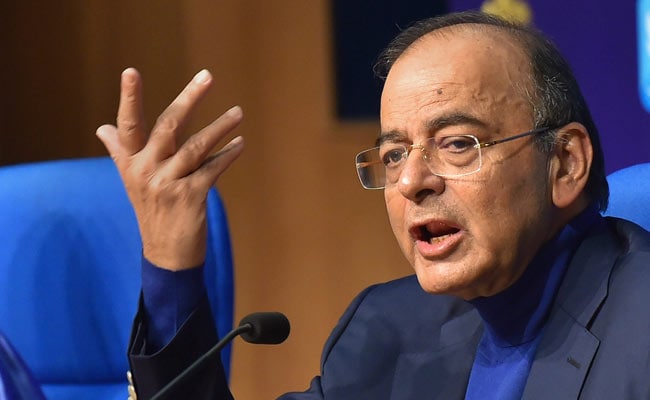
New Delhi: Finance Minister Arun Jaitley on Tuesday said changes in Section 29A of the Insolvency and Bankruptcy Code (IBC) may be required as the earlier amendment may have been "too wide" in relation to the definition of related parties. "Some people have represented to me that in the amended 29A, the reading may be too wide particularly in relation to the definition of related parties?" he said at a conference on IBC co-hosted by Insolvency and Bankruptcy Board of India (IBBI).
Section 29A, which was introduced via an ordinance in November 2017, bars wilful corporate defaulters and "connected person" from bidding for stressed assets (including own), which is under the Corporate Insolvency Resolution Process (CIRP).
"You can't amend the law every time but certainly this is a point worth consideration on the agenda...
"Some contradictions have been pointed out to me by some sections of the industry itself particularly with regard to related parties who may actually be business opponents or have business-wise nothing to do with each other," he said.
The ineligibility criteria not only ruled out Ruias, Singhals and Manoj Gaur from submitting resolution plans for their insolvent assets Essar Steel Ltd, Bhushan Power and Steel Ltd and Jaypee Infratech, respectively, but could also prevent ArcelorMittal Chairman LN Mittal, a bidder for Essar Steel, as his younger brother Pramod Mittal's company is a defaulter.
Another issue that the Minister wanted to be considered is the role of small and operational creditors in the whole insolvency resolution process.
"Once the resolutions take place, do they get almost nothing or something very marginal. I think that's a question for academics and draftsmen for a future debate and therefore once the big cases are resolved this should be an issue which have to be adequately addressed."
Asserting that the "early harvest has been reasonably good" for the two-year-old IBC, which was implemented hurriedly and has undergone several changes, Jaitley said the fact that it passes through a judicial or a quasi-judicial tribunal gives promoters a curtain of protection.
"I am quite certain that after the recent Supreme Court pronouncement with regard to frivolity of certain appeals which are preferred against every interlocutory order, hopefully the process of pending cases would now be expedited and therefore the money which is lying blocked otherwise could be utilised back into the system," he said.
Jaitley said once the initial rush of major cases under IBC was over in the next couple of years and the honest creditor-debtor relationship was restored, offering pre-IBC schemes of RBI on settlements and restructuring within the insolvency framework could be considered.
"A situation may well arise where we would have to consider the need for marrying the two processes together so that they could simultaneously exist because ultimately the management of the financial system is also the art of the possible and not a strict implementation of a municipal legislation," he said.
Further, he said the government is already working on the cross-border insolvency norms and it is not merely bilateral arrangements but also multi-lateral arrangements.

-
High US Salaries, No Green Card Certainty: The Financial Calculation Facing Indian H-1B Families

The suspension of PERM processing at eight technology employers does not cancel existing H-1B visas. What it does is force a question many Indian families have been avoiding: is the US salary worth tying your career and family plans to one employer?
-
Unhedged Position: Can India See An Indonesia-Style Time Correction?
The Nifty is trading below levels it first clocked in 2024. Is there, then, as I have suggested in the headline, potential that the current time correction drags on painfully for the next three-five, even ten years?
-
Navigating Friction And Energy Realities: An Analysis Of Marco Rubio's October Visit To India
Occurring at a critical juncture marked by stalled trade negotiations and escalating geopolitical pressures over global energy supplies, the visit offers a profound window into modern US-India relations.
-
India Exports Capital. Why Not Export Trusteeship?
The big question, then, is whether India can build an institution that global borrowers, investors, banks, and lawyers can trust, even without an Indian connection.
-
France's Economy & Politics Are In Crisis | The Reason Why
Let's look at how the French economy and politics evolved under Nicolas Sarkozy, Franois Hollande and Emmanuel Macron.
-
You May Inherit The Business. You Must Earn Its Credibility.
Succession tests the founder's ability to share authority as much as it tests the next generation's readiness to assume it.
-
Signing Deals Is One Thing; Making Them Work Is Another | The Week In Whys
Sometimes, things don't turn out as planned. Indian companies have lost some bids to rivals, some projects won't produce until 2030.
-
FOMC Wall, PERM Suspension, Hospital Stocks | Talking Points This Week
A PERM suspension would directly affect green-card sponsorship rather than H-1B visas, so the near-term earnings impact could remain relatively limited. The key question is whether this marks a new phase in US scrutiny of Indian IT.
-
Everything, Everywhere, All At Once: Dalal Street's Week To Forget | Joining The Dots
Visa curbs, a Starlink spat and cancer drug caps: what connects this week's shocks for Indian markets
-
India Is Going Abroad For Critical Minerals. But It May Take Years To Pay Off | The Reason Why
Although India's steps are in the right direction, they remain modest compared with India's growing dependence.









