Centre To Offer Wheat To Flour Millers, Biscuit Makers To Bring Down Prices: Report
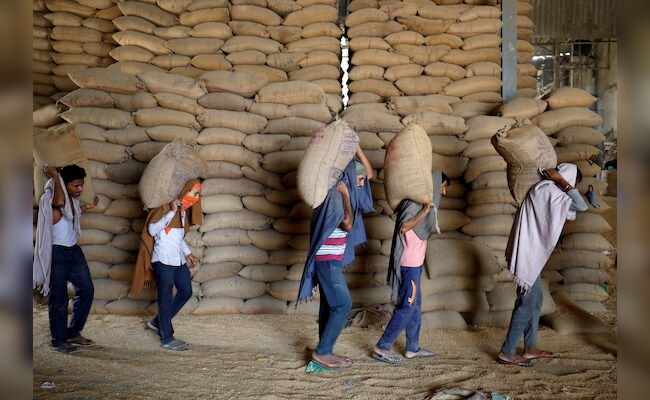
India is set to offer 2 to 3 million tonnes of wheat to bulk consumers such as flour millers and biscuit makers as part of efforts to cool record high prices, two government sources said, even as state reserves have dropped to the lowest in six years.
Wheat prices have surged in India this year after a sudden rise in temperatures hit crop yields and output.
A jump in exports following Russia's invasion of Ukraine also pushed up local wheat prices, prompting India, the world's second-biggest producer of the grain, to order a ban on exports in May, but that has failed to stop domestic prices rising.
As open market prices rose above the rate at which the government buys the staple from domestic farmers, state purchases of wheat have fallen by 53% this year to 18.8 million tonnes.
"We're planning to offload wheat in the open market to control prices as we can't afford to have yet another year of lower procurement (when purchases start in March/April 2023)," said one of the sources. "In terms of stocks, we have the elbow room to intervene in the market."
The government buys rice and wheat from farmers at state-set prices to run the world's biggest food welfare programme that entitles about 800 million people to receive 5 kg of rice and wheat every month at 2 rupees ($0.02) and 3 rupees a kg respectively.
The plan is to free up 2 to 3 million tonnes of wheat for sale to bulk users, the sources said.
India's falling wheat reserves, and rising prices of the staple are a far cry from overflowing granaries that allowed the country to export a record 7.2 million tonnes of the grain in the fiscal year to March 2022.
"We're confident that the release of 2 to 3 million tonnes of wheat in the open market will bring prices down," said the second source.
The two sources with direct knowledge of the matter didn't wish to be named, in line with official policy.
They also said the government will decide later this month whether to extend the food programme that provides free rice and wheat to the poor.
On top of the flagship food welfare scheme, Prime Minister Narendra Modi in April 2020 introduced the free food programme as part of the government's COVID-19 relief measures.
In September, ahead of some crucial state elections, Modi's administration extended the programme by three months, adding $5.46 billion to government spending and making it challenging to rein in the fiscal deficit.
As well as the cost, government officials have cited lower government wheat stocks as a serious impediment to continuing with the free food plan that requires between 95 and 100 million tonnes of rice and wheat every year.
"The government is in a tight spot due to lower stocks and that's why it would be difficult to continue with the free food programme without any curtailment," said a New-Delhi-based trader with a global trade house.
(Except for the headline, this story has not been edited by NDTV staff and is published from a syndicated feed.)

-
High US Salaries, No Green Card Certainty: The Financial Calculation Facing Indian H-1B Families

The suspension of PERM processing at eight technology employers does not cancel existing H-1B visas. What it does is force a question many Indian families have been avoiding: is the US salary worth tying your career and family plans to one employer?
-
Swiggy vs Eternal: Food Delivery's Two Rivals Are No Longer In The Same Race
Eternal is building a private AI assistant, dark.ai. Swiggy is still working out how to make Instamart pay, with an operating loss of Rs 895 crore in the July-September quarter while Blinkit stayed profitable.
-
Where You Live Shapes How You Get To Work | The Reason Why
Two-wheelers are the most popular way to get to work in India, accounting for nearly 43% of workplace commutes.
-
Unhedged Position: Can India See An Indonesia-Style Time Correction?
The Nifty is trading below levels it first clocked in 2024. Is there, then, as I have suggested in the headline, potential that the current time correction drags on painfully for the next three-five, even ten years?
-
Navigating Friction And Energy Realities: An Analysis Of Marco Rubio's October Visit To India
Occurring at a critical juncture marked by stalled trade negotiations and escalating geopolitical pressures over global energy supplies, the visit offers a profound window into modern US-India relations.
-
India Exports Capital. Why Not Export Trusteeship?
The big question, then, is whether India can build an institution that global borrowers, investors, banks, and lawyers can trust, even without an Indian connection.
-
France's Economy & Politics Are In Crisis | The Reason Why
Let's look at how the French economy and politics evolved under Nicolas Sarkozy, Franois Hollande and Emmanuel Macron.
-
You May Inherit The Business. You Must Earn Its Credibility.
Succession tests the founder's ability to share authority as much as it tests the next generation's readiness to assume it.
-
Signing Deals Is One Thing; Making Them Work Is Another | The Week In Whys
Sometimes, things don't turn out as planned. Indian companies have lost some bids to rivals, some projects won't produce until 2030.
-
FOMC Wall, PERM Suspension, Hospital Stocks | Talking Points This Week
A PERM suspension would directly affect green-card sponsorship rather than H-1B visas, so the near-term earnings impact could remain relatively limited. The key question is whether this marks a new phase in US scrutiny of Indian IT.









