Centre, States Must Act In Partnership To Strengthen Fiscal Fundamentals: NK Singh
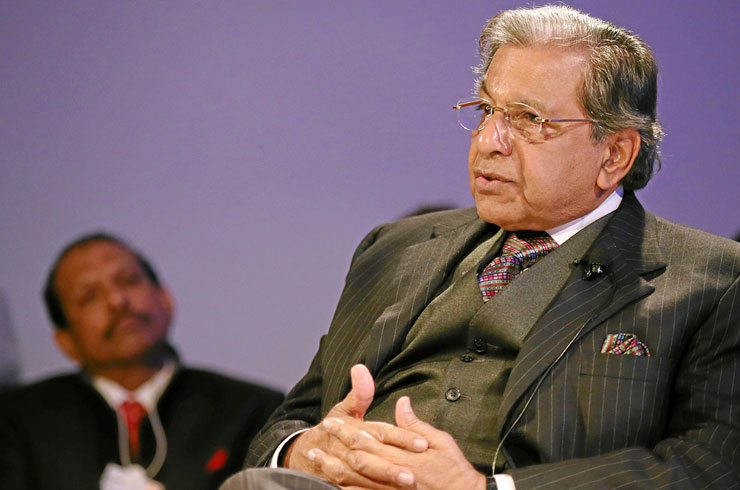
As India moves towards a new fiscal framework, the Centre and states will need to act together to bring down the country's debt to more comfortable levels and reduce the fiscal funding gap. NK Singh, who chaired a committee reviewing the Fiscal Responsibility and Budget Management (FRBM) Act, told BloombergQuint that such a partnership would be essential to bring down the country's debt-to-GDP ratio to the suggested 60 percent by 2023.
The report of the six-member FRBM review committee, submitted to the government in January, was made public earlier this month. Apart from suggesting an overall cap, the committee recommended that the Centre's debt-to-GDP ratio be restricted to 40 percent while states stick to an aggregate debt-to-GDP ratio of 20 percent.
This could prove to be a challenge at a time when state finances are seen deteriorating. Singh, however, said it is essential to control both state and central government finances as external agencies tend to look at the aggregate while judging a country's fiscal standing.
The world does not look to segregate debt into central and state government. So I think the states and the Centre will have to act in partnership for improving the overall long-term macroeconomic framework for enticing investment, for fostering growth. And we do believe that this kind of a partnership between the Centre and the state is one more desirable instrument for a working federation which we have.NK Singh, Chairman, FRBM Review Committee
After a period of consolidation, state finances started to look shaky in fiscal 2017. The fiscal deficit for 16 states widened to 3.4 percent in fiscal 2017 compared to 3.1 percent the previous year, highlighted a report by Kotak Institutional Equities released on Tuesday. Gross borrowings from these states rose to Rs 3.4 lakh crore in fiscal 2017 compared to Rs 2.6 lakh crore in the previous year.
Singh acknowledged that state finances have had a ‘checkered past' and added that upcoming Fifteenth Finance Commission should look into the inter se division of debt between states.
There are two aspects to it. One is the overall debt of the states which is 20 percent, which the report has pointed out. The other, of course, is the inter se balancing between the states and that responsibility and obligation we feel is best left to the Fifteenth Finance Commission...We have recommended one of the terms of reference for the commission should be this issue of inter se management between the states.NK Singh, Chairman, FRBM Review Committee
Singh added that the ‘information asymmetry' between individual state finances and their borrowing costs needs to be removed.
At present, the market tends to price all state borrowings at a similar spread above the central government's borrowing rate. Investors do not distinguish between well-run states and those that are running large deficits or have high debt. If this were to change, states would be under greater pressure to adhere to a path of fiscal prudence.
This information asymmetry should be bridged and the market should be better informed on the management of state finances as a whole. The states who have managed their finances better and in a more prudent way, should be in a position to borrow at terms which in some way reward their better financial management, compared to the states which have been fiscally profligate.NK Singh, Chairman, FRBM Review Committee
Arbitrary Targets?
One criticism of the NK Singh committee's recommendations came from within the committee itself. Chief Economic Adviser Arvind Subramanian, who has called for looser fiscal policy for some time now, said in a dissent note that the targets set by the committee are “arbitrary.”
“A 60 percent debt-GDP rule cannot command broad consensus,” wrote Subramanian while adding that the medium term fiscal deficit target of 2.5 percent of GDP is “based on a conceptual framework that is unrelated to the debt objective and based on calculations that are hard to justify.”
Subramanian also argued that the primary deficit ought to be the principal anchor for fiscal policy.
Singh, in response, said that a number of countries around the world have now adopted debt as the anchor for fiscal policy and added that the framework has received international acceptance. “Hardly any worthwhile country today is adopting a primary deficit really as a principal anchor,” said Singh.
Also Read: India's New Fiscal Framework: Are We Choosing The Right Targets?
An Independent Fiscal Council
The FRBM review committee has also suggested the setting up of an independent fiscal council.
The three-member council would consist entirely of government appointed members. It's main task would be to “provide an independent assessment of the central government's fiscal performance and compliance with targets” set under the revised Act. The government would also be expected to consult with the fiscal council before invoking the escape clause, which allows it to expand the fiscal deficit by upto 0.3 percent of GDP to deal with stress or structural reforms which impact government revenue.
The council is expected to function as an advisory body and is not intended to “trump” the government in any form, said Singh. The council's advice need not be binding on the government, he added.
The recommendations of the committee are still to be formally accepted by the government.

-
Navigating Energy Crossroads: S Jaishankar's Call For Diversified Supply Chains At G20 Ministerial Meeting

As geopolitical fault lines continue to test maritime trade routes and commodity flows, Jaishankar's message remains pertinent: true economic resilience requires open markets, protected transit lines, and a genuine commitment to multilateral cooperation rather than coercion.
-
Indians Are Travelling, But Not Every Journey Is A Holiday | The Week In Whys
Pilgrims, patients and working women are the real travellers, and the system hasn't quite caught up with them.
-
Getting To Work Costs Women More | The Reason Why
It is not just about women paying more than men. It is about women paying much more in cities than in villages.
-
AI Bias In Investing Cannot Be Eliminated, But It Can Be Governed
Framing is a particularly important example as identical financial information presented in terms of gains rather than losses can lead an LLM to reach a different assessment.
-
Joining The Dots | Dark Skies, Steady Diya: Why Hope Holds This Diwali
With war, a weak rupee and foreign outflows weighing on sentiment, policymakers at the NDTV World Summit and market veterans at NDTV Profit Ignite: Diwali Edition offered the same advice: stay invested and filter out the noise.
-
The Curious Case of Equitas Small Finance Bank And A CEO Who Quit For Stock
PN Vasudevan believes persistent investor concerns over a perceived conflict of interest had become a governance overhang on Equitas Small Finance Bank's stock, even as the lender improved profitability and asset quality.
-
Talking Points This Week: AI Cash Burn, A Tiger Comeback And An India That Still Finds Its Own Path
India is not immune to higher oil or tighter global liquidity, yet its earnings base is broader, its domestic policy levers are still available.
-
Foreign Investors Own Half Of HDFC Bank and ICICI Bank. An LTCG Cut Could Matter Most Here
Foreign portfolio investors have US$115 billion parked in HDFC Bank, ICICI Bank. If the government cuts long-term capital gains tax, Jefferies says returning foreign money could land here first.
-
'Never Seen This Level Of Negativity': Sandeep Tandon Says The Next Rally May Be Closer Than You Think
Veteran investor Sandeep Tandon says foreign selling is easing, large-caps are due a comeback and mid-caps are crowded, while he turns positive on gold, power and pharma this Diwali.
-
Indians Stay With Family, Not In Hotels | The Reason Why
India still lacks enough clean, reliable and affordable hotels for budget-conscious travellers.










