Carbon Pricing Is Key To Delivering Global Emissions Cuts, IMF Says
Higher temperatures and more intense storms haven't changed the fundamental challenge of climate policy: Countries around the world must find politically feasible ways to zero out emissions without taking on crushing loads of debt.
The latest edition of the International Monetary Fund's semiannual Fiscal Monitor calls that quandary a “trilemma.” It can be solved, the authors argue, through targeted policies anchored in some version of carbon pricing, traditionally economists' preferred tool. The report comes in advance of the IMF's annual meeting, to be held this month in Marrakech, Morocco.
The IMF analyzes two scenarios in which countries act to cut greenhouse gases. Each scenario simulates two hypothetical countries: one an average of the G-7 economies, the other an average of Argentina, Brazil, China, India, Indonesia, Mexico, South Africa and Turkey.
In one scenario, governments take emissions-slashing measures that balloon their debt. The massive pulse in climate-related spending pushes the debt-to-gross-domestic-product ratio of the hypothetical advanced economy up 45% by 2050, with similar effects on borrowing costs. In the hypothetical emerging or developing economy, debt-to GDP ratio jumps 50%.
In the second scenario, more modest policy measures fail to cut the rich country's emissions nearly enough — just 40% below the current level. In the hypothetical developing country, emissions fall only 10%.
In short, paying for the energy transition can't be shouldered by governments or the private sector alone. “We consider this as fiscally unsustainable” for governments, said Ruud de Mooij, deputy director of the IMF's Fiscal Affairs Department, who ran the study. “On the other hand, if the government lets the private sector pay for everything, this may produce fierce political opposition,” de Mooij said, which could undermine climate action.
There is a productive medium between the two, according to the IMF. Carbon pricing, coupled with moderate spending, lowers the debt burden in the scenarios for both developed and emerging economies.
If advanced economies can pass both carbon pricing and policies specific to hard-to-decarbonize sectors, such as buildings and steelmaking, their debt load would increase by 10% to 15% of GDP in the simulation — not great, but much more manageable than unrestricted climate investment.
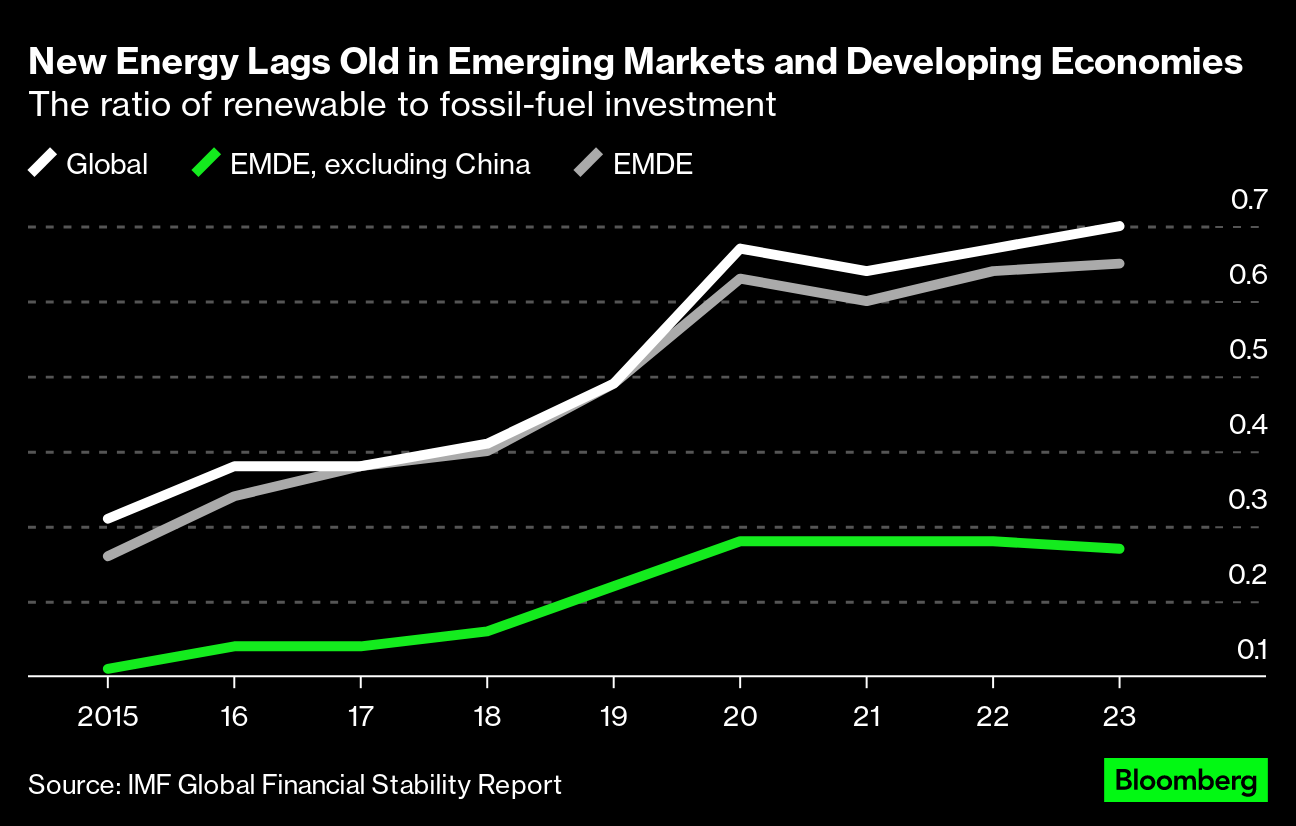
Emerging markets might also see a 15% increase in debt. Developing countries and emerging markets together are expected to be responsible for more than 70% of emissions by 2035, yet face massive debt and rising interest rates, putting them at a disadvantage to their richer neighbors. Investment in low-carbon energy in these nations is far behind the renewable transformation of advanced economies and China.
The course that IMF analysts chart through the climate strait is a plausible one. Carbon pricing policies, such as a tax or permit-trading market, are in place in 49 developed or emerging-market countries. Another 23 are planning them. The prices range from a high of $130 a ton of CO2 in Liechtenstein to a low of about $5 in Argentina. In China's national trading program, a ton of carbon dioxide is currently worth $10.40. The world average is $20 a ton, and the policies cover about 25% of global emissions.
Economists and other advocates once considered carbon pricing as close to a magic bullet as policy tools get. That's because, theoretically, it corrects the central driver of climate change — fossil fuel emissions historically have a cost, but no price — and generates revenue that can then be used to help people and industries through the transition to clean energy.
Enough carbon pricing mechanisms are in place around the world for the researchers to be able to use data to see how well they do in comparison to simulations. The oldest carbon pricing programs have been around for years. Sweden first enacted a carbon price in 1991.
Carbon pricing hasn't proved politically feasible everywhere. Australia adopted a carbon price in 2011 and repealed it three years later. A US push in 2009 for national carbon pricing failed; the US has since relied on subsidies, regulation and, most recently, the 2022 Inflation Reduction Act, a broad incentives package.
The approach also has limited value when it comes to sectors lagging in decarbonization. Building owners need more specific incentives to retrofit their systems with heat pumps. For these and other parts of the economy, the IMF recommends any of a suite of tools. These may include plain-old regulation and subsidies, as well as “feebates” that levy a fee for carbon-heavy technologies, such as internal-combustion cars, or rebate purchase costs for electric vehicles.
Fossil-fuel producing countries are in a particularly sensitive condition, as they must wind down their main export, shift to clean energy and do so at the whims of a global fossil-fuel energy market in decline. There are 10 countries that bring in more than half their revenue from fossil fuel sales. New fiscal approaches and diversification of national oil companies are critical, the IMF writes.
The climate trilemma is particularly acute in emerging markets and developing countries, the subject of an accompanying IMF release, the Global Financial Stability Report.
These nations collectively need about $2 trillion in energy-transition investment a year by 2030, up from a current level of about $400 billion. Sub-investment grade credit and high finance costs for governments mean that the private sector will need to deliver 80% of the investment — 90% if China isn't included.
Banks and insurers play a key role in how poorer countries develop. Coal plants financed by banks with stricter climate policies “are more likely to be retired or repurposed,” the authors write.
Sitting still as the climate changes is also an expensive option. Doing nothing adds 0.8% to 2% of GDP a year to public debt, as losses and adaptation costs mount. Ratios of debt to GDP are already expected to rise by one percentage point a year through 2028.
©2023 Bloomberg L.P.

-
Ten Things I Learnt This Samvat

Patience can be a trap. Cheap stocks can stay cheap. Leverage can wipe you out. What did Samvat 2082 teach us? Niraj Shah writes on 10 lessons from the year gone by.
-
Talking Points This Week: Tech Nerves, FII Buying, And A Faraway Banking Shock
The global markets are not shining this Diwali. The exception in the large markets is, India.
-
Midterm Rally Lasted A Day. The Hard Reality Of A Divided US May Last Two Years | Opinion
Between a contested AI boom, a debt ceiling that arrives in 2027 and a president with every incentive to act alone, the next two years may prove more volatile than the first day's rally suggests.
-
Blue Wave Will Derail the AI Trade but Won't Dismantle the AI Era | Unhedged Position
The Democrats' sweep of the US Congress will see politics collide with economic forces both over the long and short term.
-
It's Time To Take The GST Council's Bet On Trust Global
Payment records can prove India's services exports, and clear, proportionate rules can bring foreign digital sellers into the tax net.
-
Opinion | India at 38: From Innovation Overperformer to Innovation Powerhouse
India now has 453 VC-backed deep science startups, 18 of them late-stage, after 117 percent growth since 2020. Laurus Labs, at USD 9.3 billion, is the most valuable deep science company in any middle-income economy outside China.
-
Navigating Energy Crossroads: S Jaishankar's Call For Diversified Supply Chains At G20 Ministerial Meeting
As geopolitical fault lines continue to test maritime trade routes and commodity flows, Jaishankar's message remains pertinent: true economic resilience requires open markets, protected transit lines, and a genuine commitment to multilateral cooperation rather than coercion.
-
Indians Are Travelling, But Not Every Journey Is A Holiday | The Week In Whys
Pilgrims, patients and working women are the real travellers, and the system hasn't quite caught up with them.
-
Getting To Work Costs Women More | The Reason Why
It is not just about women paying more than men. It is about women paying much more in cities than in villages.









