Cabinet Okays Rs 1 Lakh Crore To Create "World's Largest" Grain Storage Capacity
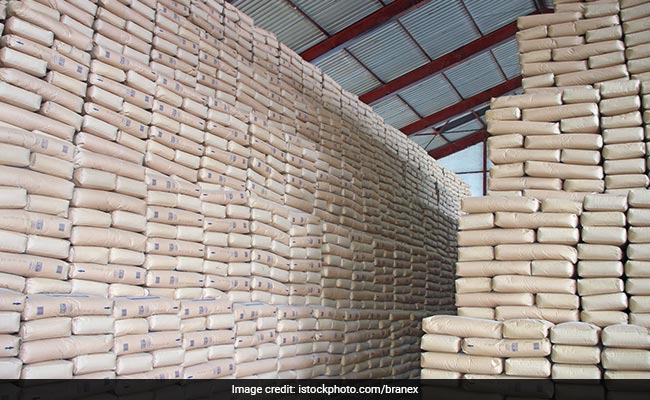
The Union Cabinet today approved a Rs 1 lakh crore programme to create the world's largest grain storage capacity in the cooperative sector to reduce crop damages and prevent distress sales by farmers, besides strengthening the country's food security.
The government is planning to create 700 lakh tonne of grain storage capacity in the cooperative sector over the next five years and said the move will also help in creating job opportunities in rural India.
Briefing media, Information and Broadcasting Minister Anurag Singh Thakur said the Cabinet has approved the "world's largest grain storage plan in the cooperative sector".
On investment, he said the programme will start "with an expenditure of around Rs 1 lakh crore".
As per the plan, a godown of 2,000 tonne capacity will be established in each block.
This will help in strengthening the cooperative sector, as Primary Agricultural Credit Societies (PACS) can diversify into the storage of food grains. There are 1 lakh PACS in the country, out of which around 63,000 are functional.
Thakur said the country's foodgrains production is around 3,100 lakh tonne, while the storage capacity is only 47 per cent of the total output.
In developed economies, he said, the storage capacities are higher than output.
Asked about the source of funding, Thakur said the funds available in ministries of agriculture, food processing and food and consumer affairs would be utilised.
At present, the total grain storage capacity in the country is about 1,450 lakh tonne, he said, adding that 700 lakh tonne storage capacity will now be established in the cooperative sector. This will take the total capacity to 2,150 lakh tonne.
On benefits, the minister said the creation of decentralised storage capacity at the local level would reduce food grain wastage and strengthen the food security of the country.
This would hugely reduce the cost incurred in the transportation of food grains to procurement centres and again transporting the stocks back from warehouses to ration shops, he said.
According to an official statement, the Cabinet approved the Constitution and Empowerment of an Inter-Ministerial Committee (IMC) for the facilitation of the 'world's largest grain storage plan in Cooperative Sector' by the convergence of various schemes of the Ministry of Agriculture, Ministry of Consumer Affairs, Food and Public Distribution and Ministry of Food Processing Industries.
To ensure time-bound and uniform implementation of the plan, the Ministry of Cooperation will implement a pilot project in at least 10 selected districts of different states/ UTs in the country.
The pilot would provide valuable insights into the various regional requirements of the project, the learnings from which will be suitably incorporated for the country-wide implementation of the plan.
The IMC will be constituted under the Chairmanship of the Minister of Cooperation, with the Minister of Agriculture, Minister of Consumer Affairs, Food and Public Distribution, Minister of Food Processing Industries and Secretaries concerned as members.
The committee will modify guidelines/implementation methodologies of the schemes of the respective ministries as and when the need arises, within the approved outlays and prescribed goals, for facilitation of this programme by creation of infrastructure, such as godowns, etc. for agriculture and allied purposes, at selected 'viable' Primary Agricultural Credit Societies (PACS).
The plan would be implemented by utilising the available outlays provided under the identified schemes of the respective ministries.
The schemes have been identified for convergence under the plan.
In the Ministry of Agriculture, the schemes are the Agriculture Infrastructure Fund (AIF), Agricultural Marketing Infrastructure Scheme (AMI), Mission for Integrated Development of Horticulture (MIDH) and Sub Mission on Agricultural Mechanization (SMAM).
The schemes identified under the Ministry of Food Processing Industries are the Pradhan Mantri Formalization of Micro Food Processing Enterprises Scheme (PMFME) and Pradhan Mantri Kisan Sampada Yojana (PMKSY).
In the Ministry of Consumer Affairs, Food and Public Distribution, the programmes for the allocation of food grains under the National Food Security Act and procurement operations at Minimum Support Price (MSP) have been identified.
"The plan is multi-pronged – it aims to address not just the shortage of agricultural storage infrastructure in the country by facilitating the establishment of godowns at the level of PACS, but would also enable PACS to undertake various other activities," the statement said.
PACS can function as procurement centres for state agencies/ Food Corporation of India (FCI) and serve as Fair Price Shops (FPS). They can set up custom hiring centres, and establish common processing units, including assaying, sorting, grading units for agricultural produce, etc.
"Through a whole-of-Government approach, the Plan would strengthen PACS by enabling them to diversify their business activities, thus enhancing the incomes of the farmer members as well," the statement said.
(Except for the headline, this story has not been edited by NDTV staff and is published from a syndicated feed.)

-
Navigating Energy Crossroads: S Jaishankar's Call For Diversified Supply Chains At G20 Ministerial Meeting

As geopolitical fault lines continue to test maritime trade routes and commodity flows, Jaishankar's message remains pertinent: true economic resilience requires open markets, protected transit lines, and a genuine commitment to multilateral cooperation rather than coercion.
-
Indians Are Travelling, But Not Every Journey Is A Holiday | The Week In Whys
Pilgrims, patients and working women are the real travellers, and the system hasn't quite caught up with them.
-
Getting To Work Costs Women More | The Reason Why
It is not just about women paying more than men. It is about women paying much more in cities than in villages.
-
AI Bias In Investing Cannot Be Eliminated, But It Can Be Governed
Framing is a particularly important example as identical financial information presented in terms of gains rather than losses can lead an LLM to reach a different assessment.
-
Joining The Dots | Dark Skies, Steady Diya: Why Hope Holds This Diwali
With war, a weak rupee and foreign outflows weighing on sentiment, policymakers at the NDTV World Summit and market veterans at NDTV Profit Ignite: Diwali Edition offered the same advice: stay invested and filter out the noise.
-
The Curious Case of Equitas Small Finance Bank And A CEO Who Quit For Stock
PN Vasudevan believes persistent investor concerns over a perceived conflict of interest had become a governance overhang on Equitas Small Finance Bank's stock, even as the lender improved profitability and asset quality.
-
Talking Points This Week: AI Cash Burn, A Tiger Comeback And An India That Still Finds Its Own Path
India is not immune to higher oil or tighter global liquidity, yet its earnings base is broader, its domestic policy levers are still available.
-
Foreign Investors Own Half Of HDFC Bank and ICICI Bank. An LTCG Cut Could Matter Most Here
Foreign portfolio investors have US$115 billion parked in HDFC Bank, ICICI Bank. If the government cuts long-term capital gains tax, Jefferies says returning foreign money could land here first.
-
'Never Seen This Level Of Negativity': Sandeep Tandon Says The Next Rally May Be Closer Than You Think
Veteran investor Sandeep Tandon says foreign selling is easing, large-caps are due a comeback and mid-caps are crowded, while he turns positive on gold, power and pharma this Diwali.
-
Indians Stay With Family, Not In Hotels | The Reason Why
India still lacks enough clean, reliable and affordable hotels for budget-conscious travellers.










