Byju's Says Promoters Re-Invested Amount Raised From Secondary Share Sale
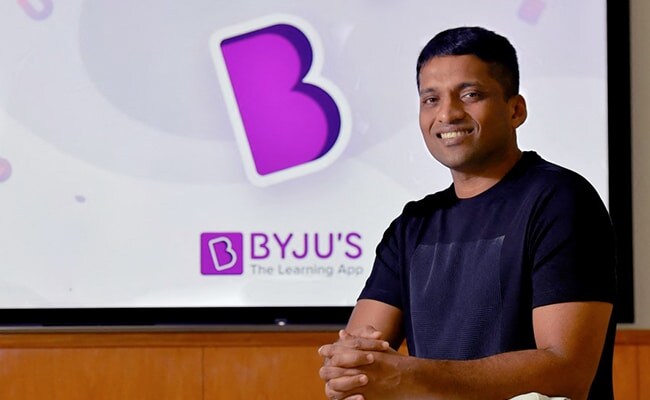
Edtech major Byju's on Tuesday said its promoters have re-invested the entire amount raised by them through secondary sale of shares in the company.
According to private market intelligence firm PrivateCircle Research, Byju's promoters -- Byju Raveendran, Divya Gokulnath and Riju Ravindran -- have together sold shares worth around $408.53 million in 40 secondary transactions since 2015.
"The promoters of BYJU'S have reinvested the entire amounts raised from secondary sales into the business for purposes of scaling it over the years," Byju's said in a statement.
The statement came in the backdrop of the report of the intelligence firm.
PrivateCircle said Mr Raveendran holds 15.90 per cent, whereas Divya Gokulnath and Riju Ravindran have 3.32 per cent and 1.99 per cent, respectively.
"Promoters' shareholding in the company has been gradually dropping since 2016. First significant drop was between 2015-2016, when the promoters' stake dipped from 71.6 per cent to 54.7 per cent and later came down to 34.7 per cent in 2019 and 21.2 per cent in 2023," the report said.
The private market intelligence platform said that it has analysed various public data sources to arrive at the findings and in two instances where the secondary share price was not available, PrivateCircle has used the closest available primary share price.
"Since 2015, Byju Raveendran individually sold 29,306 shares worth USD 3.28 million, whereas his wife and co-founder Divya Gokulnath sold 64,565 shares worth USD 29.40 million, and brother Riju Ravindran sold 337,911 shares worth USD 375.83 million.
"Over the years, multiple investors participated in BYJU'S secondary transactions including the likes of Silver Lake Partners, Blackrock, T Rowe Price, Chan Zuckerberg, Owl Ventures, Naspers, Times Internet, Lightspeed Ventures, Proxima Beta, Naspers Ventures, General Atlantic, and Alkeon," it said.
PrivateCircle Research said the secondary deals at Byju's were often executed at a discounted valuation as compared to the company's primary valuation at that time.
"For instance, an average of 53 per cent discount was observed in secondary sales during its Series F round. During this round, BYJU'S promoters sold their shares in the price range of Rs 1,12,126 - Rs 1,64,000 per share and the Series F primary share price was in the range Rs 2,13,042 - Rs 2,37,336," the report said.
According to the report, Mr Raveendran purchased a total of 31,960 shares since 2012 from multiple sellers, including Ravindran Kunnaruvath (Byju Raveendran's father), Arunangshu Bhakta (BYJU's employee), Brijesh Maheshbhai Patel (BYJU's employee), Smit Rajanikant Patel (BYJU's employee), Unique Jain (BYJU's employee), and Pravin Prakash (BYJU's employee).
Divya Gokulnath purchased a total 4,666 shares from Navin Balan and Priya Mohan (founders of Vidyartha).
Byju's acquired Vidhyartha in 2017.
"Riju Ravindran also purchased 100 shares from Mrinal Mohit (BYJU'S COO). However, we could not ascertain the value of these secondary purchases," the report said.
Mr Raveendran, during a call with investors, highlighted his personal investments in the company, including $400 million in the parent company, $250 million for the Aakash acquisition, and an additional $250 million through pledged secondary shares for the last funding round.
In a recent town hall with employees, Mr Raveendran said that promoters continue to be the largest investor in the company.
(Except for the headline, this story has not been edited by NDTV staff and is published from a syndicated feed.)

-
Unhedged Position: Can India See An Indonesia-Style Time Correction?

The Nifty is trading below levels it first clocked in 2024. Is there, then, as I have suggested in the headline, potential that the current time correction drags on painfully for the next three-five, even ten years?
-
Navigating Friction And Energy Realities: An Analysis Of Marco Rubio's October Visit To India
Occurring at a critical juncture marked by stalled trade negotiations and escalating geopolitical pressures over global energy supplies, the visit offers a profound window into modern US-India relations.
-
India Exports Capital. Why Not Export Trusteeship?
The big question, then, is whether India can build an institution that global borrowers, investors, banks, and lawyers can trust, even without an Indian connection.
-
France's Economy & Politics Are In Crisis | The Reason Why
Let's look at how the French economy and politics evolved under Nicolas Sarkozy, Franois Hollande and Emmanuel Macron.
-
You May Inherit The Business. You Must Earn Its Credibility.
Succession tests the founder's ability to share authority as much as it tests the next generation's readiness to assume it.
-
Signing Deals Is One Thing; Making Them Work Is Another | The Week In Whys
Sometimes, things don't turn out as planned. Indian companies have lost some bids to rivals, some projects won't produce until 2030.
-
FOMC Wall, PERM Suspension, Hospital Stocks | Talking Points This Week
A PERM suspension would directly affect green-card sponsorship rather than H-1B visas, so the near-term earnings impact could remain relatively limited. The key question is whether this marks a new phase in US scrutiny of Indian IT.
-
Everything, Everywhere, All At Once: Dalal Street's Week To Forget | Joining The Dots
Visa curbs, a Starlink spat and cancer drug caps: what connects this week's shocks for Indian markets
-
India Is Going Abroad For Critical Minerals. But It May Take Years To Pay Off | The Reason Why
Although India's steps are in the right direction, they remain modest compared with India's growing dependence.
-
When Everyone Has AI, What Gives You An Edge?
India's young workforce is entering an uncertain world of work where powerful AI tools are becoming widely accessible. The advantage will belong to those who combine deep expertise with digital fluency, and the distinctly human capabilities that technology cannot manufacture.









