Businesses Fear Inflation Spike After Covid-19 Disruption, Shows IIM-Ahmedabad Survey
Indian businesses are fearing a spike in inflation due to supply disruptions caused by measures introduced to stem the spread of Covid-19. This, despite the fact that demand is expected to remain weak through the course of this year.
India has been under a 40-day nationwide lockdown, which began on March 24. In addition, restrictions on production and movement of goods globally have led to supply chains being disrupted.
A business inflation expectation survey, compiled by Indian Institute of Management-Ahmedabad and tracked widely by policymakers, shows that companies are expecting prices to rise due to these disruptions.
The one-year ahead business inflation expectation shot up to 4.57 percent in March 2020 from 3.85 percent reported in February 2020, according to a release by the IIM-A on Thursday. This is the highest ever print recorded since the inception of this survey in May 2017, the release said.
“For the first time, respondents attached a 21 percent probability that one-year ahead inflation expectations would be above 10 percent,” it added.
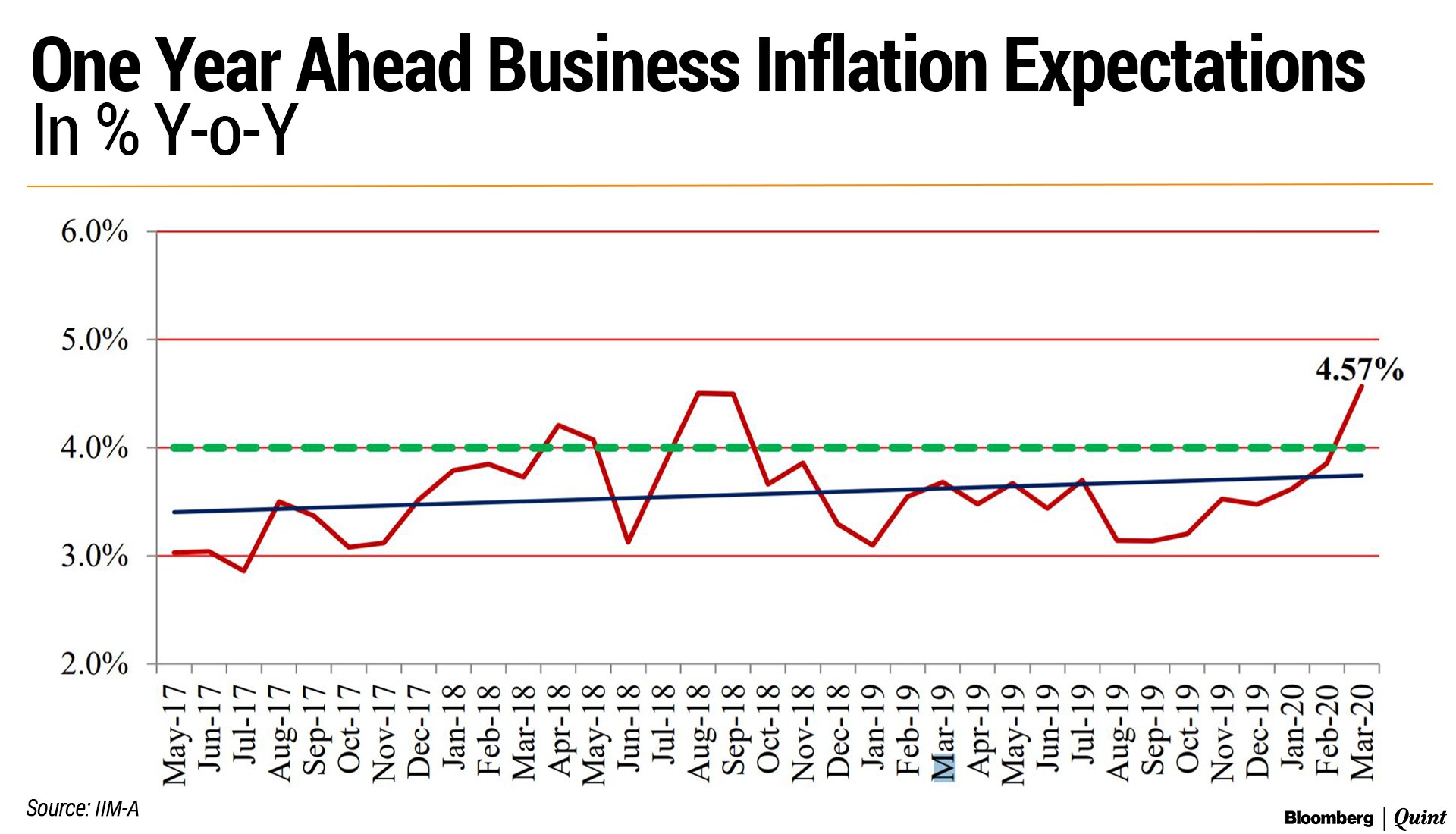
The survey results are based on the responses of over 1300 companies primarily from the manufacturing sector. The number of respondents in this round rose by over 300 from the February round of the survey. The inflation expectations for one-year ahead are estimated from the mean of the individual probability distribution of unit cost increase.
The effect of extension of lockdown against the backdrop of COVID-19 spread is clearly seen in the results of this round, said Abhiman Das, RBI Chair Professor for Finance and Economics at the IIM-Ahmedabad. The economy has come to a standstill and inflation expectations are rising fast, he explained.
The survey's findings are at odds with the expectation that inflation will fall because of weaker demand. Early developments suggest that inflation is on a declining trajectory, Reserve Bank of India Governor Shaktikanta Das had said in his statement on April 17, 2020. In the period ahead, inflation could recede even further, barring supply disruption shocks, and may even settle well below the target of 4 percent by the second half of 2020-21, said Das, suggesting that this may leave room for further monetary policy easing.
To be sure, the inflation expectation of businesses could diverge from those of households. The latter is captured in the RBI's inflation expectations survey, scheduled to be released next in June.
What Businesses Are Expecting
Along with a build-up in cost pressures, businesses are expecting lower sales and weaker profit margins.
Sales Levels
- Over 81 percent of firms in March 2020 reported that sales are ‘much less than normal' as against over 64 percent firms reporting in February 2020.
- Around 93 percent of firms report that sales are ‘somewhat or much less than normal' as against 85 percent in February 2020.
Profit Margins
- The proportion of firms in the sample reporting ‘much less than normal' profit jumped to 79 percent in March 2020 from 65 percent in February 2020.
- Over 93 percent of firms in the sample expect ‘much less than normal or somewhat less than normal' profit margins. This proportion has remained around 75 percent since June 2019 till January 2020, the release said.

-
Ten Things I Learnt This Samvat

Patience can be a trap. Cheap stocks can stay cheap. Leverage can wipe you out. What did Samvat 2082 teach us? Niraj Shah writes on 10 lessons from the year gone by.
-
Talking Points This Week: Tech Nerves, FII Buying, And A Faraway Banking Shock
The global markets are not shining this Diwali. The exception in the large markets is, India.
-
Midterm Rally Lasted A Day. The Hard Reality Of A Divided US May Last Two Years | Opinion
Between a contested AI boom, a debt ceiling that arrives in 2027 and a president with every incentive to act alone, the next two years may prove more volatile than the first day's rally suggests.
-
Blue Wave Will Derail the AI Trade but Won't Dismantle the AI Era | Unhedged Position
The Democrats' sweep of the US Congress will see politics collide with economic forces both over the long and short term.
-
It's Time To Take The GST Council's Bet On Trust Global
Payment records can prove India's services exports, and clear, proportionate rules can bring foreign digital sellers into the tax net.
-
Opinion | India at 38: From Innovation Overperformer to Innovation Powerhouse
India now has 453 VC-backed deep science startups, 18 of them late-stage, after 117 percent growth since 2020. Laurus Labs, at USD 9.3 billion, is the most valuable deep science company in any middle-income economy outside China.
-
Navigating Energy Crossroads: S Jaishankar's Call For Diversified Supply Chains At G20 Ministerial Meeting
As geopolitical fault lines continue to test maritime trade routes and commodity flows, Jaishankar's message remains pertinent: true economic resilience requires open markets, protected transit lines, and a genuine commitment to multilateral cooperation rather than coercion.
-
Indians Are Travelling, But Not Every Journey Is A Holiday | The Week In Whys
Pilgrims, patients and working women are the real travellers, and the system hasn't quite caught up with them.
-
Getting To Work Costs Women More | The Reason Why
It is not just about women paying more than men. It is about women paying much more in cities than in villages.









