Businesses Expect To Pass Along 50% Of Tariffs, Fed Survey Finds
Business expect to pass through roughly half of tariff-related expenses to US consumers still reeling from the pandemic-era inflation surge, according to a new survey from the Federal Reserve Bank of Atlanta.
The findings show that many businesses anticipate they'll need to take a different approach from 2018, when they passed through nearly all tariff-related costs to their customers, Atlanta Fed researchers wrote in a blog post published Thursday.
“Our results suggest many firms believe their customers are price-sensitive enough this time around (perhaps owing to the recent inflationary surge that isn't too far in the rearview mirror) that they cannot pass through the entire cost increase without reducing demand,” wrote Atlanta Fed researchers Kevin Foster, Aaron Jalca and Brent Meyer.
Businesses were asked to estimate what portion of higher tariff costs they would be able to pass along to customers based on current levels of demand. Those businesses that reported stronger demand levels said they expect to pass through a greater share of costs than than businesses facing weaker sales, according to the survey, which was conducted April 7 through April 18.
During the survey period, President Donald Trump had put in place a 10% baseline tariff for almost all countries and a 25% tariff on all foreign-made autos and auto parts. China and the European Union faced significantly higher tariffs at that time.
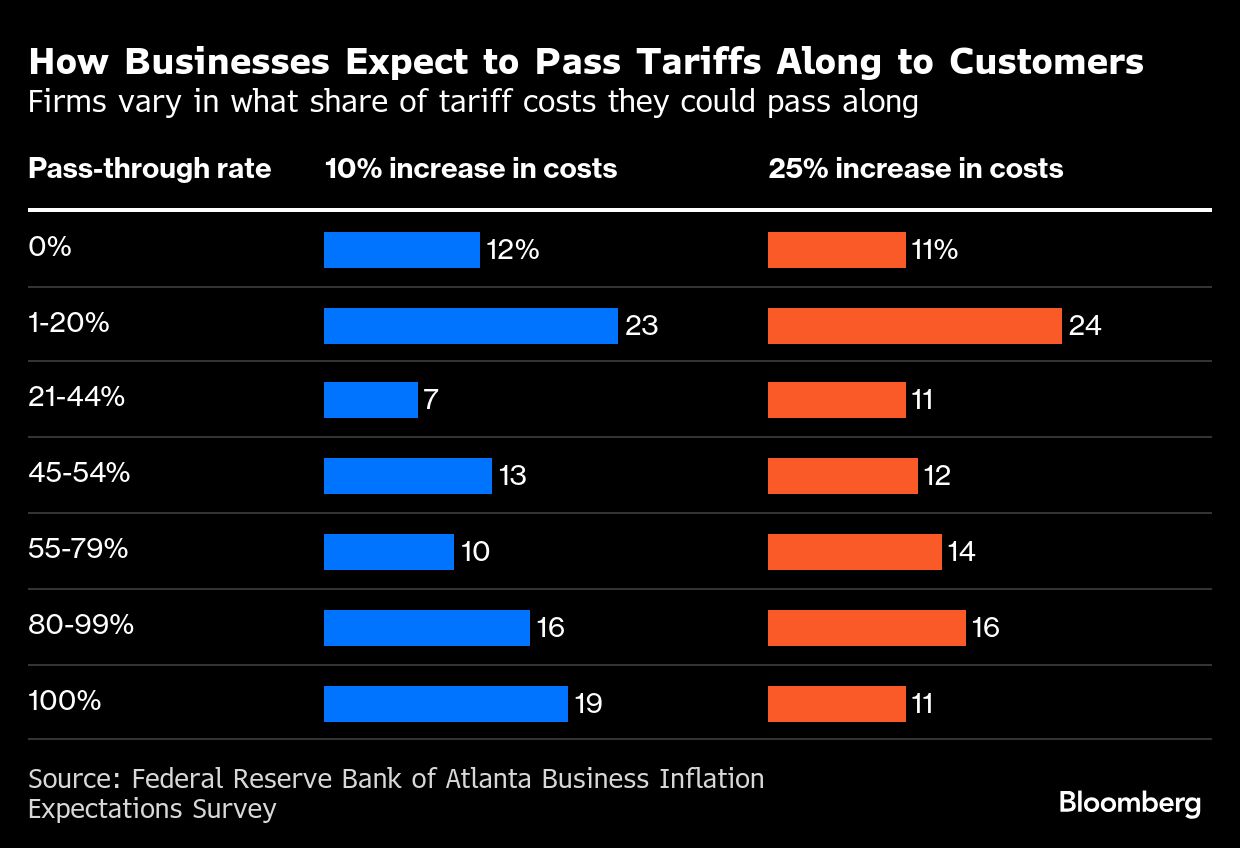
On average, businesses told the Atlanta Fed researchers they'd expect to be able to pass through 51.1% of a 10% increase in costs without harming current demand levels. In a scenario with a 25% increase in costs, firms said they could likely pass on 47.3% of the tariffs.
Business owners have had to grapple with several iterations of Trump's tariffs since he announced them, with the president granting extensions on some components and lowering levies for several countries temporarily while negotiations take place. US courts added yet another layer of uncertainty last week, first blocking and then reinstating the bulk of the levies during the appeals process. The lack of clarity over the final state of the tariffs and how they'll affect prices and growth has Fed officials keeping interest rates stable while they wait for more data.
The tariffs have yet to show up clearly in official data for prices or the labor market, with inflation moderating and employment remaining solid. But both consumers and business leaders are anxious about how the levies will affect their bottom line.
Economic activity declined in recent weeks amid the uncertainty, according to the Fed's Beige Book survey released Wednesday. That report found that businesses planning to increase prices because of tariffs expect to do so within three months. A few regions expected these increases to be “strong, significant, or substantial.”

-
Blue Wave Will Derail the AI Trade but Won't Dismantle the AI Era | Unhedged Position

The Democrats' sweep of the US Congress will see politics collide with economic forces both over the long and short term.
-
It's Time To Take The GST Council's Bet On Trust Global
Payment records can prove India's services exports, and clear, proportionate rules can bring foreign digital sellers into the tax net.
-
Opinion | India at 38: From Innovation Overperformer to Innovation Powerhouse
India now has 453 VC-backed deep science startups, 18 of them late-stage, after 117 percent growth since 2020. Laurus Labs, at USD 9.3 billion, is the most valuable deep science company in any middle-income economy outside China.
-
Navigating Energy Crossroads: S Jaishankar's Call For Diversified Supply Chains At G20 Ministerial Meeting
As geopolitical fault lines continue to test maritime trade routes and commodity flows, Jaishankar's message remains pertinent: true economic resilience requires open markets, protected transit lines, and a genuine commitment to multilateral cooperation rather than coercion.
-
Indians Are Travelling, But Not Every Journey Is A Holiday | The Week In Whys
Pilgrims, patients and working women are the real travellers, and the system hasn't quite caught up with them.
-
Getting To Work Costs Women More | The Reason Why
It is not just about women paying more than men. It is about women paying much more in cities than in villages.
-
AI Bias In Investing Cannot Be Eliminated, But It Can Be Governed
Framing is a particularly important example as identical financial information presented in terms of gains rather than losses can lead an LLM to reach a different assessment.
-
Joining The Dots | Dark Skies, Steady Diya: Why Hope Holds This Diwali
With war, a weak rupee and foreign outflows weighing on sentiment, policymakers at the NDTV World Summit and market veterans at NDTV Profit Ignite: Diwali Edition offered the same advice: stay invested and filter out the noise.
-
The Curious Case of Equitas Small Finance Bank And A CEO Who Quit For Stock
PN Vasudevan believes persistent investor concerns over a perceived conflict of interest had become a governance overhang on Equitas Small Finance Bank's stock, even as the lender improved profitability and asset quality.










