Budget Unlikely To Have Much Inflationary Impact: Shaktikanta Das
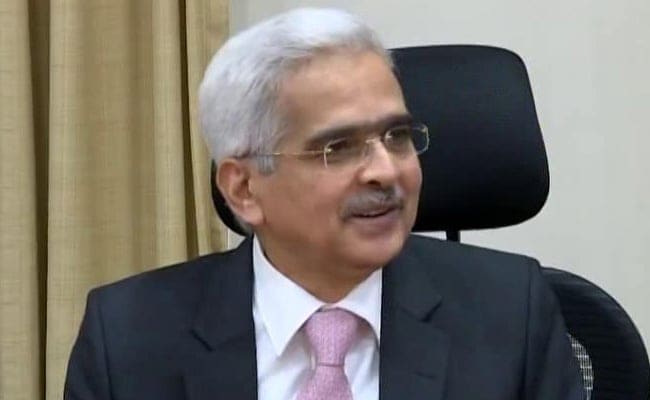
RBI Governor Shaktikanta Das said on Saturday that the budget proposals will not have much inflationary impact as the government has by and large remained within the fiscal deficit roadmap set under the Fiscal Responsibility and Budget Management (FRBM) Act.
The Union Budget earlier this month raised the fiscal deficit target to 3.8 per cent of the GDP for 2019-20, from the 3.3 per cent pegged earlier, due to revenue shortage.
"The direct inflationary impact of any budget is fiscal deficit number, when borrowing goes up, but the government has adhered to the principle of fiscal prudence. The ''escape clause'' under FRBM Act, the deficit number in the current year as well as the next year is very much within the parameters set as per FRBM committee recommendations," Mr Das said.
Mr Das was talking to reporters after the customary address of the finance minister to the central board of RBI post budget.
The government has utilised ''escape clause'' under the FRBM Act, which allows the Centre to breach its fiscal deficit target by 0.5 percentage points at times of severe stress in the economy, including periods of structural change and when growth falls sharply.
"The good part of the government borrowing is also budgeted to come from small savings. Therefore, I don't see much of an inflationary impact. Declining crude prices has definitely positive impact on inflation...The main reason for spike in inflation is because of food inflation, mostly milk, fish, and various protein related items. Core inflation has slightly edged up because of revision of telecom tariffs," he said.
Retail inflation based on consumer price index (CPI) soared to a near six-year high of 7.59 per cent in January, surpassing the Reserve Bank of India's comfort range primarily on account of rising vegetable and food prices.
This was the highest rate of inflation since May 2014, when it came in at 8.33 per cent.
Similarly, wholesale prices-based inflation accelerated to a 10-month high of 3.10 per cent in January mainly due to costlier food articles, particularly that of onion and potato.
On inclusion of core inflation in the monetary policy framework, Mr Das said, "Internally we are reviewing, we are analysing how MPC framework has worked over the last 3.5 years. There is already an internal review process going on. At the appropriate time, if required, we will have dialogue and discussion with the government. At the moment, it is under review within the RBI."
Asked if the board considered payment of interim dividend to the government, the governor was non-committal and said if any decision is taken, it will be made public.
"For greater transparency, we are uploading minutes of RBI's central board meeting. If any decision is taken, it will be uploaded on the website," he said.
On moderating credit growth, Mr Das said there are signs of an uptick and the momentum is gathering pace.
The flow to commercial sector is seen rising from October till now and credit flow from all sources -- banks, domestic market and external commercial borrowing -- has improved to Rs 7.5 lakh crore, he said, adding that nearly Rs 6 lakh crore has gone to the commercial sector between October and January.
"Within that if you look at bank credit to the commercial sector, it was actually a negative growth at the end of September by about Rs 1.3 lakh crore or so. Now it is plus Rs 2.7 lakh crores, the latest number we have at the end of January. So this is within the total number I mentioned," he said.
The momentum is gathering pace, he said, adding "credit flow is slowly and steadily reviving and thanks to the various measures announced in the budget and in the run up to the budget by the government and the reserves, which the RBI has announced, we do hope and we do expect the credit flow to improve in the coming months."
Replying to a question on alignment of RBI's accounting year with financial year, Das said, "It is under consideration, you'll hear very shortly on that."
RBI follows the July-June accounting year.

-
Where You Live Shapes How You Get To Work | The Reason Why

Two-wheelers are the most popular way to get to work in India, accounting for nearly 43% of workplace commutes.
-
High US Salaries, No Green Card Certainty: The Financial Calculation Facing Indian H-1B Families
The suspension of PERM processing at eight technology employers does not cancel existing H-1B visas. What it does is force a question many Indian families have been avoiding: is the US salary worth tying your career and family plans to one employer?
-
Unhedged Position: Can India See An Indonesia-Style Time Correction?
The Nifty is trading below levels it first clocked in 2024. Is there, then, as I have suggested in the headline, potential that the current time correction drags on painfully for the next three-five, even ten years?
-
Navigating Friction And Energy Realities: An Analysis Of Marco Rubio's October Visit To India
Occurring at a critical juncture marked by stalled trade negotiations and escalating geopolitical pressures over global energy supplies, the visit offers a profound window into modern US-India relations.
-
India Exports Capital. Why Not Export Trusteeship?
The big question, then, is whether India can build an institution that global borrowers, investors, banks, and lawyers can trust, even without an Indian connection.
-
France's Economy & Politics Are In Crisis | The Reason Why
Let's look at how the French economy and politics evolved under Nicolas Sarkozy, Franois Hollande and Emmanuel Macron.
-
You May Inherit The Business. You Must Earn Its Credibility.
Succession tests the founder's ability to share authority as much as it tests the next generation's readiness to assume it.
-
Signing Deals Is One Thing; Making Them Work Is Another | The Week In Whys
Sometimes, things don't turn out as planned. Indian companies have lost some bids to rivals, some projects won't produce until 2030.
-
FOMC Wall, PERM Suspension, Hospital Stocks | Talking Points This Week
A PERM suspension would directly affect green-card sponsorship rather than H-1B visas, so the near-term earnings impact could remain relatively limited. The key question is whether this marks a new phase in US scrutiny of Indian IT.
-
Everything, Everywhere, All At Once: Dalal Street's Week To Forget | Joining The Dots
Visa curbs, a Starlink spat and cancer drug caps: what connects this week's shocks for Indian markets









