Budget 2021: Finance Minister Promises 'Never Before' Like Union Budget, Seeks Inputs
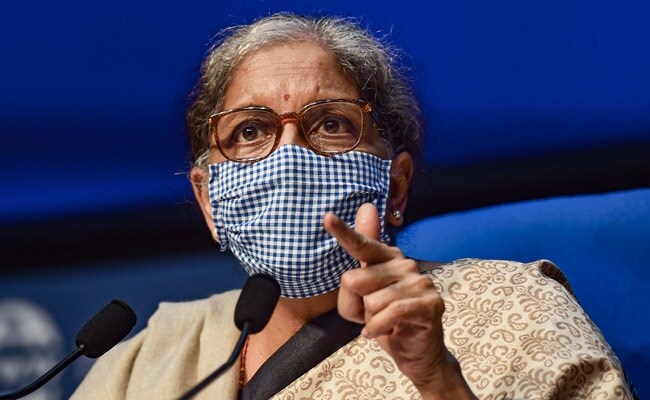
Finance Minister Nirmala Sitharaman on Friday promised a "never before" like Union Budget as the government looks to steer the pandemic-battered economy and push growth. While investment in health, medical Research & Development (R&D) and developing greater skills to handle telemedicine is going to be critical, livelihood challenges would have to be seen in a newer canvas with newer perspective on vocational training and skill development.
"Send me your inputs so that we can see a Budget which is a Budget like never before, in a way. 100 years of India wouldn't have seen a Budget being made post-pandemic like this. "And that is not going to be possible unless I get your inputs and wish list, clear observation of what has put you through the challenge... Without that, it is impossible for me to draft something which is going to be that Budget like never before, a Budget which is being made after a pandemic," Sitharaman said while addressing the CII Partnership Summit 2020.
The Union Budget for 2021-22 is scheduled to be presented in Parliament on February 1, 2021. The minister said that to revive growth, support has to be extended to those areas which have been disrupted badly due to the COVID-19 pandemic as well as to those areas which are now going to be the centres for newer demand and newer engines of growth.
"Considering our size, population and potential that India hold for good growth and building of economy, I wouldn't hesitate here to say that we shall be the engine of global growth along with a few other countries. We will be a significant contributor to global economic revival," she said.
Further, Sitharaman said that while providing more funding for infrastructure, it would be important to bring in private partnerships for not just providing buildings and hospitals, but also for providing the capacities to run these hospitals.
Telemedicines will also need greater level of understanding and greater skills to handle, she noted. "... many economies are wondering where to procure the vaccine from after they are formulated or after they are certified, those which are getting manufactured somewhere, will have to be obtained. "Whereas we in India are actually very fortunate to have such capacities to produce the formulation, then to get it certified and we in India have the capacity to be able to produce as much as we (need)... and more for exports...," she said.
Sitharaman also said that the need of the time is more investments towards medical R&D, biotechnology R&D and pharma R&D. India has to look at both public and private partnership and also engagement and investment in the areas of research for medicine, she added. "We will probably be taking all the inputs that health sector has given us for a good consideration in the Budget," the minister said.
"A good example of Aatmanirbhar Bharat is the capacity that we have shown to produce vaccines, to manufacture formulations that the vaccine developers have given and be in a position not just to manufacture those vaccines which we are formulating in India but also to receive the rights to produce vaccines which are developed elsewhere not just for Indian markets but also to export," she said.
According to the minister, job creation would undergo massive change post pandemic and hence newer skills would have to be imparted.
"Livelihood is also going to be a newer canvas in the post pandemic era. Whether it is small businesses or large industries, the way in which jobs are going to be created will go through a massive change... So vocational training and skills have to be brought in with newer perspective, some of the trainings and skills given earlier may probably be not even required now but something totally new may be required," she said. Livelihood is going to be a basketful of challenges where industry would have to put in their views, she added. a

-
Unhedged Position: Can India See An Indonesia-Style Time Correction?

The Nifty is trading below levels it first clocked in 2024. Is there, then, as I have suggested in the headline, potential that the current time correction drags on painfully for the next three-five, even ten years?
-
Navigating Friction And Energy Realities: An Analysis Of Marco Rubio's October Visit To India
Occurring at a critical juncture marked by stalled trade negotiations and escalating geopolitical pressures over global energy supplies, the visit offers a profound window into modern US-India relations.
-
India Exports Capital. Why Not Export Trusteeship?
The big question, then, is whether India can build an institution that global borrowers, investors, banks, and lawyers can trust, even without an Indian connection.
-
France's Economy & Politics Are In Crisis | The Reason Why
Let's look at how the French economy and politics evolved under Nicolas Sarkozy, Franois Hollande and Emmanuel Macron.
-
You May Inherit The Business. You Must Earn Its Credibility.
Succession tests the founder's ability to share authority as much as it tests the next generation's readiness to assume it.
-
Signing Deals Is One Thing; Making Them Work Is Another | The Week In Whys
Sometimes, things don't turn out as planned. Indian companies have lost some bids to rivals, some projects won't produce until 2030.
-
FOMC Wall, PERM Suspension, Hospital Stocks | Talking Points This Week
A PERM suspension would directly affect green-card sponsorship rather than H-1B visas, so the near-term earnings impact could remain relatively limited. The key question is whether this marks a new phase in US scrutiny of Indian IT.
-
Everything, Everywhere, All At Once: Dalal Street's Week To Forget | Joining The Dots
Visa curbs, a Starlink spat and cancer drug caps: what connects this week's shocks for Indian markets
-
India Is Going Abroad For Critical Minerals. But It May Take Years To Pay Off | The Reason Why
Although India's steps are in the right direction, they remain modest compared with India's growing dependence.
-
When Everyone Has AI, What Gives You An Edge?
India's young workforce is entering an uncertain world of work where powerful AI tools are becoming widely accessible. The advantage will belong to those who combine deep expertise with digital fluency, and the distinctly human capabilities that technology cannot manufacture.









