Nirmala Sitharaman's Budget Lifeline For Struggling Shadow Banks
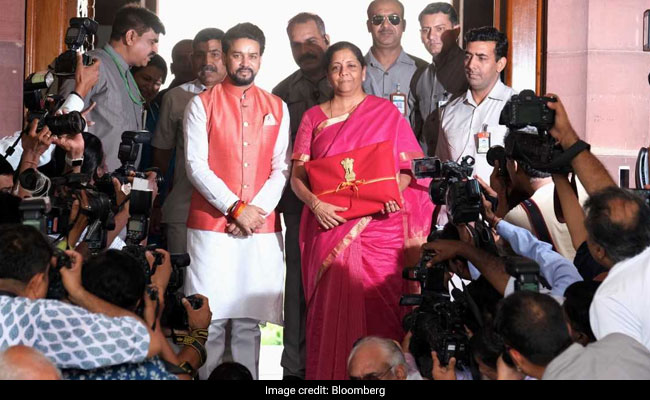
India threw a lifeline to the country's struggling shadow banks, announcing measures to improve their access to funding by providing a limited backstop for purchases of their assets.
The government will provide a partial guarantee to state banks for the acquisition of up to Rs 1 lakh crore ($14.6 billion) of highly rated assets from non-bank finance companies, Finance Minister Nirmala Sitharaman said during her Budget speech on Friday.
“NBFCs that are fundamentally sound should continue to get funds from banks and mutual funds without being unduly risk averse,” Ms said Sitharaman, who also announced measures to strengthen regulatory control over the shadow bank sector.
The decision follows concerns that a broader financial crisis may emerge as firms like Dewan Housing Finance Corp. and Anil Ambani's Reliance Capital Ltd. struggle to find fresh funding. The cash crunch at such firms could weaken the financial system and economy given their large lending role and ties with banks, mutual funds and insurers.
The Reserve Bank of India will take over as regulator of housing finance firms, replacing the National Housing Bank, Ms Sitharaman said.
News of the credit guarantee pushed up shares of NBFCs or non-banking financial companies. Mahindra & Mahindra Financial Services Ltd. and L&T Finance Holdings Ltd. jumped more than 5 per cent, while Shriram Transport Finance Co. rose more than 3 per cent, though all three later pared their gains.
The move is likely to help restore the finances of the healthier NBFCs, thereby improving the flow of credit to small and medium-sized companies, according to Hardika Shah, the chief executive officer of Kinara Capital. “Enhancing credit guarantee for portfolio purchases will definitely improve the flow of funds to healthy NBFCs with a good quality asset pool,” Ms Shah said.
The shadow banking crisis erupted a year ago when Infrastructure Leasing & Financial Services Ltd. defaulted on a series of debt obligations. Since then, banks and mutual funds have reduced their exposure to the industry, causing shadow lenders to restrict new loans.
India has more than 9,000 NBFCs, of which about 350, including deposit-taking firms, are listed as systemically important by the RBI. While NBFCs typically haven't been as tightly regulated as banks, that is now changing.
The RBI has proposed plans to tighten NBFCs' asset-liability management and liquidity coverage ratios. On Friday, the central bank announced it will ease some mandatory liquidity requirements for banks in a move that may encourage them to buy NBFC assets.
But it has resisted demands from within the industry to provide a separate liquidity window for NBFCs. RBI Governor Shaktikanta Das said in a speech last month that the central bank will take more steps to monitor NBFCs closely, including more frequent supervision of their books.

-
High US Salaries, No Green Card Certainty: The Financial Calculation Facing Indian H-1B Families

The suspension of PERM processing at eight technology employers does not cancel existing H-1B visas. What it does is force a question many Indian families have been avoiding: is the US salary worth tying your career and family plans to one employer?
-
Swiggy vs Eternal: Food Delivery's Two Rivals Are No Longer In The Same Race
Eternal is building a private AI assistant, dark.ai. Swiggy is still working out how to make Instamart pay, with an operating loss of Rs 895 crore in the July-September quarter while Blinkit stayed profitable.
-
Where You Live Shapes How You Get To Work | The Reason Why
Two-wheelers are the most popular way to get to work in India, accounting for nearly 43% of workplace commutes.
-
Unhedged Position: Can India See An Indonesia-Style Time Correction?
The Nifty is trading below levels it first clocked in 2024. Is there, then, as I have suggested in the headline, potential that the current time correction drags on painfully for the next three-five, even ten years?
-
Navigating Friction And Energy Realities: An Analysis Of Marco Rubio's October Visit To India
Occurring at a critical juncture marked by stalled trade negotiations and escalating geopolitical pressures over global energy supplies, the visit offers a profound window into modern US-India relations.
-
India Exports Capital. Why Not Export Trusteeship?
The big question, then, is whether India can build an institution that global borrowers, investors, banks, and lawyers can trust, even without an Indian connection.
-
France's Economy & Politics Are In Crisis | The Reason Why
Let's look at how the French economy and politics evolved under Nicolas Sarkozy, Franois Hollande and Emmanuel Macron.
-
You May Inherit The Business. You Must Earn Its Credibility.
Succession tests the founder's ability to share authority as much as it tests the next generation's readiness to assume it.
-
Signing Deals Is One Thing; Making Them Work Is Another | The Week In Whys
Sometimes, things don't turn out as planned. Indian companies have lost some bids to rivals, some projects won't produce until 2030.
-
FOMC Wall, PERM Suspension, Hospital Stocks | Talking Points This Week
A PERM suspension would directly affect green-card sponsorship rather than H-1B visas, so the near-term earnings impact could remain relatively limited. The key question is whether this marks a new phase in US scrutiny of Indian IT.









