BSNL Rolls Out Voluntary Retirement Scheme For Its Employees, Details Here
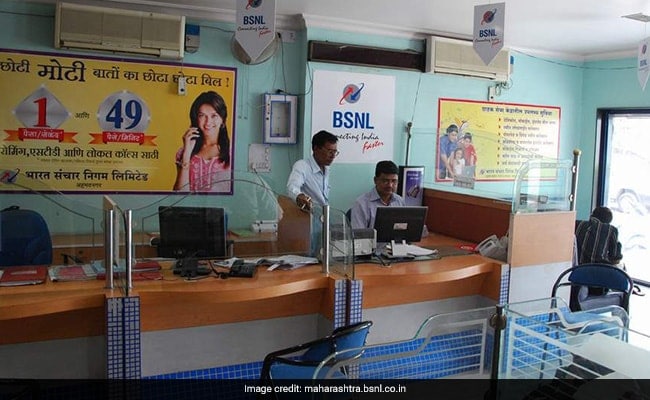
Within days of government approving a relief package for the ailing corporation, state-owned BSNL has rolled out a voluntary retirement scheme for its employees, and said it expects 70,000-80,000 personnel to opt for it leading to savings of about Rs 7,000 crore in wage bill.
BSNL Chairman and Managing Director P K Purwar told PTI that the scheme will be open till December 3, and that instructions have already been given to field units to inform employees about the VRS offering. In all, nearly one lakh BSNL employees are eligible for the VRS out of its total staff strength of 1.50 lakh. "This is the best VRS given by the government and BSNL employees should see it in a positive frame of mind," Mr Purwar said.
He said the corporation expects 70,000-80,000 employees to opt for the scheme, and added that saving in wage bill is expected to be about Rs 7,000 crore with those numbers.
According to BSNL Voluntary Retirement Scheme - 2019' all regular and permanent employees of BSNL including those on deputation to other organisation or posted outside BSNL on deputation basis, who attended the age of 50 years or above are eligible to seek voluntary retirement under the scheme.
The amount of ex-gratia for any eligible employee will be equal to 35 days salary for each completed year of service and 25 days salary for every year of service left until superannuation.
Mahanagar Telephone Nigam Ltd (MTNL) too has rolled out a VRS for its employees. The scheme, based on Gujarat Model of VRS, will be open for employees till December 3, 2019. In a notice issued by MTNL to employees recently, it mentioned that "all regular and permanent employees of 50 years and above as on January 31, 2020" are eligible to opt for the scheme.
The government last month had approved a plum Rs 69,000 crore revival package for BSNL and MTNL that includes merging the two loss-making firms, monetising their assets and giving VRS to employees so that the combined entity turns profitable in two years.
The Union Cabinet has approved the plan to combine MTNL - which provides services in Mumbai and New Delhi - with Bharat Sanchar Nigam Ltd (BSNL) that services the rest of the nation.
The rescue package approved includes infusion of Rs 20,140 crore for purchase of 4G spectrum, Rs 3,674 crore for GST to be paid on spectrum allocation, companies raising Rs 15,000 crore in debt on the sovereign guarantee and government funding Rs 17,160 crore VRS and another Rs 12,768 crore towards retirement liability.
The proceeds of the sovereign bonds issue will be to restructure debt and meet other expenses. The bond will have to be serviced by the PSUs only. The two firms will also monetise assets worth Rs 37,500 crore in the next three years.
MTNL has reported losses in nine of the past 10 years and BSNL too has been ringing in loss since 2010. The total debt on both the companies stood at Rs 40,000 crore, of which half of the liability is on MTNL alone.

-
High US Salaries, No Green Card Certainty: The Financial Calculation Facing Indian H-1B Families

The suspension of PERM processing at eight technology employers does not cancel existing H-1B visas. What it does is force a question many Indian families have been avoiding: is the US salary worth tying your career and family plans to one employer?
-
Unhedged Position: Can India See An Indonesia-Style Time Correction?
The Nifty is trading below levels it first clocked in 2024. Is there, then, as I have suggested in the headline, potential that the current time correction drags on painfully for the next three-five, even ten years?
-
Navigating Friction And Energy Realities: An Analysis Of Marco Rubio's October Visit To India
Occurring at a critical juncture marked by stalled trade negotiations and escalating geopolitical pressures over global energy supplies, the visit offers a profound window into modern US-India relations.
-
India Exports Capital. Why Not Export Trusteeship?
The big question, then, is whether India can build an institution that global borrowers, investors, banks, and lawyers can trust, even without an Indian connection.
-
France's Economy & Politics Are In Crisis | The Reason Why
Let's look at how the French economy and politics evolved under Nicolas Sarkozy, Franois Hollande and Emmanuel Macron.
-
You May Inherit The Business. You Must Earn Its Credibility.
Succession tests the founder's ability to share authority as much as it tests the next generation's readiness to assume it.
-
Signing Deals Is One Thing; Making Them Work Is Another | The Week In Whys
Sometimes, things don't turn out as planned. Indian companies have lost some bids to rivals, some projects won't produce until 2030.
-
FOMC Wall, PERM Suspension, Hospital Stocks | Talking Points This Week
A PERM suspension would directly affect green-card sponsorship rather than H-1B visas, so the near-term earnings impact could remain relatively limited. The key question is whether this marks a new phase in US scrutiny of Indian IT.
-
Everything, Everywhere, All At Once: Dalal Street's Week To Forget | Joining The Dots
Visa curbs, a Starlink spat and cancer drug caps: what connects this week's shocks for Indian markets
-
India Is Going Abroad For Critical Minerals. But It May Take Years To Pay Off | The Reason Why
Although India's steps are in the right direction, they remain modest compared with India's growing dependence.









