Brace Yourself For Higher Phone Bills As Telcos May Go For Another Tariff Hike By Early 2026

Indian mobile users may have to brace for higher bills again, with industry watchers expecting telecom operators to announce a fresh round of tariff hikes within the next six months.
According to Ankit Jain of ICRA, the increase could come between October 2025 and January 2026. However, the quantum is likely to be less than 15-20%—smaller than the hikes seen in 2024, he said.
“A tariff hike is imminent. We expect jump to be less than last year, less than 15–20%… Going forward, the trend of price hikes will be more frequent than a bi-yearly exercise,” an ICRA analyst said, adding that average revenue per user could climb from Rs 200 in fiscal 2025 to Rs 220 in fiscal 2026.
Experts say the last major round of hikes in 2024 saw Airtel, Reliance Jio, and Vodafone Idea raise tariffs by around 19–21%, prompting some users to switch to state-run BSNL. This time, operators are expected to stick to headline price increases, without altering plan validity periods.
Bharti Airtel has already hinted at headroom for raising data tariffs. “Mobile tariff design is skewed in India; the rich are paying less and the poor are not required to pay anymore,” said Gopal Vittal, vice-chairman and MD, Bharti Airtel, during the company's first quarter earnings call. He added that the company is focussed on improving its customer mix and driving upgrades to postpaid and smartphones.
Reliance Jio has not yet announced a timeline for its next revision, but in past earnings calls, the company has maintained that tariff corrections are necessary to support ongoing 5G investments.
Why Another Hike Is On The Cards?
Industry experts point out that India's mobile ARPU—at $2.1—is among the lowest in the world, giving operators room to make moderated increases. Another telecom expert who is of a slightly different opinion that ICRA, told NDTV Profit that while the telecom sector grew 10.6% year-on-year in FY25, sustaining double-digit growth will require more than subscriber additions.
“Moderated tariff increase would be required… Beyond headline hikes, adopting innovative pricing models would be key for sustained monetisation,” the expert added, suggesting tiered 5G plans for heavy users, content bundling, and quality of service-based packages similar to those seen in China and Finland.
While between the eight-year period of financial years 2017-2025, the sector's gross revenue grew at a CAGR of 3.8%, growth accelerated the most between fiscal 2020-25 to 8% CAGR as operators pushed for data monetisation and network upgrades.
In 2024, the tariff hikes implemented by Airtel, Jio, and Vodafone Idea showed both entry-level and higher-end prepaid plan price revisions.
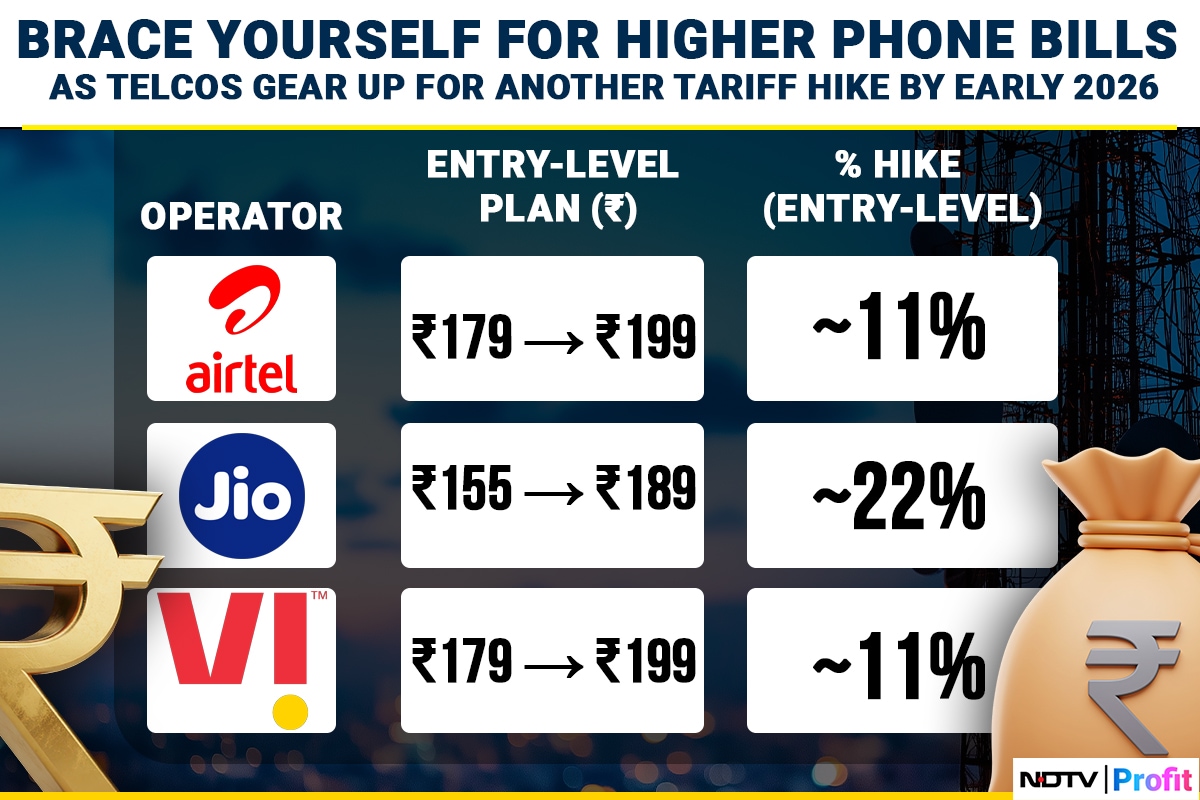
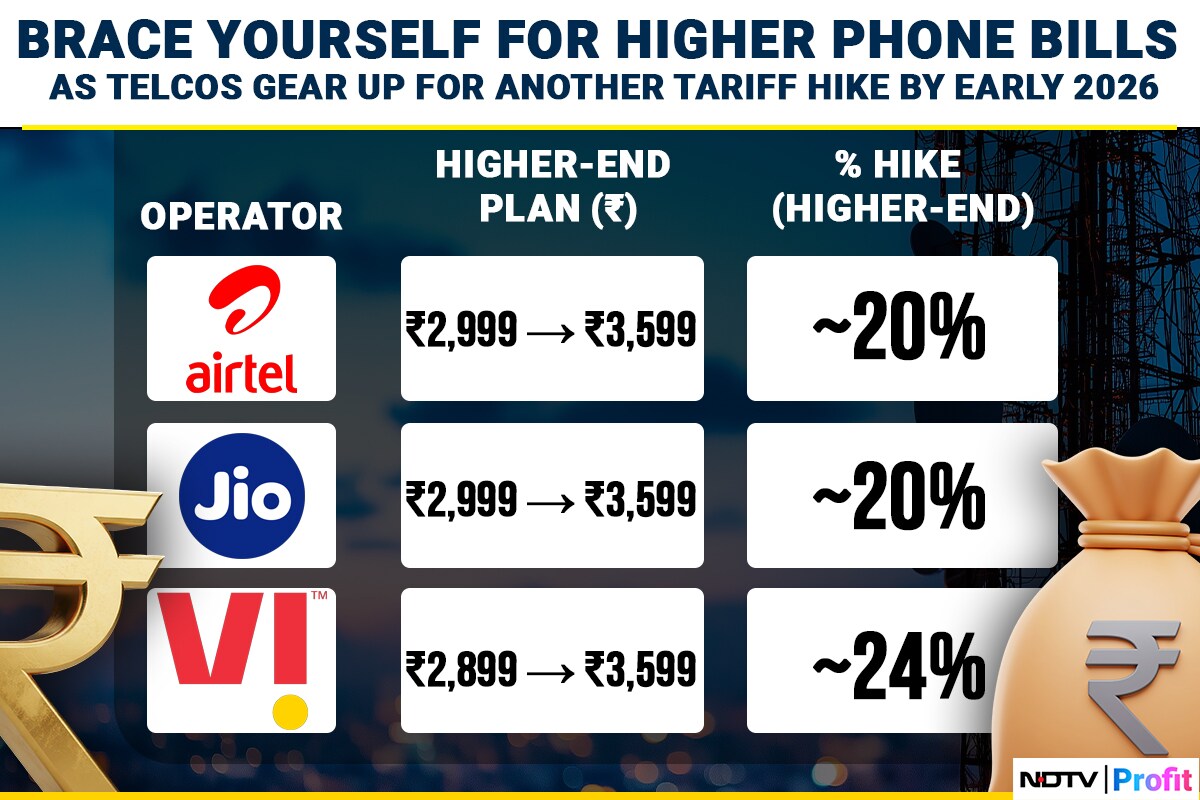
In the 2024 round of tariff revisions, telecom operators applied different levels of price hikes across plan tiers. Entry-level or base prepaid packs — often used by low-data or first-time users — saw relatively modest increases of around 11–22%.
Mid-tier daily-data plans, which form the bulk of active subscriptions, registered sharper hikes in the 17–25% range, reflecting operators' focus on boosting average revenue per user from high-usage segments.
Long-validity or annual packs faced some of the steepest adjustments, with prices rising by roughly 20%, a move aimed at locking in higher-paying customers for longer periods while realigning tariffs with rising network and spectrum costs.
With 5G rollouts in full swing and the push for higher-value customers, both analysts and operators agree that Indian mobile tariffs are set to move upward again—though in smaller, more frequent steps rather than big, infrequent jumps.

-
High US Salaries, No Green Card Certainty: The Financial Calculation Facing Indian H-1B Families

The suspension of PERM processing at eight technology employers does not cancel existing H-1B visas. What it does is force a question many Indian families have been avoiding: is the US salary worth tying your career and family plans to one employer?
-
Swiggy vs Eternal: Food Delivery's Two Rivals Are No Longer In The Same Race
Eternal is building a private AI assistant, dark.ai. Swiggy is still working out how to make Instamart pay, with an operating loss of Rs 895 crore in the July-September quarter while Blinkit stayed profitable.
-
Where You Live Shapes How You Get To Work | The Reason Why
Two-wheelers are the most popular way to get to work in India, accounting for nearly 43% of workplace commutes.
-
Unhedged Position: Can India See An Indonesia-Style Time Correction?
The Nifty is trading below levels it first clocked in 2024. Is there, then, as I have suggested in the headline, potential that the current time correction drags on painfully for the next three-five, even ten years?
-
Navigating Friction And Energy Realities: An Analysis Of Marco Rubio's October Visit To India
Occurring at a critical juncture marked by stalled trade negotiations and escalating geopolitical pressures over global energy supplies, the visit offers a profound window into modern US-India relations.
-
India Exports Capital. Why Not Export Trusteeship?
The big question, then, is whether India can build an institution that global borrowers, investors, banks, and lawyers can trust, even without an Indian connection.
-
France's Economy & Politics Are In Crisis | The Reason Why
Let's look at how the French economy and politics evolved under Nicolas Sarkozy, Franois Hollande and Emmanuel Macron.
-
You May Inherit The Business. You Must Earn Its Credibility.
Succession tests the founder's ability to share authority as much as it tests the next generation's readiness to assume it.
-
Signing Deals Is One Thing; Making Them Work Is Another | The Week In Whys
Sometimes, things don't turn out as planned. Indian companies have lost some bids to rivals, some projects won't produce until 2030.
-
FOMC Wall, PERM Suspension, Hospital Stocks | Talking Points This Week
A PERM suspension would directly affect green-card sponsorship rather than H-1B visas, so the near-term earnings impact could remain relatively limited. The key question is whether this marks a new phase in US scrutiny of Indian IT.









