BQ Explains: Why Your Nearest ATM May Be Short Of Cash

The last few days have been oddly reminiscent of the period after Prime Minister Narendra Modi withdrew old high-value notes worth 86 percent of the currency in circulation in November 2016.
What's The Problem?
News reports from various states, including Andhra Pradesh, Madhya Pradesh, Telangana, Maharashtra and Bihar, said that ATMs were facing a cash crunch. The government and Reserve Bank of India officials attributed the shortage to unusual local demand in a few states. Finance Minister Arun Jaitley called the cash crunch a “temporary shortage”.
Have reviewed the currency situation in the country. Over all there is more than adequate currency in circulation and also available with the Banks. The temporary shortage caused by ‘sudden and unusual increase' in some areas is being tackled quickly.
April 17, 2018About 10-12 percent of the ATMs are facing the crunch, particularly for Rs 500 and Rs 2,000 notes. That will remain the case for the next five to seven days, according to the banking secreatary Rajiv Kumar.
What Could Have Led To The Crunch
There's a sudden increase in demand for cash, particularly in some parts of the country such as Andhra Pradesh, Telangana, Karnataka, Madhya Pradesh and Bihar, the finance ministry said.
According to R Gandhi, a former RBI deputy governor, the current shortage is related to local demand and supply. “Currency demand depends on occasions such as elections, festivals where we see a spike. Also, when state and central governments pay out their social welfare schemes in currency, there's a spike,” he said.
Another reason for the crunch is that payments to farmers have gone up during the ongoing crop procurement season, according to Rajnish Kumar, the chairman of India's largest bank State Bank of India.
Meanwhile, the Reserve Bank of India said the shortage "in some pockets" is largely due to logistical issues of repleneshing cash in ATMs frequently.
Economic Affairs Secretary Subhash Garg said there is a trend of high-value notes being hoarded as Rs 2,000 notes are being circulated but not returning to the system. “We have not got this investigated, but you can assume this is the one note which is most suitable to hoard as this is a high value note.”
The government is still analysing the reasons for the shortage reported in five states.
Also Read: Government Steps Up Currency Notes Printing Amid Cash Crunch
What's The Government Doing About It?
Finance Minister Arun Jaitley has assured citizens that the cash crunch is temporary and will be resolved soon.
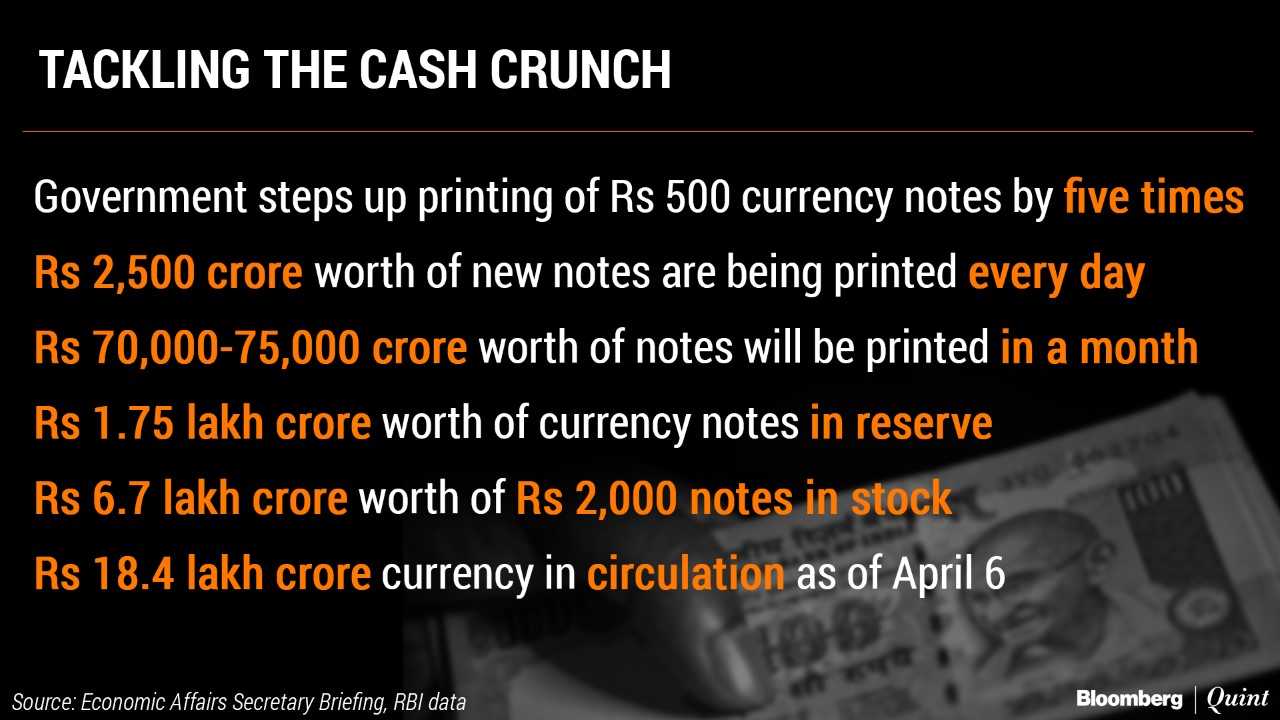
The government has stepped up printing of Rs 500 notes by five times. New Rs 500 notes worth Rs 2,500 crore are being printed everyday. Around Rs 70,000-75,000 crire worth of notes will be printed in a month.
There are also Rs 1.75 lakh crore worth of currency notes in reserve.
The government is taking all steps to ensure that ATMs are supplied with cash and to get non-functional ATMs normalised at the earliest.PIB StatementThe RBI said that printing of notes has been ramped up in all the four note presses. It is also taking steps to move cash to areas that are witnessing unusually high demand as a precautionary measure.
Should You Be Concerned?
Probably not. The government and the RBI have both said that they are doing their best to respond.
“There is no need to panic. We have more than adequate cash and this will be supplied to ATMs and bank branches very quickly in next few days,” India's principal economic adviser Sanjeev Sanyal told BloombergQuint.
Garg said the government generally keeps a sixth of the currency in circulation in stock, and it has the wherewithal to deal with a situation where the demand for cash in the country doubles from current levels.
The level of cash, according to the central bank, is now close to the pre-demonetisation level at Rs 18.4 lakh crore as of April 6. But in terms cash-to-GDP ratio, it's still lower at 10.9 percent compared to 12 percent before the note ban.

-
High US Salaries, No Green Card Certainty: The Financial Calculation Facing Indian H-1B Families

The suspension of PERM processing at eight technology employers does not cancel existing H-1B visas. What it does is force a question many Indian families have been avoiding: is the US salary worth tying your career and family plans to one employer?
-
Swiggy vs Eternal: Food Delivery's Two Rivals Are No Longer In The Same Race
Eternal is building a private AI assistant, dark.ai. Swiggy is still working out how to make Instamart pay, with an operating loss of Rs 895 crore in the July-September quarter while Blinkit stayed profitable.
-
Where You Live Shapes How You Get To Work | The Reason Why
Two-wheelers are the most popular way to get to work in India, accounting for nearly 43% of workplace commutes.
-
Unhedged Position: Can India See An Indonesia-Style Time Correction?
The Nifty is trading below levels it first clocked in 2024. Is there, then, as I have suggested in the headline, potential that the current time correction drags on painfully for the next three-five, even ten years?
-
Navigating Friction And Energy Realities: An Analysis Of Marco Rubio's October Visit To India
Occurring at a critical juncture marked by stalled trade negotiations and escalating geopolitical pressures over global energy supplies, the visit offers a profound window into modern US-India relations.
-
India Exports Capital. Why Not Export Trusteeship?
The big question, then, is whether India can build an institution that global borrowers, investors, banks, and lawyers can trust, even without an Indian connection.
-
France's Economy & Politics Are In Crisis | The Reason Why
Let's look at how the French economy and politics evolved under Nicolas Sarkozy, Franois Hollande and Emmanuel Macron.
-
You May Inherit The Business. You Must Earn Its Credibility.
Succession tests the founder's ability to share authority as much as it tests the next generation's readiness to assume it.
-
Signing Deals Is One Thing; Making Them Work Is Another | The Week In Whys
Sometimes, things don't turn out as planned. Indian companies have lost some bids to rivals, some projects won't produce until 2030.
-
FOMC Wall, PERM Suspension, Hospital Stocks | Talking Points This Week
A PERM suspension would directly affect green-card sponsorship rather than H-1B visas, so the near-term earnings impact could remain relatively limited. The key question is whether this marks a new phase in US scrutiny of Indian IT.









