Bond Losses Set To Rise As Dissent Breaks Out At RBI: Report
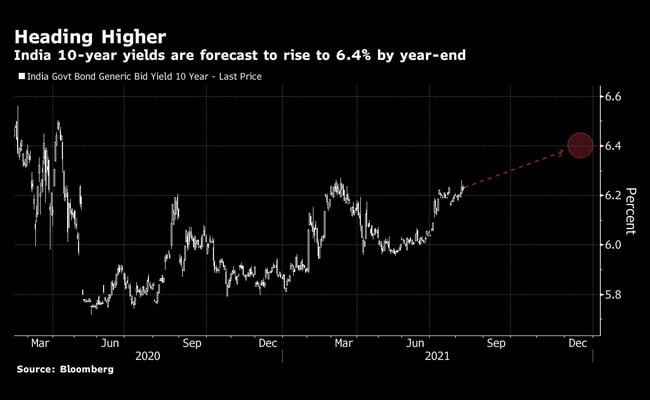
The bond yields in India will rise by year-end as disagreement among central bank's rate-setting panel members indicates they are moving toward a more hawkish stance, a Bloomberg survey has found. The benchmark 10-year yield will climb to 6.40 per cent by December, while the five-year yield will increase to 5.90 per cent, according to the median estimate in the survey of 15 traders, fund managers and economists conducted this week. The 10-year yield closed at 6.23 per cent on Thursday, and the five-year at 5.74 per cent.
Bearishness toward the country's sovereign debt increased after one of the six Reserve Bank of India monetary policy panel members voted against the lower-for-longer stance at last week's policy meeting. That was a departure from previous gatherings this year when they had been unanimous on the need to support growth amid the coronavirus.
"What caused the unease for the market was that the vote for the accommodative stance was 5-1," said Badrish Kulhalli, head of fixed income at HDFC Life Insurance in Mumbai. "The expectation is that, once the minutes are out, they may show a greater amount of debate about the time period for maintaining the accommodative stance."
Two other bond negatives also came out of the meeting. The RBI raised its average inflation forecast for the current fiscal year to 5.7 per cent from 5.1 per cent, and said it would increase the amount of money it drains from the banking system via its variable rate reverse repurchase agreements.
The dissent from monetary policy committee member Jayanth Rama Varma came after India's annual inflation rate topped 6 per cent in both May and June, putting it back above the upper end of the RBI's target band. While this wasn't the first time Mr Varma dissented, it added to a slew of negatives for the nation's debt including rising supply, stubborn inflation and speculation the global recovery is gathering pace.
The Bloomberg survey also found a wide divergence of views about when the RBI will start raising its key reverse repurchase rate. Six of the analysts forecast the first move will take place in December, while two said February, six April and one in June.
Swap markets are currently predicting the initial hike will take place in October, while 40 basis points are priced in by December, according to ICICI Securities Primary Dealership.
"The RBI could straddle this divide between market expectations and its own patient approach by guiding the market for a December hike using growth and vaccination goalposts," ICICI economists including A. Prasanna in Mumbai wrote in a research note. "Such a contingent guidance in the October review would plausibly prevent premature tightening of financial conditions."
RBI Purchases
Another crucial determinant for India's bond yields is how aggressive the RBI will be in trying to prevent them from rising. The central bank is scheduled to buy 1.2 trillion rupees ($16.2 billion) of bonds this quarter under its government securities acquisition programme.
"The way the market moves will depend on supply and how much the RBI buys in its so-called GSAP purchases," said Rajeev Pawar, head of treasury at Ujjivan Small Finance Bank Ltd. in Mumbai. "It's pure supply and demand driven right now. The market is not in a bearish mode, but completely in a holding pattern."
| Here are the results of the survey: | |
|---|---|
| Category | Forecasts |
| Five-year yield at end-2021 | 5.90% |
| 10-year yield at end-2021 | 6.40% |
| When will first hike in reverse repurchase rate take place? | Dec. = 6 |
| Feb. = 2 | |
| April = 6 | |
| June = 1 | |
| Does increase in variable reverse repo signal policy normalization? | Yes = 7 |
| No = 8 |
(Except for the headline, this story has not been edited by NDTV staff and is published from a syndicated feed.)

-
A New Samvat Wishlist: Inclusive Prosperity And Human Development

India has strengthened its economic foundations through infrastructure, digital access and enterprise. Its next growth chapter must deepen productivity, create better livelihoods and widen participation in prosperity.
-
Love, Sex Aur Dhokha: The Audacious Plot To Spy On Jensen Huang
A Taipei dinner, a Singapore chip buyer and a suspected Chinese asset: inside the alleged spy operation that got close to NVIDIA's Jensen Huang.
-
Ten Things I Learnt This Samvat
Patience can be a trap. Cheap stocks can stay cheap. Leverage can wipe you out. What did Samvat 2082 teach us? Niraj Shah writes on 10 lessons from the year gone by.
-
Talking Points This Week: Tech Nerves, FII Buying, And A Faraway Banking Shock
The global markets are not shining this Diwali. The exception in the large markets is, India.
-
Midterm Rally Lasted A Day. The Hard Reality Of A Divided US May Last Two Years | Opinion
Between a contested AI boom, a debt ceiling that arrives in 2027 and a president with every incentive to act alone, the next two years may prove more volatile than the first day's rally suggests.
-
Blue Wave Will Derail the AI Trade but Won't Dismantle the AI Era | Unhedged Position
The Democrats' sweep of the US Congress will see politics collide with economic forces both over the long and short term.
-
It's Time To Take The GST Council's Bet On Trust Global
Payment records can prove India's services exports, and clear, proportionate rules can bring foreign digital sellers into the tax net.
-
Opinion | India at 38: From Innovation Overperformer to Innovation Powerhouse
India now has 453 VC-backed deep science startups, 18 of them late-stage, after 117 percent growth since 2020. Laurus Labs, at USD 9.3 billion, is the most valuable deep science company in any middle-income economy outside China.
-
Navigating Energy Crossroads: S Jaishankar's Call For Diversified Supply Chains At G20 Ministerial Meeting
As geopolitical fault lines continue to test maritime trade routes and commodity flows, Jaishankar's message remains pertinent: true economic resilience requires open markets, protected transit lines, and a genuine commitment to multilateral cooperation rather than coercion.









