Boeing CEO Sees Company Reaching Key 737 Output Goal This Year

Boeing Co. Chief Executive Officer Kelly Ortberg said he's optimistic the company can return to a closely watched production rate of its all-important 737 airliner this year, a key milestone to help turn a corner after reporting the second-worst annual loss in its history.
Ortberg said that “on balance” the planemaker would have a production rate of 38 737 aircraft a month this year as it starts ramping up output. The Federal Aviation Administration will need to sign off on any rate that goes beyond that level, and Ortberg said he's optimistic of receiving that approval from the FAA by the second half, he said in an interview with CNBC after Boeing reported earnings.
For January, Boeing expects to deliver “in the upper 30s” of the aircraft, though some of those are coming out of inventory, Ortberg said. The company has made progress in its turnaround, adjusting its factories and supplier base for higher production levels going forward, and addressing money-losing defense programs, Ortberg said in memo to employees earlier on Tuesday after unveiling a fourth-quarter $4 billion operating loss.
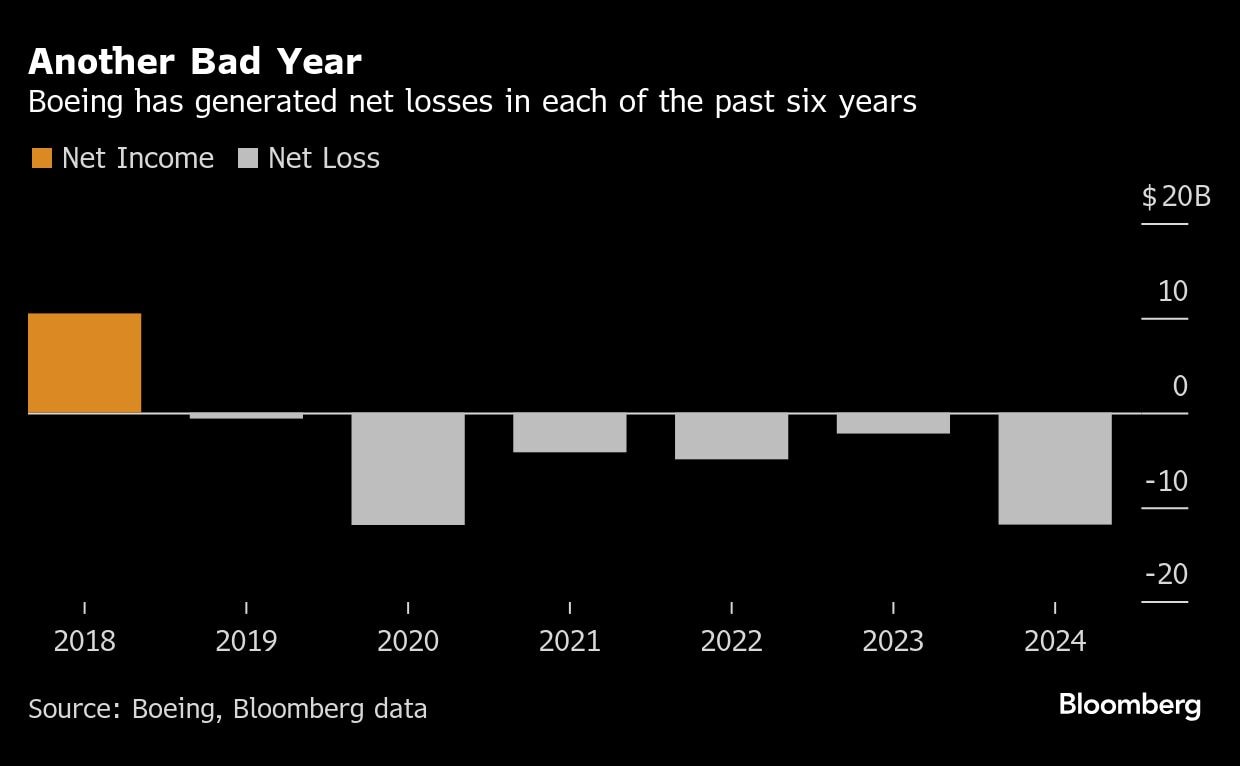
The US planemaker's dismal fourth-quarter results, parts of which it announced late last week, underscore the urgency for Ortberg to pull Boeing out of a six-year nose dive. The company burned through a total of $14.3 billion of free cash during a calamitous year marked by near-catastrophe on an airborne 737 Max, leadership turmoil, federal investigations and a lengthy worker strike.
Boeing shares advanced as much as 5.8% in New York to their highest intraday level in nearly six months, as investors gained confidence Ortberg is making progress in ramping up production of the top-selling 737 Max.
The operating loss per share was $5.90 for the quarter, worse than the core loss of $3.07 that analysts had expected, according to data compiled by Bloomberg. For the year, the company lost $20.38 per share, one of the worst showings in its history, and Boeing's sixth straight annual deficit.
The CEO, along with Chief Financial Officer Brian West, is set to provide more detail around the defense charges and Boeing's portfolio review during a conference call later Tuesday. Ortberg didn't identify any assets that might be cut or sold as Boeing starts to streamline its structure following a review of its portfolio. The company also refrained from providing a financial outlook for the year.
The earnings put the spotlight on the troubled defense and space business, which racked up additional charges on programs including the mid-air refueling tanker and the new Air Force One presidential jet.
Among possible divestments is the Jeppesen navigation unit, which is attracting major aviation suppliers and private equity suitors and could fetch $6 billion to $8 billion for Boeing, people familiar with the talks have said.
The CEO faces a drawn-out recovery as he works to settle Boeing's factories back into the steady operating tempo that was the norm before two 737 Max crashes in 2018 and early 2019 and the Covid pandemic hammered suppliers. But new challenges loom as Ortberg works to shore up Boeing's quality controls and finances amid a leadership vacuum at the FAA and uncertainty over global trade under the Trump Administration.
After raising about $34 billion in debt and equity in 2024, the US manufacturer should have a cushion as it slogs through operational difficulties that span its commercial and defense portfolios. Boeing ended the year with $26.3 billion in cash and short-term securities after pre-paying $3.5 billion of debt that is due in May.
Ortberg reiterated that Boeing is prioritizing the health of its production system and ensuring that suppliers can support any step-ups in jetliner output. The US manufacturer returned to producing five of its widebody 787 Dreamliners per month in December, Ortberg said, a target it initially set for the end of 2023.
The earnings included almost $3 billion in charges, including a larger-than-expected $1.7 billion accounting loss for the defense, space and security business.
Company officials have completed deep dives into five fixed-price defense and space programs, and Boeing is now “more proactive and clear-eyed on the risks,” Ortberg said.

-
High US Salaries, No Green Card Certainty: The Financial Calculation Facing Indian H-1B Families

The suspension of PERM processing at eight technology employers does not cancel existing H-1B visas. What it does is force a question many Indian families have been avoiding: is the US salary worth tying your career and family plans to one employer?
-
Swiggy vs Eternal: Food Delivery's Two Rivals Are No Longer In The Same Race
Eternal is building a private AI assistant, dark.ai. Swiggy is still working out how to make Instamart pay, with an operating loss of Rs 895 crore in the July-September quarter while Blinkit stayed profitable.
-
Where You Live Shapes How You Get To Work | The Reason Why
Two-wheelers are the most popular way to get to work in India, accounting for nearly 43% of workplace commutes.
-
Unhedged Position: Can India See An Indonesia-Style Time Correction?
The Nifty is trading below levels it first clocked in 2024. Is there, then, as I have suggested in the headline, potential that the current time correction drags on painfully for the next three-five, even ten years?
-
Navigating Friction And Energy Realities: An Analysis Of Marco Rubio's October Visit To India
Occurring at a critical juncture marked by stalled trade negotiations and escalating geopolitical pressures over global energy supplies, the visit offers a profound window into modern US-India relations.
-
India Exports Capital. Why Not Export Trusteeship?
The big question, then, is whether India can build an institution that global borrowers, investors, banks, and lawyers can trust, even without an Indian connection.
-
France's Economy & Politics Are In Crisis | The Reason Why
Let's look at how the French economy and politics evolved under Nicolas Sarkozy, Franois Hollande and Emmanuel Macron.
-
You May Inherit The Business. You Must Earn Its Credibility.
Succession tests the founder's ability to share authority as much as it tests the next generation's readiness to assume it.
-
Signing Deals Is One Thing; Making Them Work Is Another | The Week In Whys
Sometimes, things don't turn out as planned. Indian companies have lost some bids to rivals, some projects won't produce until 2030.
-
FOMC Wall, PERM Suspension, Hospital Stocks | Talking Points This Week
A PERM suspension would directly affect green-card sponsorship rather than H-1B visas, so the near-term earnings impact could remain relatively limited. The key question is whether this marks a new phase in US scrutiny of Indian IT.









